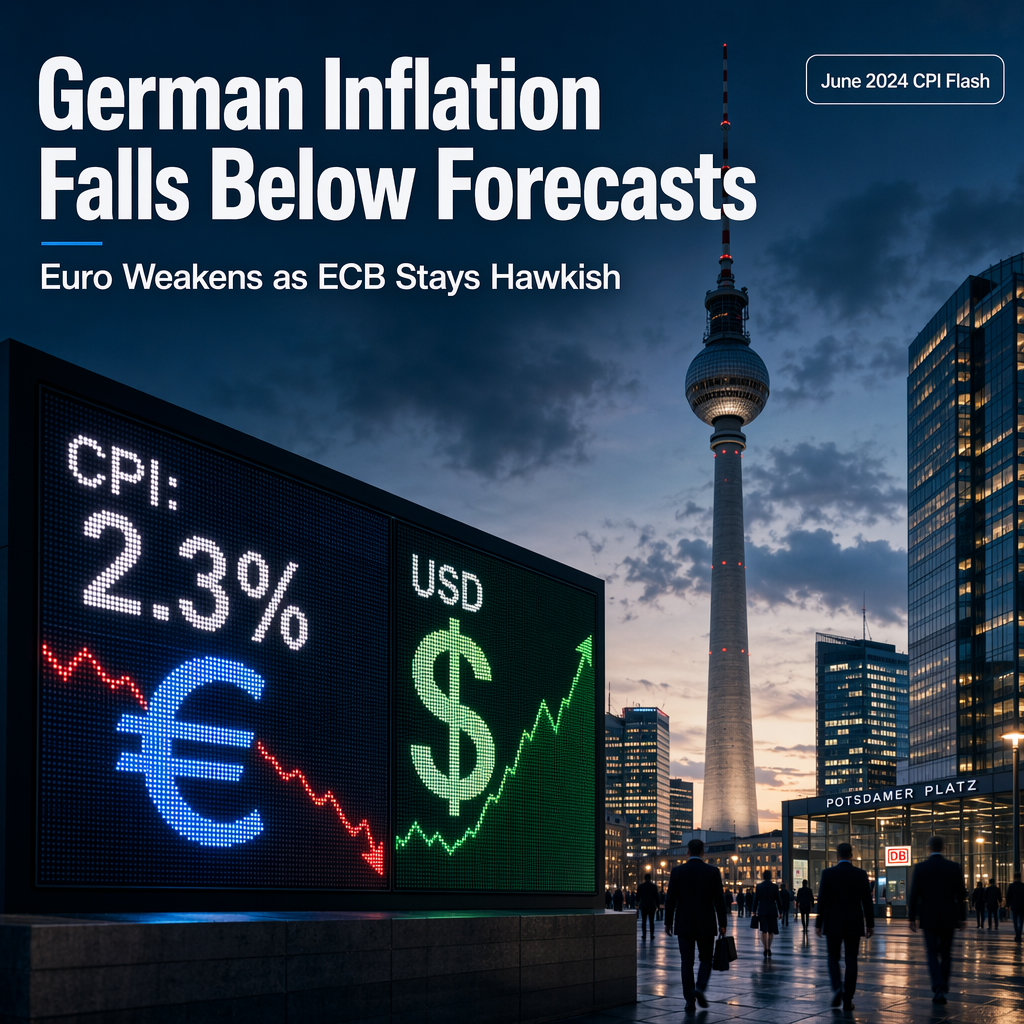
Germany's annual Consumer Price Index (CPI) inflation softened to 2.3% in June, according to the flash estimate, down from 2.6% in May and below the market expectation of 2.5% [1]. On a monthly basis, the CPI declined by 0.3%, following a 0.2% decrease in May [1]. The Harmonized Index of Consumer Prices (HICP), which is the European Central Bank's (ECB) preferred inflation gauge, fell 0.2% month-on-month and rose 2.4% year-on-year, with both figures coming in below analysts' estimates [1].
Following the release of these weaker-than-expected inflation figures, the Euro struggled to remain resilient against the US Dollar. At the time of reporting, the EUR/USD pair was trading below 1.1400, marking a daily loss of about 0.3% [1]. The subdued inflation data, combined with a risk-averse market atmosphere due to uncertainty around US-Iran talks and concerns over persistent global inflation, further supported the US Dollar [1].
Despite the softer inflation readings, analysts suggest that these numbers are unlikely to significantly alter market expectations regarding the ECB's policy outlook. Recent comments from ECB policymakers indicate a willingness to maintain a tighter policy stance if Euro area inflation does not show a steady decline [1]. ECB President Christine Lagarde, in her remarks at the ECB Forum on Central Banking, emphasized that the Euro area is likely to face inflation shocks in the coming years, highlighting persistent upside risks to inflation and reinforcing a hawkish bias [1]. Lagarde's comments, which received a speech score of 7.3 from FXS Speechtracker (above her historic average of 5.6), suggest that the ECB may keep policy tighter for longer, with future tightening or a slower easing path remaining possible [1].
Overall, while the June inflation data was weaker than expected, the ECB's focus on inflation risks and Euro area resilience suggests that monetary policy may remain restrictive. However, the Euro could continue to face challenges against the US Dollar, especially as the Federal Reserve is widely expected to raise rates in response to inflation [1].
CONCLUSION
Germany's June inflation data came in below expectations, leading to a weaker Euro against the US Dollar. Despite the softer readings, the ECB maintains a hawkish stance, signaling that policy may remain tight if inflation risks persist. Market participants are likely to remain cautious as the ECB and Fed policy paths diverge.