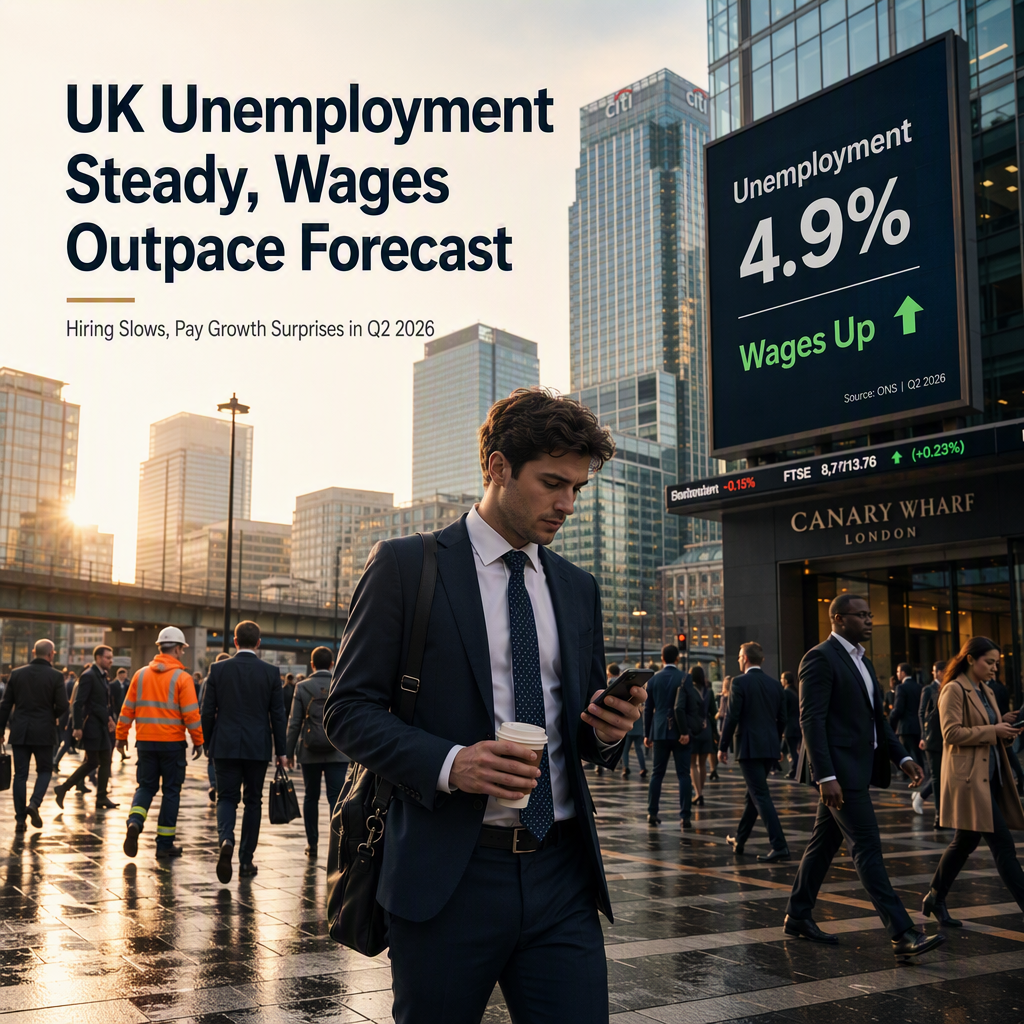
The UK unemployment rate remained steady at 4.9% for the period of April to June 2026, according to the latest Office for National Statistics release. This figure missed market expectations, which had forecast a decline to 4.8%, disappointing traders who had anticipated a stronger improvement in the labor market. The unemployment rate was up 0.2 percentage points year-over-year but showed a slight decrease of 0.1 percentage points compared to the previous quarter. In absolute terms, the number of unemployed people fell by 36,000 on the quarter to 1.772 million, though this was still 88,000 higher than the same period in 2025 [1].
Despite the higher-than-expected unemployment rate, wage growth provided a positive surprise. Regular wages (excluding bonuses) increased by 3.5% year-over-year, beating the 3.4% market forecast. Total wages, including bonuses, rose by 4.1%, also surpassing the 4.0% forecast, though this was a slight easing from the 4.3% recorded in the prior period as the bonus season faded. Public sector regular pay saw a notable increase of 6.1%, attributed to the timing of government pay award cycles, while private sector wage growth slowed to 2.8%, marking the weakest pace since 2020 [1].
Other labor market indicators showed mixed signals. The Claimant Count fell to a year-long low of 1.665 million in July 2026, down from 1.689 million in June and lower both month-on-month and year-on-year. Job vacancies dropped to 707,000 in the three months to July, the lowest level since late 2014, with small firms citing higher labor costs as a reason for reduced hiring. Payrolled employees reached 30.3 million in July 2026, a decrease of 13,000 from the previous month and 94,000 lower than July 2025. The employment rate for those aged 16 to 64 edged up by 0.1 percentage points on the quarter to 75.1% [1].
The ONS noted a data collection issue in May 2026 that briefly reduced LFS telephone survey coverage but confirmed this had minimal impact on the headline estimates, and longer-term trends remain reliable. Real regular wages (CPIH-adjusted) grew by 0.5% year-over-year, indicating that workers' earnings are still outpacing inflation, though the margin has narrowed [1].
CONCLUSION
The UK labor market showed resilience with steady unemployment and stronger-than-expected wage growth, though hiring momentum remains weak, especially among small firms. While wage gains continue to outpace inflation, the narrowing margin and persistent labor market slack suggest a cautious outlook. Market participants may remain watchful for further signs of improvement or deterioration in upcoming releases.