
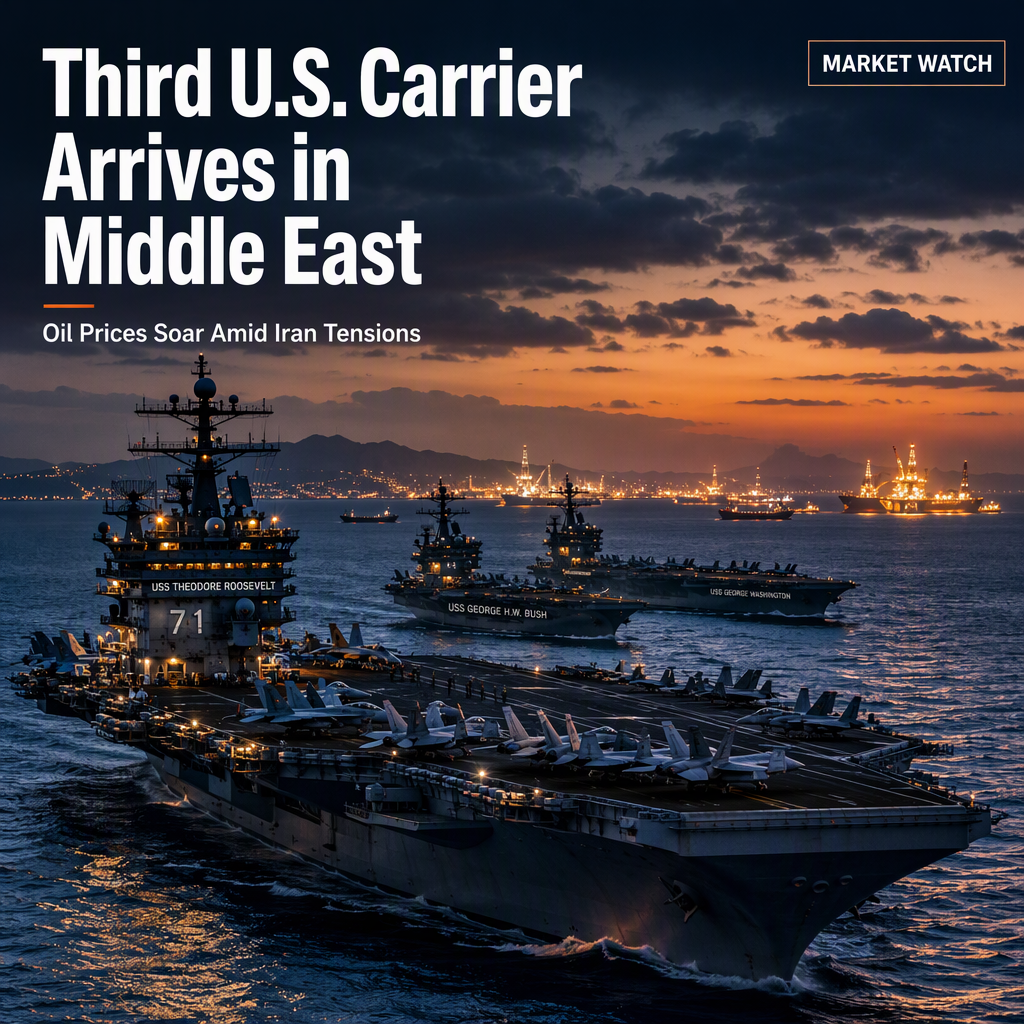
The United States has reportedly deployed a third aircraft carrier, the USS Theodore Roosevelt, to the Middle East, joining the USS George H.W. Bush and the USS George Washington in the region. This move, as reported by the Wall Street Journal, also includes the deployment of Marine Corps ships and up to 10,000 additional troops expected to arrive in November. The buildup has heightened concerns over a potential escalation of the Iran conflict, leading to a sharp increase in oil prices on Thursday [1].
Brent crude surged 4.4% to close at $102.31 per barrel, while U.S. West Texas Intermediate futures climbed 2.7% to settle at $92.87 a barrel. These price movements reflect market fears of continued conflict and possible disruptions to energy supplies in the region [1].
In addition to the military buildup, the U.S. Treasury announced further sanctions targeting Iran's automotive and rail sectors, as well as the A7 Network, described as a 'shadow banking network with ties to Russia used by the Iranian regime to evade sanctions' [1].
Despite the spike in oil prices, U.S. equity markets showed resilience. The S&P 500 rose 0.19%, and both the Dow and Nasdaq posted marginal gains, supported by a retreat in Treasury yields from multiyear highs. Jeff Kilburg, CEO of KKM Financial, noted 'there's some fatigue in the bond market.' In contrast, Asian markets such as South Korea's Kospi and Japan's Nikkei 225 declined [1].
CONCLUSION
The deployment of a third U.S. aircraft carrier to the Middle East and additional sanctions on Iran have significantly raised geopolitical tensions, driving oil prices sharply higher. However, U.S. equity markets remained resilient, buoyed by easing Treasury yields, while Asian markets declined. The situation underscores heightened market sensitivity to Middle East developments and energy supply risks.