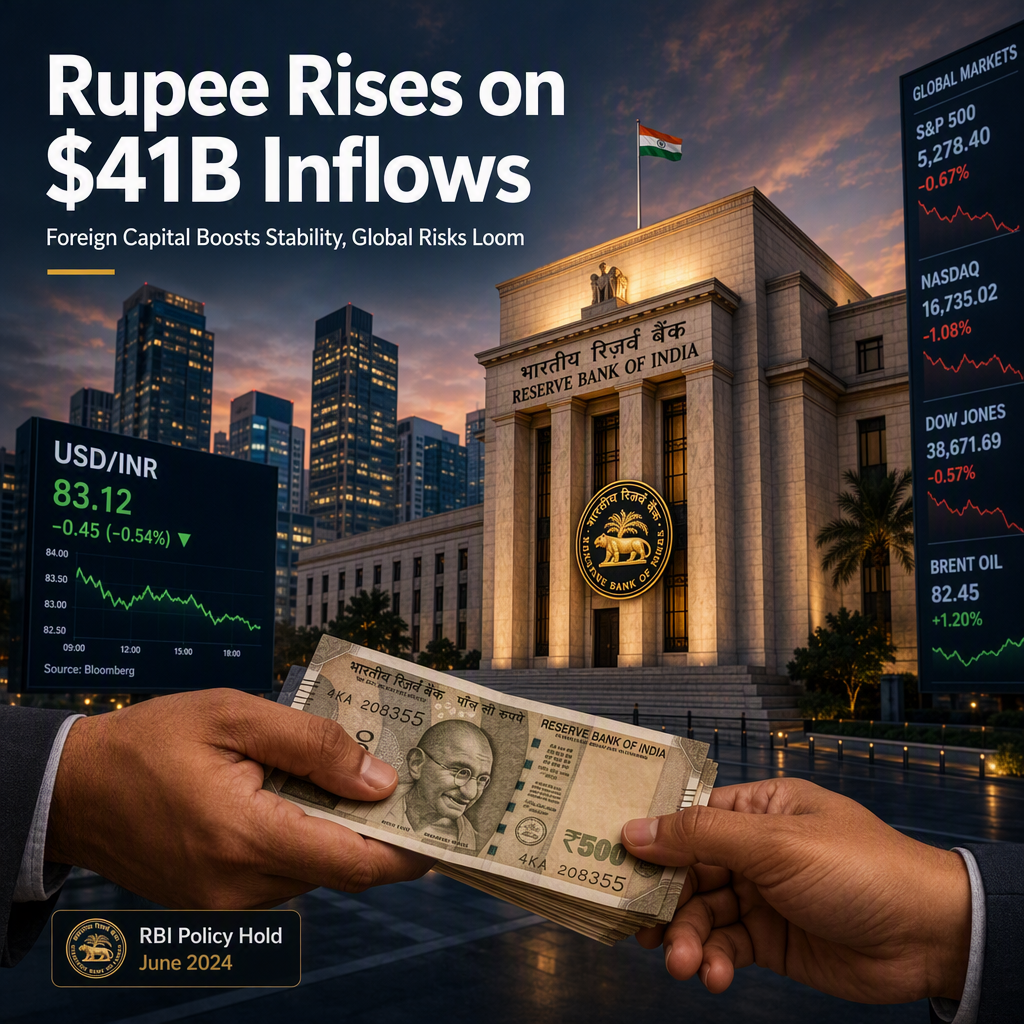
The Reserve Bank of India (RBI) held its benchmark repo rate steady at 5.25% for the fourth consecutive meeting, maintaining a neutral policy stance and citing recent inflation increases as supply-driven rather than broad-based. The RBI also upgraded its GDP growth projection to 6.7% (from 6.6%) and trimmed its medium-term inflation forecast to 5.0% (from 5.1%), reflecting resilient domestic demand and a more optimistic macroeconomic outlook [6].
The Indian Rupee (INR) has found local support against the US Dollar (USD), with USD/INR easing to around 95.10 following the RBI's decision. This stability is underpinned by significant foreign capital inflows, with recent regulatory measures attracting nearly $41 billion ($36.7 billion via FCNR deposits, $2.57 billion in overseas foreign currency borrowings, and $1.5 billion in swap facilities), putting India's balance of payments on track for a healthy surplus [6]. ING economists project that inflows could exceed $50 billion by September, aided by FCNR deposit schemes and the potential inclusion of Indian bonds in major global indices, as well as a rotation from AI-driven equities to Indian assets [7].
Despite these supportive factors, analysts at Commerzbank and OCBC caution that the Rupee remains one of Asia's weaker performers this year. They note that elevated US Treasury yields and geopolitical volatility in oil markets could limit further INR appreciation, with technical resistance seen at 95.40 and 95.70 and support at 95.00 and 94.70/74 [6]. ING also highlights that the Rupee has given back much of its June gains due to US–Iran tensions and rising oil prices, though they remain constructive on the INR's medium-term prospects [7].
Commerzbank further observes that the RBI's wait-and-see approach diverges from other Asian central banks that have raised rates to counter energy and currency pressures. The June CPI rose to 4.4% year-on-year, above the RBI's 4% target, but policymakers view this as a temporary, supply-driven phenomenon, leading markets to scale back expectations for near-term rate hikes [6].
CONCLUSION
The RBI's steady policy and robust foreign inflows have provided near-term support for the Indian Rupee, with analysts expecting further inflows to bolster the currency. However, upside remains capped by external risks such as US yields and oil volatility. Overall, the INR is seen as stable but not immune to global headwinds.