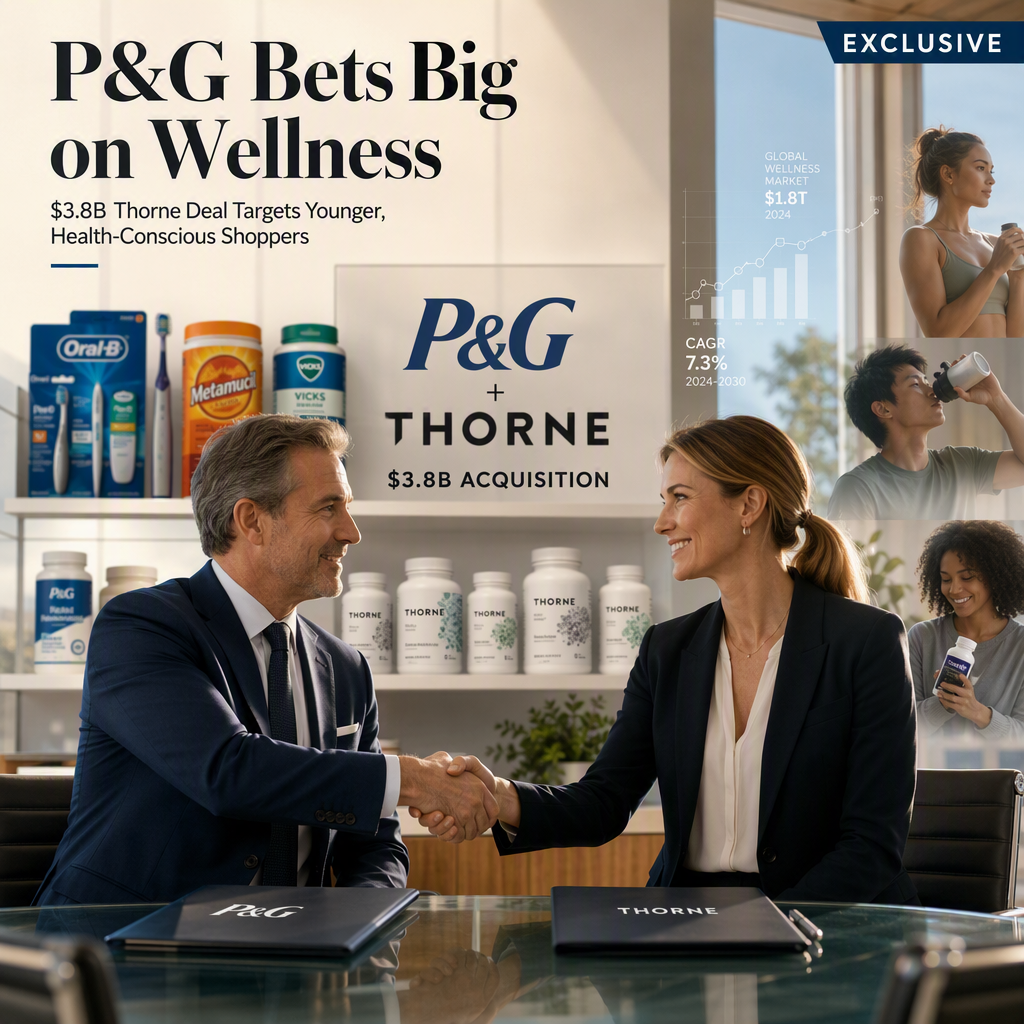
Procter & Gamble (P&G) announced the acquisition of supplements brand Thorne for $3.8 billion, as revealed by CEO Shailesh Jejurikar on CNBC's 'Squawk on the Street' [1]. Jejurikar described the deal as a strategic move to bolster P&G's health and wellness division, which already includes brands such as Metamucil, Align Probiotic, and New Chapter vitamins, alongside Oral-B and Vick's [1].
Thorne, founded in 1984, went public in late 2021 with a valuation of $525 million and was taken private by L Catterton in 2023 for $680 million [1]. The company reported annual revenue surpassing $500 million in 2025, and CEO Colin Watts previously stated that Thorne has the potential to become a billion-dollar brand within the next few years [1]. Thorne's growth has been driven by direct-to-consumer sales, with most revenue coming from shoppers under 40 years old [1].
The acquisition comes amid a broader expansion in the vitamins and supplements market, fueled by consumer interest in health products targeting sleep and energy, and movements such as 'Make America Healthy Again' led by Health and Human Services Secretary Robert F. Kennedy Jr. [1]. P&G's move follows Unilever's earlier purchase of gummy supplement brand Grüns, highlighting increased competition among consumer giants for premium supplement brands [1].
Despite Thorne's relatively small size within P&G's portfolio, the acquisition aligns with the company's strategy to target younger consumers with relevant, premium brands [1]. In P&G's latest quarter, company volume was flat, resulting in worse-than-expected revenue, with the healthcare segment being the weakest performer by volume [1]. Following the announcement, P&G shares were trading up less than 1% in morning trading on Tuesday [1].
CONCLUSION
Procter & Gamble's $3.8 billion acquisition of Thorne signals a strategic push into the growing health and wellness market, particularly targeting younger consumers. While the immediate market reaction was modest, the deal reflects P&G's commitment to expanding its premium brand portfolio amid flat company volumes and a weak healthcare segment.