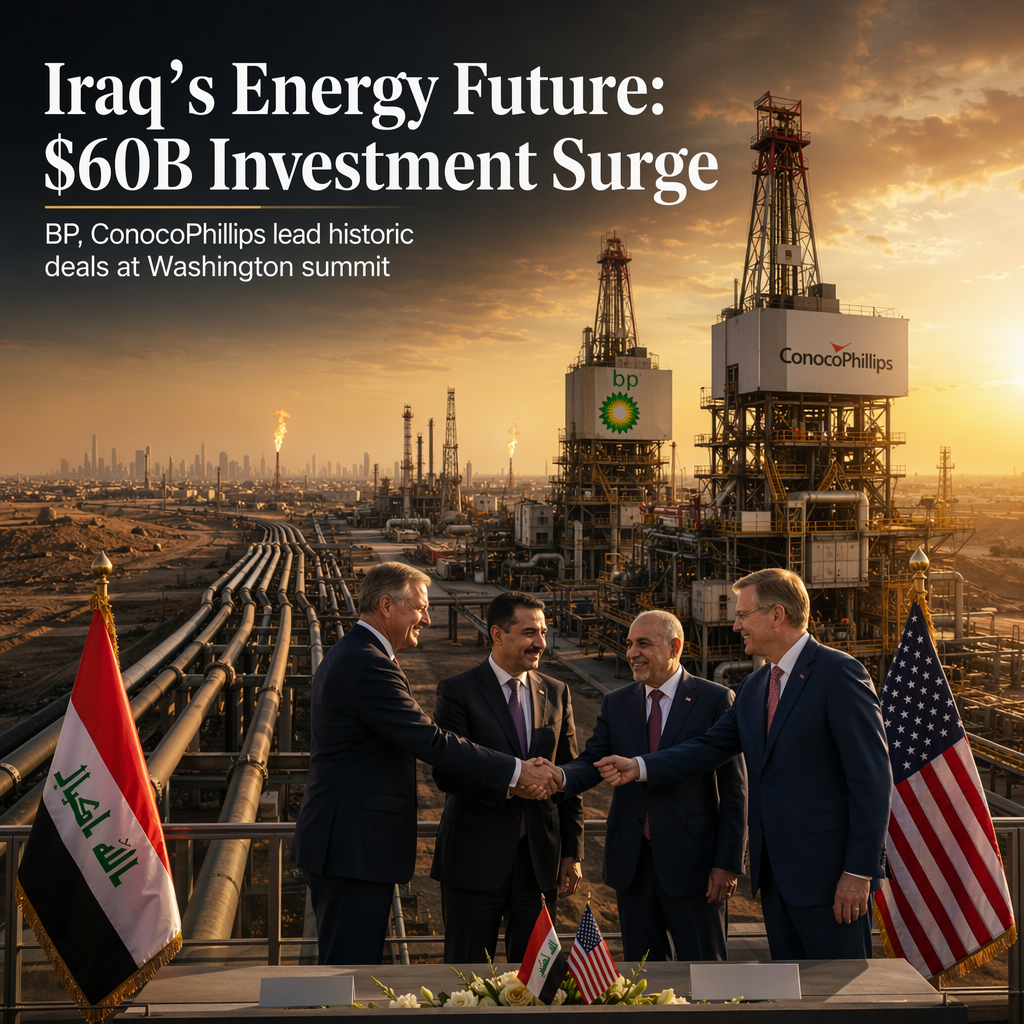
BP and ConocoPhillips are set to announce billions of dollars in new investments in Iraq, with the official announcement expected during the U.S.-Iraq Business Summit in Washington on Friday, according to sources cited by CNBC. The summit will be attended by Iraqi Prime Minister Ali Al-Zaidi, senior U.S. officials, and executives from major energy companies, and is anticipated to feature more than $60 billion in agreements and memorandums of understanding between U.S. companies and the Iraqi government [1].
The investments by BP, ConocoPhillips, and other companies are described as being in the billions of dollars, potentially reaching tens of billions, although specific details of individual commitments were not immediately available [1]. These deals are part of a broader U.S. strategy to expand investment in Iraq's energy sector, increase the country's oil production, and diversify export routes that are currently vulnerable to regional disruption, particularly those affected by tensions with Iran [1].
BP has a longstanding presence in Iraq, including recent agreements to redevelop oil and gas resources in Kirkuk, covering the Baba and Avanah domes of the Kirkuk field and the nearby Bai Hassan, Jambur, and Khabbaz fields, with a major agreement finalized in 2025 [1]. In addition to BP and ConocoPhillips, Iraqi Prime Minister Al-Zaidi met with representatives from Halliburton, Shell, Honeywell, Weatherford, and Baker Hughes in Houston to discuss investment, technology, and potential participation in large energy projects [1].
The Strait of Hormuz, which previously handled roughly a fifth of global oil before the outbreak of war, remains a critical focus for energy markets due to renewed tensions between the United States and Iran [1]. Iraq's efforts to attract major energy-services and industrial companies are aimed at expanding oil and gas production and accelerating the development of its natural gas resources [1].
CONCLUSION
BP and ConocoPhillips' planned multi-billion dollar investments in Iraq signal a significant boost to the country's energy sector and align with U.S. efforts to reduce regional vulnerabilities. The anticipated agreements, totaling over $60 billion, underscore strong international interest in Iraq's energy development and could have substantial implications for global oil markets.