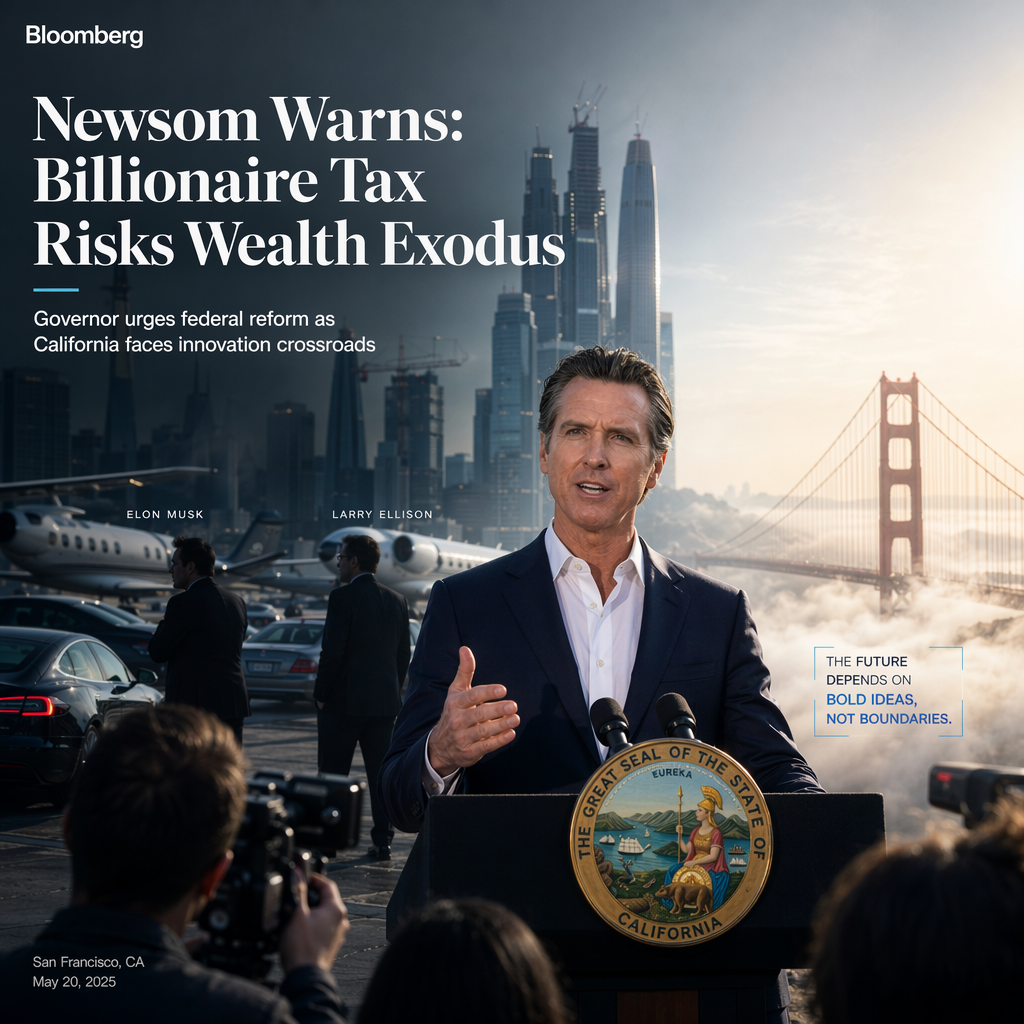
California Governor Gavin Newsom has publicly opposed the California Billionaire Tax Act, a measure that would impose a one-time, 'emergency' 5% tax on residents with assets exceeding $1 billion, which has been officially added to the November ballot [1][2]. Newsom warned that such a tax could accelerate the ongoing exodus of wealthy individuals and business leaders from California, citing examples such as Elon Musk, Larry Page, and Larry Ellison who have already left the state [1]. He argued that 'wealth is movable, and it shops for the state with the lowest taxes,' and predicted that billionaires would relocate to states like Texas or Florida to avoid the tax [1]. Silicon Valley entrepreneur Allison Huynh also forecasted a 'mass migration,' not only of billionaires but of investors in new ideas and infrastructure, if the tax is implemented [1].
Despite his opposition to the state-level tax, Newsom has called for a nationwide billionaire tax as part of what he describes as an 'economic reset for America' [1][2]. In a Substack post and social media video, Newsom advocated for a 'true minimum tax on billionaires — a modern Buffett Rule — that ensures the people at the very top pay at least the tax rate their own workers pay' [2]. He also proposed closing tax loopholes, ending the 'tax-free lifestyle loan' strategy, rewriting inheritance rules, and returning corporate tax rates to pre-2017 levels [2]. Newsom further suggested creating a 'national public equity fund' to ensure all Americans benefit from advancements in AI [2].
The California Billionaire Tax Act has been endorsed by Sen. Bernie Sanders, who called it 'reasonable and necessary' in light of growing wealth consolidation and income inequality [1]. However, Newsom maintains that the fight to make the wealthiest Americans pay more in taxes should occur at the federal level, not state by state [1][2]. He described the current federal tax, corporate, and inheritance codes as 'fundamentally broken' and in need of reform [1][2].
Market implications discussed in the sources focus on the potential for increased migration of wealthy individuals and investors out of California, which could impact the state's business environment and innovation ecosystem [1]. No specific market reactions or analyst opinions are provided regarding the immediate impact of the ballot measure or Newsom's federal proposals [1][2].
CONCLUSION
Governor Newsom's opposition to the California Billionaire Tax Act centers on concerns about a mass exodus of wealth and business from the state, while he advocates for comprehensive federal tax reform targeting billionaires. The debate highlights significant uncertainty for California's economic landscape and underscores broader calls for nationwide changes to address wealth inequality. The market takeaway is a heightened focus on tax policy's influence on business migration and investment decisions.