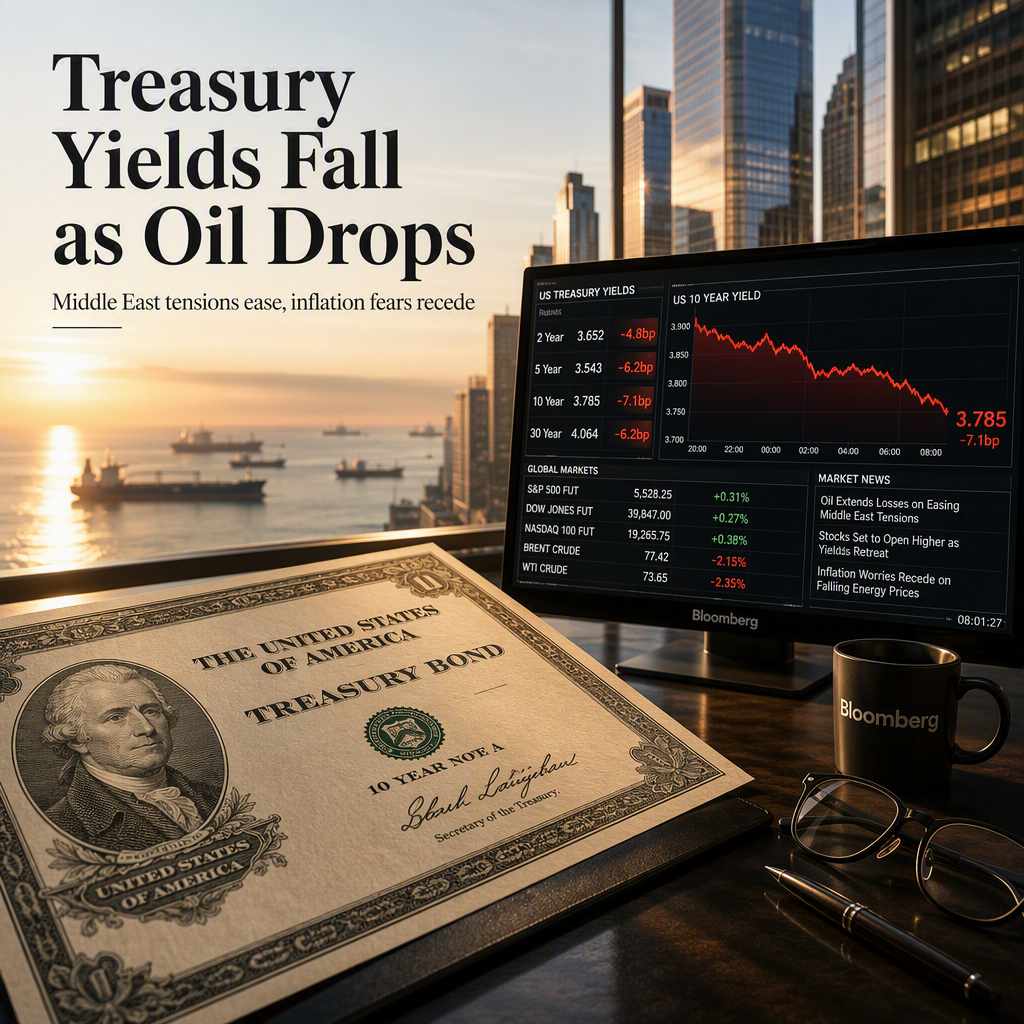
US Treasury yields declined across the curve on Tuesday, with the 2-year T-note yield falling nearly five basis points to 4.193% and the 10-year benchmark note dropping six basis points to 4.635% [1]. This move followed a sharp drop in oil prices, which tumbled more than 3% after the US Treasury imposed sanctions on 60 entities linked to Iran on Monday [1]. Positive developments in the Middle East contributed to easing inflationary pressures, as reports indicated that Pakistan Army Chief Munir conveyed an offer from the US to Iran regarding halting the blockade in the Strait of Hormuz in exchange for opening the Strait and stopping proxy attacks, though Iran denied these claims and stated that Munir was seeking to open negotiations and convey Iran’s conditions to the US [1].
Additionally, the White House announced the removal of mines in the Strait of Hormuz, confirmed by two US officials as reported by Axios [1]. These geopolitical developments have contributed to the downward pressure on oil prices and, consequently, on inflation expectations [1].
On the economic front, the US jobs market showed continued strength, with the ADP Employment Change 4-week average improving sharply, and US Building Permits in July also showing improvement [1]. However, US households reported decreased confidence regarding financial and economic conditions [1].
Market participants are now focused on the upcoming release of the Federal Reserve’s preferred inflation gauge, the Core Personal Consumption Expenditures (PCE) Price Index, scheduled for Wednesday. Additionally, traders are awaiting further jobs and growth data, as well as a speech from Fed Chair Kevin Warsh [1].
CONCLUSION
US Treasury yields fell as easing tensions in the Middle East and lower oil prices reduced inflation fears. Market attention is now turning to key US economic data releases and upcoming remarks from the Federal Reserve for further direction.