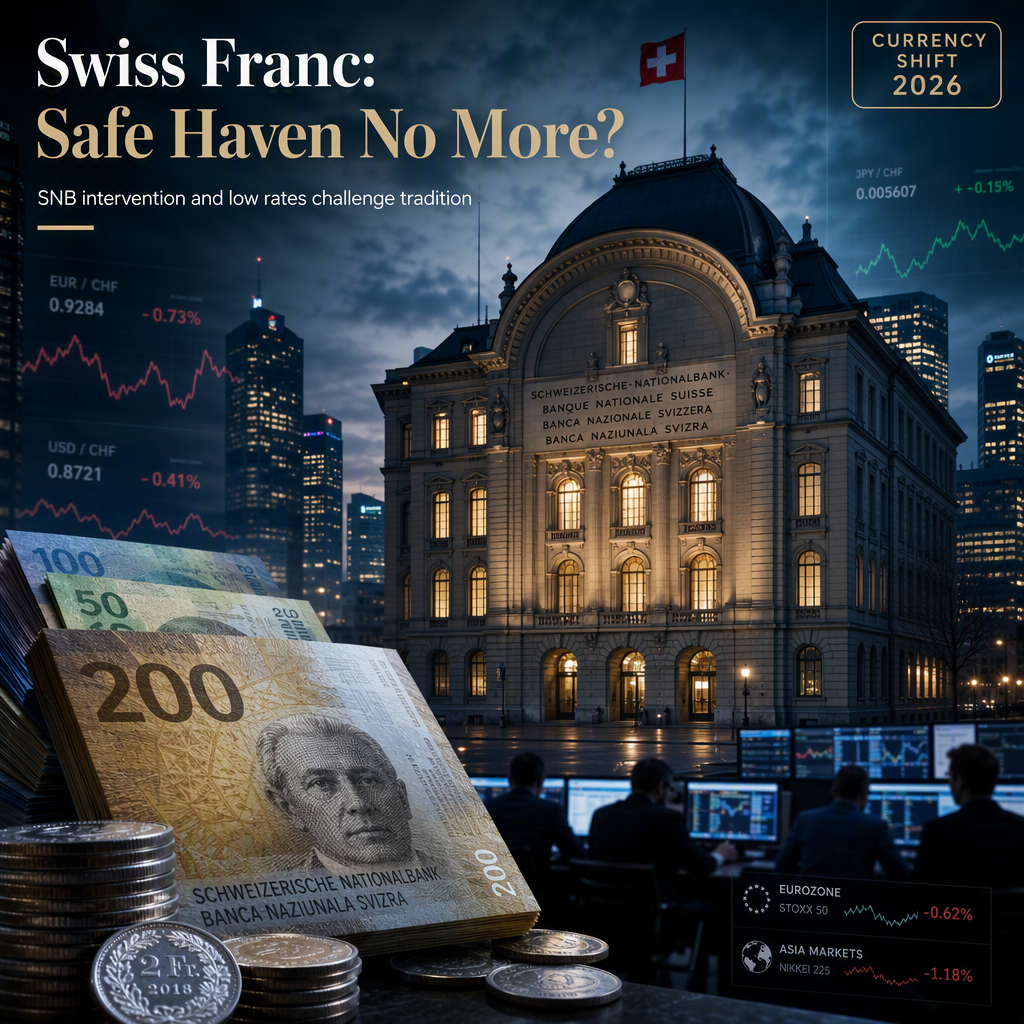
Rabobank’s Senior FX Strategist Jane Foley has analyzed the evolving role of the Swiss Franc (CHF), questioning whether it will transition from its traditional safe haven status to a funding currency. Foley cites the Swiss National Bank’s (SNB) intervention in March 2026, at the onset of the Iran war, which was aimed at halting a surge of safe haven inflows into the CHF. This intervention successfully arrested the rapid appreciation of the currency, diminishing its safe haven appeal in the aftermath [1].
Since the start of the Iran war, the CHF has been the second worst performing G10 currency, trailing only the Swedish Krona (SEK). Foley notes that neither the SNB nor Sweden’s Riksbank are currently concerned about persistent inflation pressures, with Swiss inflation remaining subdued and the SNB policy rate at zero [1].
Market participants see little risk of a SNB rate hike this year, raising the possibility that the CHF could increasingly be used as a funding currency. However, Foley warns that this shift is not straightforward, as the CHF’s established safe haven status could still attract long positions if market anxieties rise, particularly in response to Eurozone political risks such as the upcoming French Presidential election and the potential for a far-right victory [1].
Foley also suggests that if the Bank of Japan (BoJ) signals an accelerated pace of policy tightening at its September 18 meeting, investors may seek alternative funding currencies. With Switzerland’s very low interest rates, the CHF could become attractive to some investors, though its safe haven reputation may deter others [1].
CONCLUSION
The Swiss Franc is currently caught between its traditional safe haven role and the prospect of becoming a funding currency, influenced by SNB intervention, low inflation, and a zero policy rate. While subdued inflation and low rates support its funding currency appeal, ongoing political risks in the Eurozone and global market anxieties could still trigger safe haven inflows. Market participants remain cautious, awaiting further developments from central banks and political events.