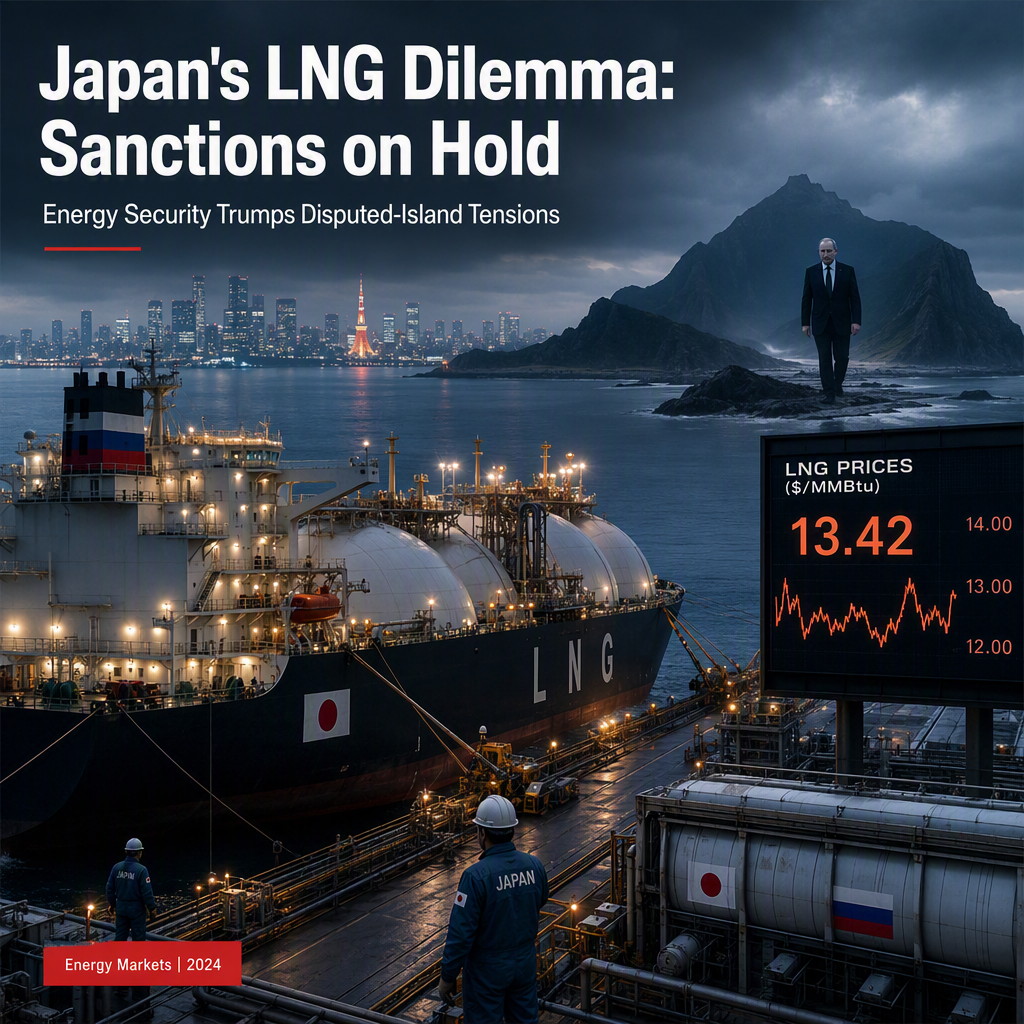
Japanese Prime Minister Sanae Takaichi has objected to Russian President Vladimir Putin's recent visit to a disputed northwestern Pacific island, but Japan has not taken any concrete countermeasures in the month since the event. This restraint highlights Japan's complex relationship with Russia, a key supplier of liquefied natural gas (LNG), especially as instability in the Middle East due to the Iran war continues to affect global energy markets [1].
Japan relies heavily on LNG imports from Russia, particularly from the Sakhalin-2 project, which supplies a significant portion of the nation's energy needs. Market analysts note that Japan's energy security concerns have taken precedence over territorial disputes, with one Tokyo-based energy strategist stating, "Japan faces a delicate balance: ensuring a stable LNG supply while managing diplomatic tensions with Russia." The risk premium on LNG contracts with Russia has increased, but Tokyo is not currently seeking alternative suppliers due to the potential for substantial costs [1].
Energy traders report that spot LNG prices in Asia remain elevated, with Japanese buyers maintaining long-term contracts to secure supply. Technical analysis shows resistance above $14/MMBtu for Asian spot LNG, with support near $12/MMBtu, reflecting ongoing geopolitical uncertainty. Market sentiment remains cautious amid fears of further disruptions [1].
The Japanese government has refrained from announcing new sanctions or import restrictions targeting Russia, instead emphasizing diplomatic dialogue to avoid escalation. A senior official from Japan's Ministry of Economy, Trade and Industry stated, "Our priority is to protect the interests of Japanese consumers and industries. We are closely monitoring developments and will take measured steps as necessary." Traders advise caution in the LNG market, noting that further political developments could impact price levels and supply chains [1].
CONCLUSION
Japan's muted response to Putin's disputed-island visit underscores the nation's dependence on Russian LNG and the prioritization of energy security over territorial disputes. Market sentiment remains cautious, with elevated LNG prices and no immediate policy changes expected. Further political developments could influence both supply stability and price levels.