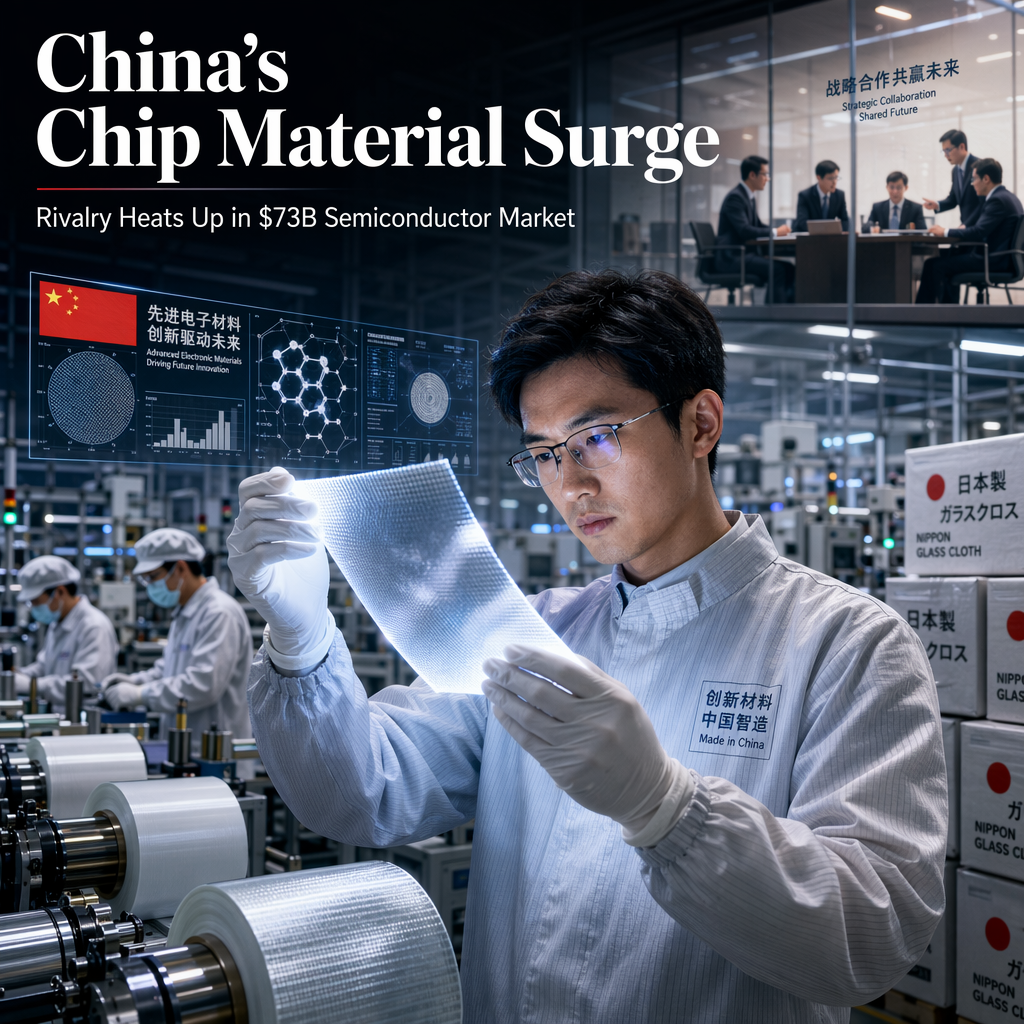
Chinese chip material manufacturers are ramping up production of advanced products in a bid to catch up with long-established Japanese market leaders, as Beijing intensifies its push for semiconductor self-sufficiency [1]. The market for chip materials is valued at $73 billion, with leading Japanese companies such as Nittobo now facing increasing competition from Chinese firms that are making significant investments to expand their presence [1].
A notable example is Guangyuan New Material, which is increasing its output of glass cloth—a critical component for AI chip packaging—demonstrating China's commitment to strengthening its domestic semiconductor supply chain [1]. This expansion is part of a broader strategy by Chinese companies to develop advanced materials essential for fabricating chips used in artificial intelligence and high-performance computing, aiming to reduce reliance on Japanese suppliers who have traditionally dominated the sector [1].
The competition is intensifying as both Japanese and Chinese companies introduce new products and expand their production capacities, driven by surging global demand for materials used in AI chip packaging, glass cloth, and other advanced substrates [1]. Chinese manufacturers are leveraging state support and aggressive investment to close the technological and market share gap with their Japanese counterparts [1].
As financial stakes rise alongside the growing demand for advanced chips, the ongoing battle for the $73 billion chip material market is expected to reshape global supply chains and alter the balance of power within the semiconductor materials industry [1].
CONCLUSION
Chinese chip material makers are aggressively expanding production and investment to challenge Japanese dominance in the $73 billion semiconductor materials market. This intensifying competition is likely to reshape supply chains and shift the industry's balance of power as global demand for advanced chip materials continues to rise.