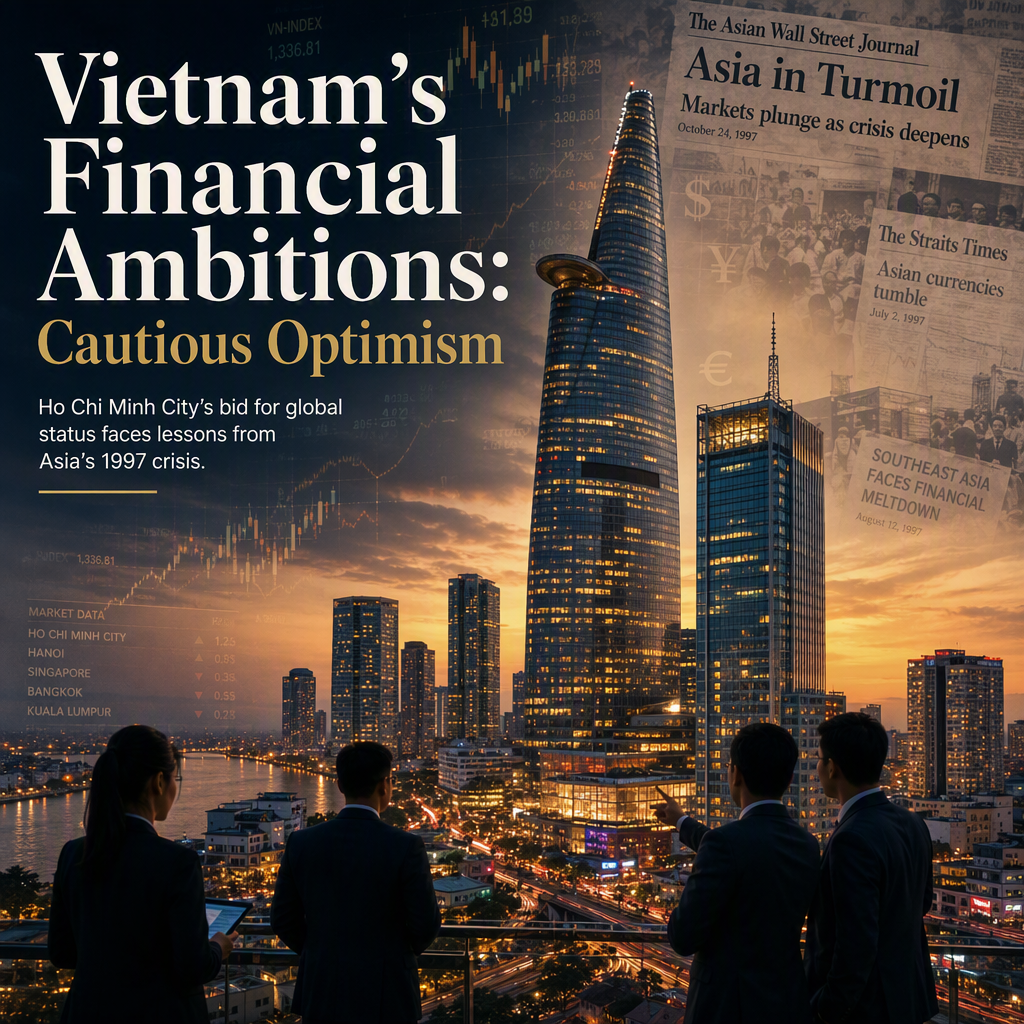
Vietnam is advancing its ambitions to become a regional and potentially global financial center, with Ho Chi Minh City positioned at the core of these efforts [1]. The government aims to attract multinational banks, institutional investors, and financial service providers, leveraging the country's robust growth rates, youthful population, and increasing integration into global supply chains [1]. However, the article highlights significant risks, drawing parallels to Thailand’s experience in the mid-1990s, where rapid financial liberalization led to asset bubbles, currency mismatches, and ultimately the 1997 Asian financial crisis [1].
Vietnam’s financial infrastructure is described as underdeveloped, with persistent non-performing loan issues and regulatory oversight that has yet to meet international standards [1]. The article stresses the importance of prudent capital account management, advocating for clearer regulations, stricter supervision of credit growth, and effective mechanisms to monitor cross-border flows [1]. According to a recent Asian Development Bank report cited in the article, some analysts recommend a gradual approach, suggesting Vietnam should first deepen its domestic capital markets and enhance transparency before pursuing full financial liberalization [1]. This includes strengthening the bond market, improving bankruptcy laws, and encouraging better corporate governance among listed firms [1].
Market participants are closely monitoring Vietnam’s currency management, as the State Bank of Vietnam has intervened to stabilize the dong during periods of volatility [1]. The article notes that pressure on the currency could intensify if capital inflows surge or if global interest rates shift, making a credible exchange rate policy critical for maintaining investor confidence [1].
The overall sentiment is one of cautious optimism, with the article emphasizing that Vietnam’s policymakers must balance ambition with patience, discipline, and lessons learned from past regional crises to build a resilient financial center [1].
CONCLUSION
Vietnam’s drive to become a financial hub is attracting optimism but also caution, as analysts and market participants highlight the need for gradual reforms and robust safeguards. The country’s success will depend on strengthening its financial infrastructure and maintaining credible policies to avoid the pitfalls that triggered past regional crises.