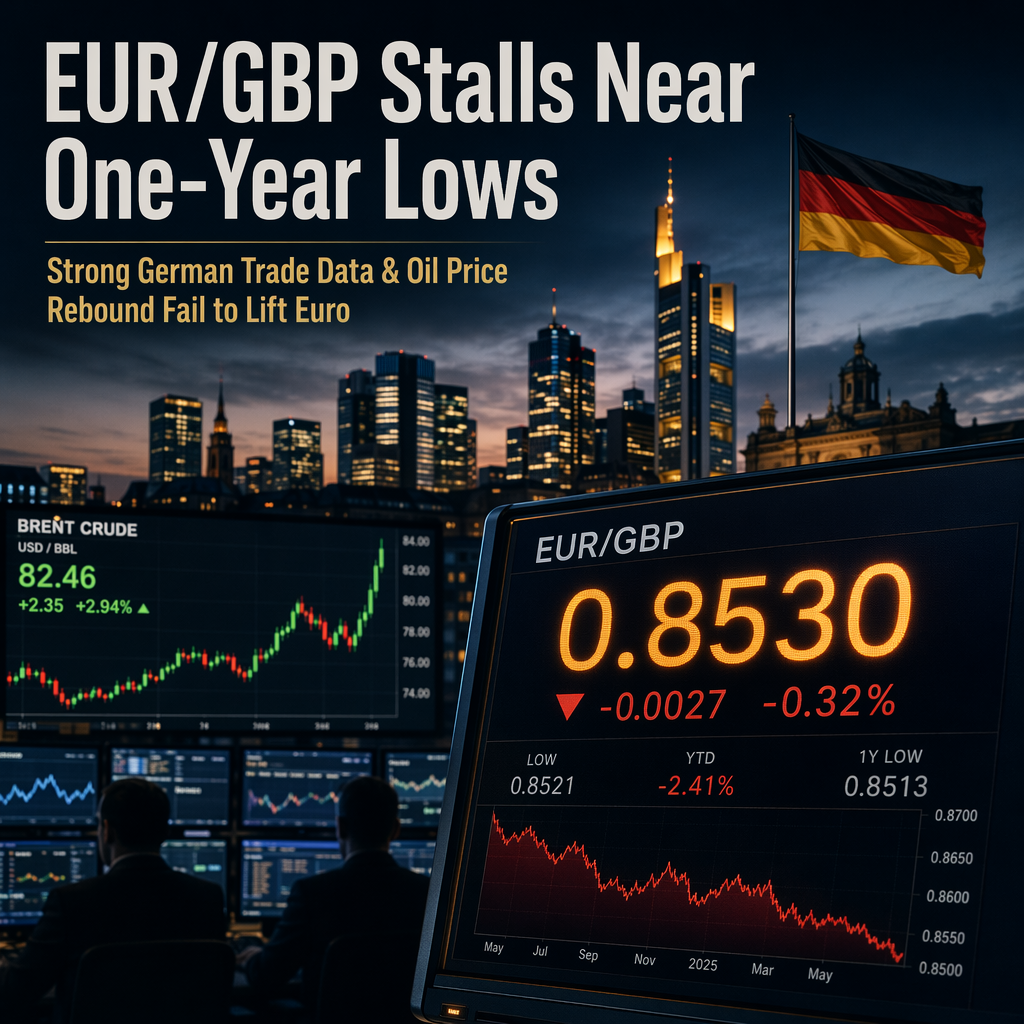
The EUR/GBP currency pair remained subdued just above one-year lows, trading flat around 0.8530 on Thursday, as the Euro failed to gain significant support despite positive economic data from the Eurozone [1]. German Trade Balance data for May showed a surplus of EUR 19.1 billion, surpassing the previous month's surplus of EUR 14.5 billion, with exports growing against expectations [1]. However, this strong trade performance did not translate into upward momentum for the Euro against the British Pound [1].
The market environment was influenced by rising geopolitical tensions, as the US launched new attacks in Iran, leading to a sharp rebound in oil prices. Brent crude oil surged nearly 10%, reaching the $80 level on Wednesday after having bottomed near $70 the previous week [1]. These developments contributed to a cautious market tone, weighing on the Euro's performance [1].
Technical analysis indicates that while EUR/GBP maintains a bearish near-term outlook, selling pressure has diminished. The Relative Strength Index (RSI) at 28 suggests a bullish divergence, and the MACD indicator is stabilizing around the zero line, pointing to a period of consolidation rather than a decisive bullish reversal [1]. For a bullish correction to be confirmed, the pair would need to break above the previous yearly low at 0.8533 and the top of the descending wedge pattern near 0.8555 [1]. On the downside, a break below 0.8519 could expose the pair to further losses, with no clear support until the early June 2025 lows around 0.8410 [1].
A weekly performance table shows the Euro was strongest against the Japanese Yen but lost ground against the British Pound, reflecting the pair's ongoing weakness [1].
CONCLUSION
Despite robust German trade data and a rebound in oil prices, EUR/GBP remains under pressure near one-year lows, with technical indicators pointing to consolidation rather than a reversal. The market continues to monitor geopolitical tensions and their impact on currency movements.