
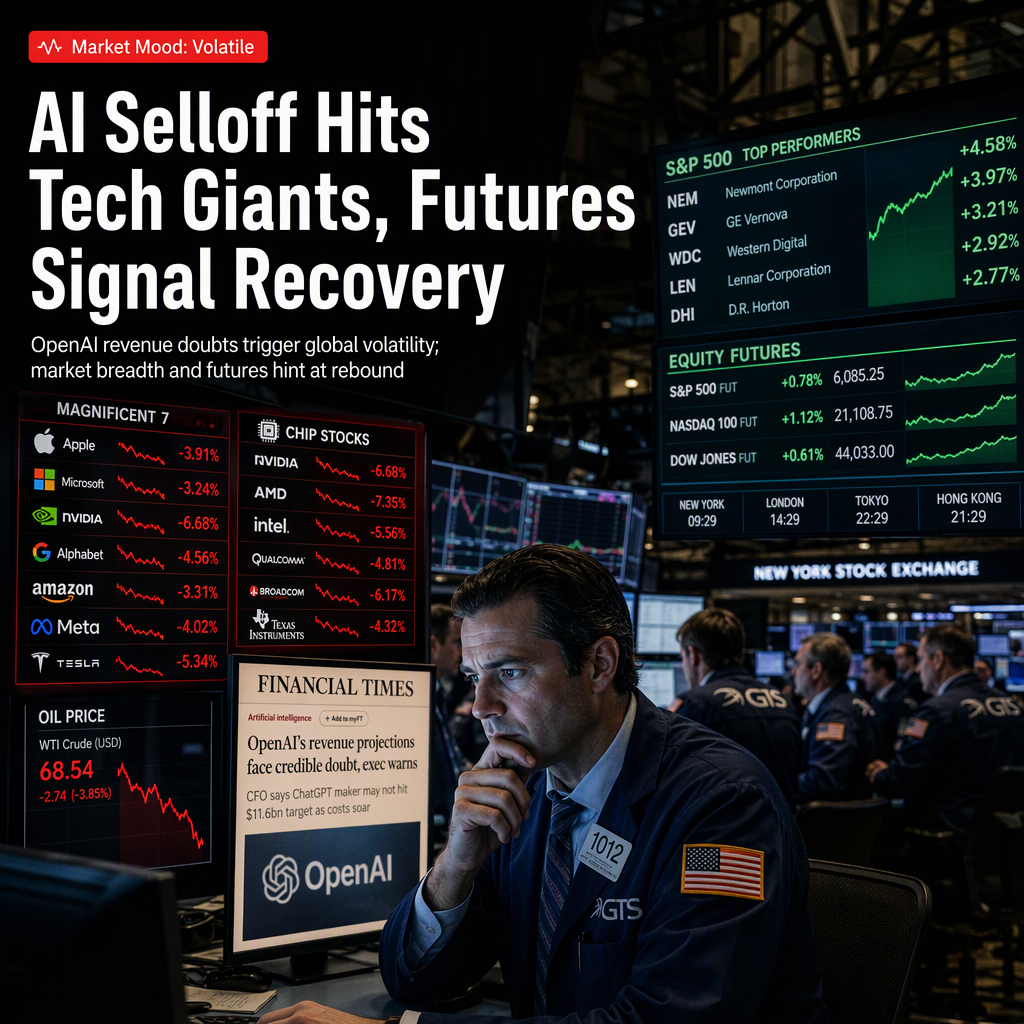
The S&P 500 experienced a second consecutive decline, falling by 0.47%, primarily due to weakness in the Magnificent 7 stocks, which dropped 0.95% following concerns about the sustainability of the AI-driven rally. These concerns were heightened after a Financial Times report indicated that OpenAI’s annualised revenue is closer to $50 billion, significantly below previous reports suggesting $70 billion, leading to a sharp selloff in chip stocks. The Philadelphia Semiconductor Index fell 3.39%, marking its worst day in over three weeks [1].
Despite the headline declines, market breadth was more positive, with two-thirds of S&P 500 constituents posting gains on the day. However, the risk-off sentiment extended to European markets, where the STOXX 600 dropped 0.75% to its lowest level since June, and France’s CAC 40 fell 0.51% to its lowest since March. European banks also struggled, with the STOXX Banks index down 2.26%, reaching its lowest point since June, even as spreads remained broadly steady [1].
Asian markets reflected mixed sentiment amid ongoing questions about the AI rally. The Nikkei lost 0.32%, the Shanghai Composite fell 1.21%, and the CSI 300 declined 1.27%. In contrast, the Hang Seng gained 1.09% and Australia’s S&P/ASX 200 rose 0.56%. South Korean markets were closed for a holiday [1].
Looking ahead, both US and European equity futures are indicating a potential recovery, with S&P 500 futures up 0.30% and DAX futures rising 0.78%, as oil prices continue to retreat. This suggests a possible rebound in equities following the recent AI-related selloff [1].
CONCLUSION
Concerns over AI revenue growth, particularly regarding OpenAI, triggered a broad tech-led selloff and weighed on global equities. However, positive market breadth and rising equity futures point to a potential recovery, indicating that investor sentiment may stabilize as oil prices fall.