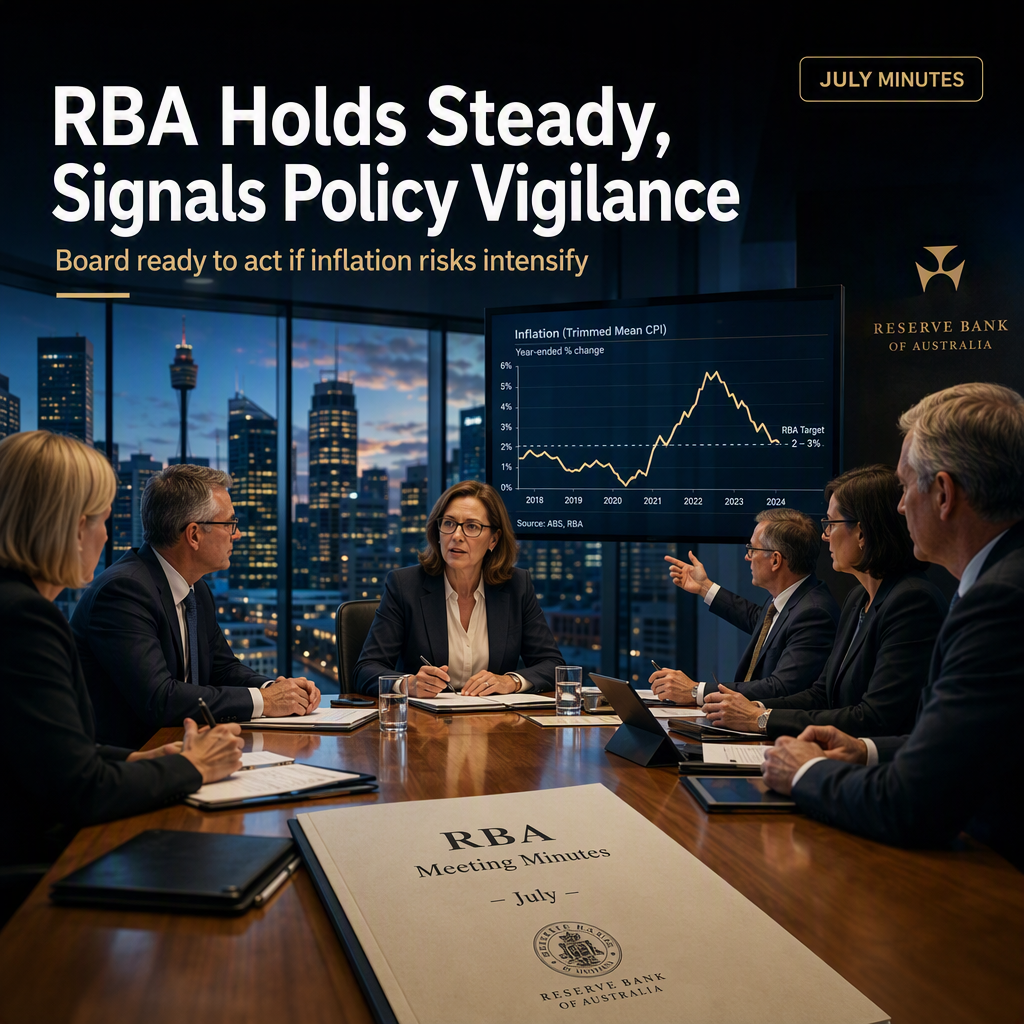
The Reserve Bank of Australia (RBA) released the minutes from its July monetary policy meeting, revealing that the Board is prepared to raise interest rates if upside risks to inflation materialize [1]. The minutes highlighted that 'several' board members believe there is a significant possibility that upside inflation risks could crystallize, while other members noted offsetting downside risks, suggesting there is still time to assess incoming economic data before making further policy adjustments [1].
During the meeting, the Board considered whether to increase the cash rate by 25 basis points or keep it unchanged. Ultimately, they agreed that the current cash rate is at the top end of both model- and market-based estimates of neutral, though these estimates remain uncertain [1]. The Board also noted that policy appears sufficiently restrictive to bring inflation to target within a reasonable timeframe, but emphasized the need for further progress in data to be certain about inflation returning to target [1].
Key upside risks to inflation identified by the RBA include rising oil prices, the pass-through of cost pressures, and the ongoing data center boom. Conversely, the Board observed that momentum in the housing market has shifted, with prices falling, which could slow the economy and potentially balance inflation risks [1]. Staff research suggested that a more pre-emptive approach to monetary policy might be appropriate, and it is possible that bringing inflation down faster could do less harm to the labor market than previously thought [1].
The market reaction to the RBA minutes was muted, with the Australian Dollar (AUD) remaining largely unchanged. As of the report, AUD/USD was trading modestly flat near 0.7150 [1].
CONCLUSION
The RBA minutes indicate a cautious but vigilant stance, with the Board ready to raise rates if inflation risks intensify, but currently seeing policy as sufficiently restrictive. The lack of immediate market reaction suggests investors are awaiting further economic data before adjusting their expectations. The RBA's future moves will depend on upcoming inflation, jobs, and GDP data.