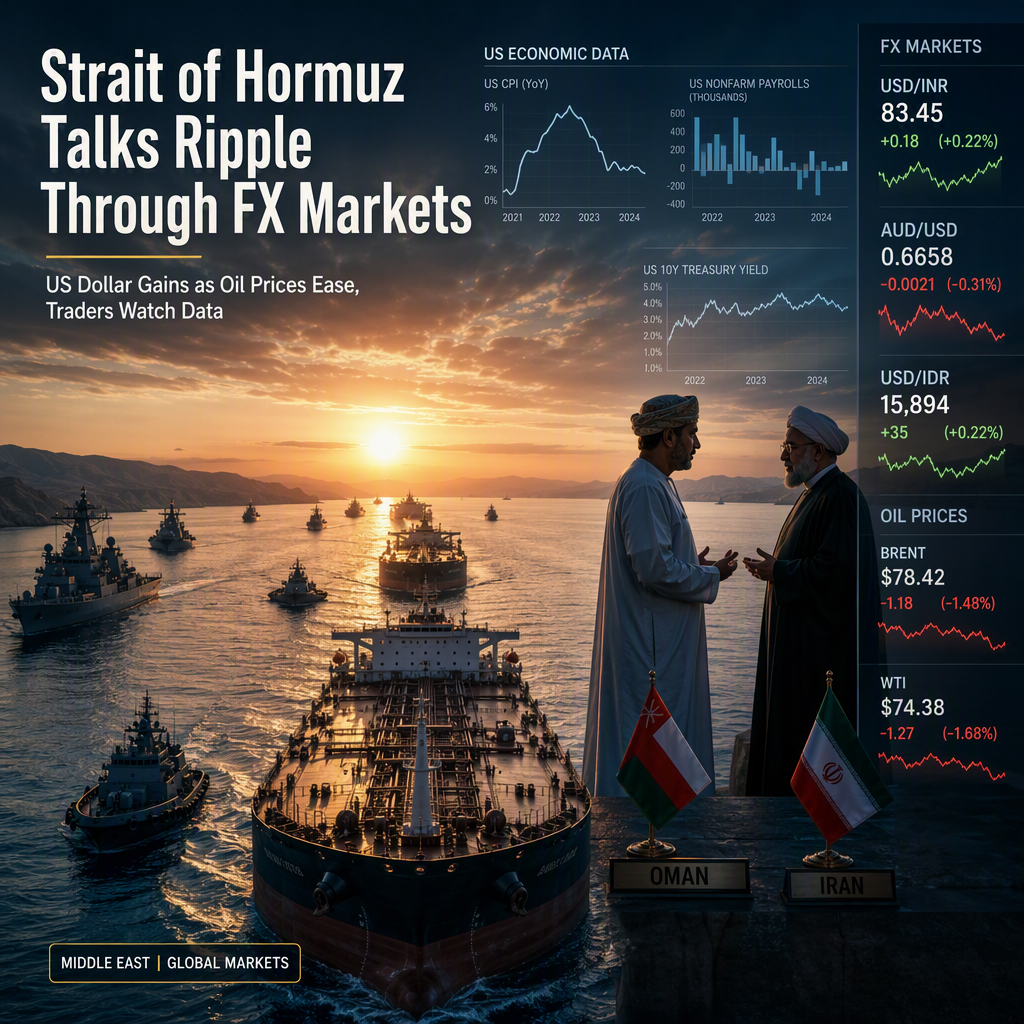
A series of diplomatic and economic developments centered on the Strait of Hormuz and US macroeconomic data have influenced major currency pairs across Asia and Europe. The US Dollar (USD) gained traction on Thursday, reversing a two-day losing streak as traders awaited further clarity on Middle East negotiations, particularly regarding a potential US-Iran deal and the reopening of the Strait of Hormuz [1][2][4]. Optimism over a possible agreement between Iran and Oman to manage navigation through the Strait has supported risk sentiment and contributed to lower oil prices, which in turn has benefited currencies like the Indian Rupee (INR) [3][4].
Iranian and Omani officials are reportedly close to finalizing a framework for shipping through the Strait of Hormuz, with a senior Gulf official estimating a 50% chance of an agreement by Friday [3][4]. However, there are conflicting reports about the extent of US involvement, as an Iranian official denied ongoing talks with Washington over the waterway [2]. Tehran emphasized that any reopening depends on the US ending its naval blockade on Iranian ports, and clarified that the proposed route would be temporary, lasting two to four months, rather than a full reopening [3][4]. Meanwhile, ongoing attacks by Yemen’s Houthis on Saudi tankers in the Red Sea continue to pose risks to energy supply [3].
In currency markets, the AUD/USD pair edged lower to just below 0.7050, retreating from its highest level since June 17, as the USD strengthened on safe-haven demand and ahead of key US data releases [1]. Technical indicators for AUD/USD remain constructive, with the MACD modestly positive and the RSI near 58, suggesting dips may attract buyers. Traders are watching for a breakout above 0.7070 to target higher retracement levels, while support is seen at 0.7020 and 0.6958 [1].
The Indian Rupee traded flat at 95.12 against the USD, supported by lower oil prices and expectations of normalized navigation through the Strait of Hormuz [3]. The Reserve Bank of India (RBI) kept its repo rate unchanged at 5.25% and lowered its inflation forecast to 5%, though it warned of potential core inflation acceleration in the third quarter [3]. Standard Chartered economists noted the RBI’s dovish tone and a high bar for future rate hikes [3].
The Indonesian Rupiah (IDR) remained stable, with USD/IDR trading around 17,960. Market focus is on the nomination process for a new Bank Indonesia governor following Perry Warjiyo’s resignation, with Destry Damayanti emerging as a frontrunner [4]. Economists at DBS Group Research highlighted the stability in Indonesia’s currency and rates markets, aided by lower oil prices and the absence of fresh negative triggers [4].
US macroeconomic data showed ADP private-sector payrolls rising by just 44,000 in July, down from 98,000 in June and below the 70,000 consensus, while the ISM Services PMI edged up to 54.1, slightly missing expectations [2][4]. The upcoming US Initial Jobless Claims and Nonfarm Payrolls reports are seen as key drivers for further market direction [1][2][4].
CONCLUSION
Currency markets are being shaped by evolving Middle East maritime negotiations and mixed US economic data, with the US Dollar gaining on safe-haven flows and anticipation of key labor reports. While optimism over a Strait of Hormuz agreement has eased some supply concerns and supported risk currencies, ongoing geopolitical risks and data uncertainty keep market sentiment cautious. Traders are closely monitoring upcoming US data and central bank developments for further direction.