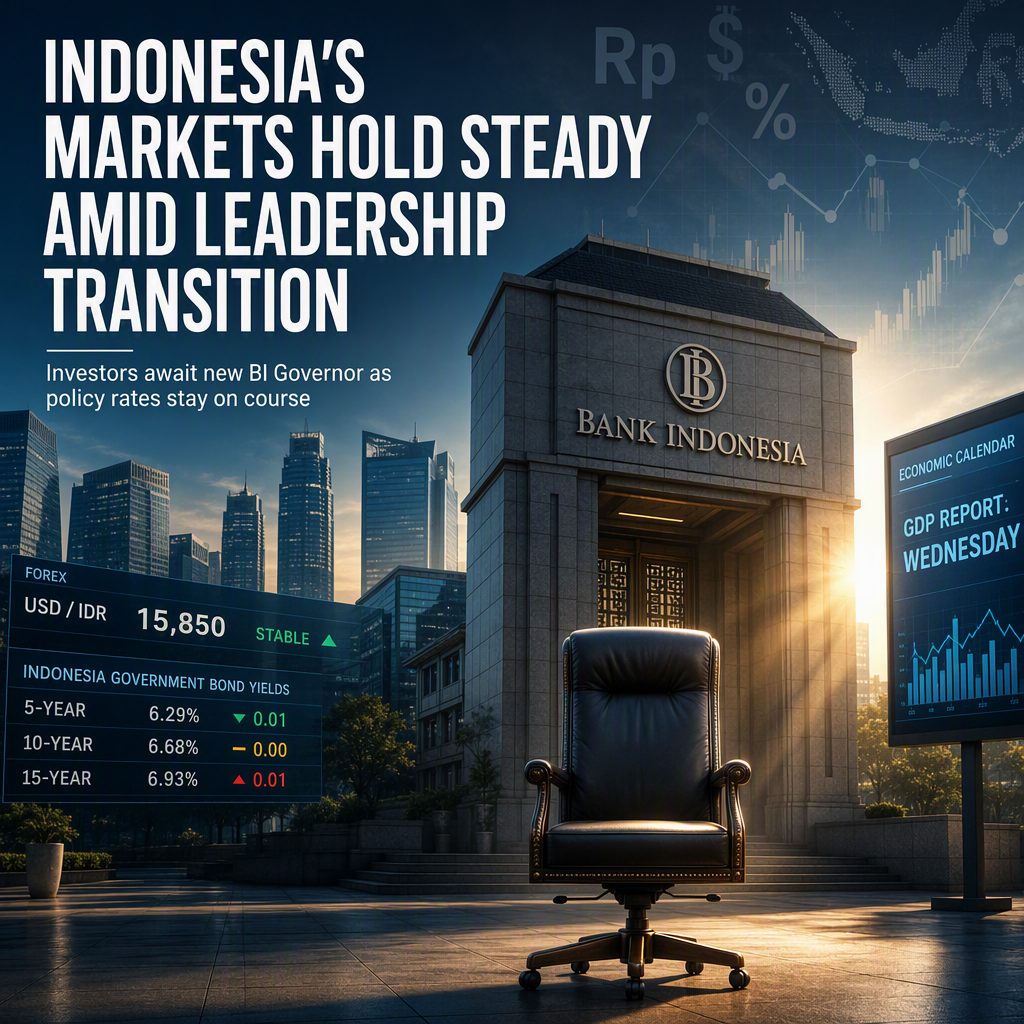
Indonesia's financial markets are currently focused on the appointment of a new Bank Indonesia (BI) Governor following the departure of Perry Warjiyo last week, with Acting Governor Destry Damayanti emphasizing non-rate measures and IDR liquidity management [1]. DBS Group Research economist Radhika Rao notes that the macroeconomic backdrop is characterized by a mixed growth-inflation environment, a weaker external balance, and a rangebound USD/IDR exchange rate, which collectively support an unchanged policy rate stance in the near term [1].
The USD/IDR has remained stable within the 17,900–18,000 range this week, aided by a pullback in oil prices and the absence of new negative triggers, while Indonesia's benchmark long-end yield has held steady around 7.3%, reflecting influences from rising US rates [1]. The upcoming 2Q GDP growth report, scheduled for Wednesday, is expected to show output expanding by a relatively firm 5.3% year-on-year, compared to 5.6% in the previous quarter, despite the energy shock [1].
Given the current stability in the rupiah and the mixed growth-inflation signals, DBS argues that Bank Indonesia is likely to maintain its policy rates this month [1].
CONCLUSION
Indonesia's markets are in a holding pattern as they await new central bank leadership, with macroeconomic indicators supporting a steady policy rate outlook. The stability in the rupiah and bond yields, alongside firm GDP growth, suggest limited immediate market disruption. Investors are likely to remain focused on the upcoming GDP report and the appointment of the new BI Governor.