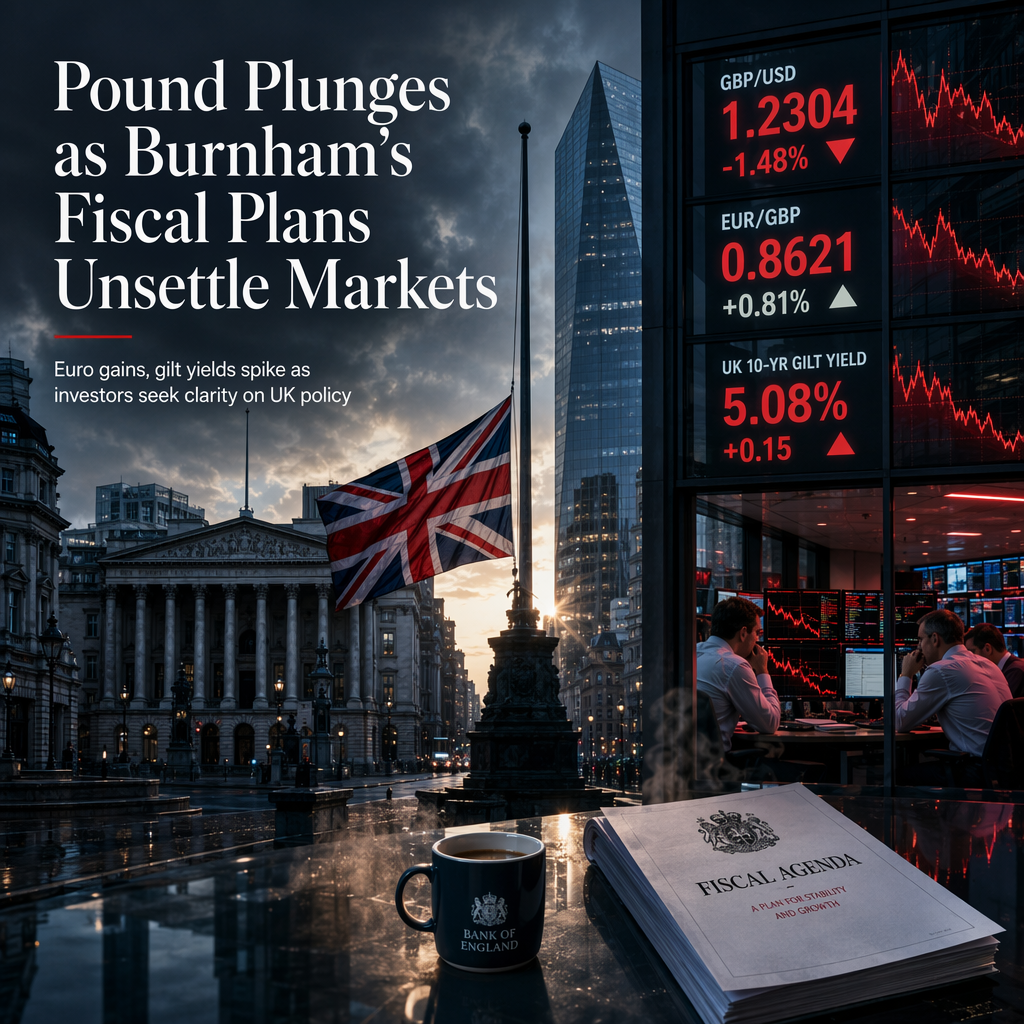
The British Pound (GBP) weakened sharply against major currencies following the appointment of Andy Burnham as UK Prime Minister and the unveiling of his new cabinet and fiscal agenda. Rabobank’s Senior FX Strategist Jane Foley noted that 10-year UK gilt yields rose above 5%, reflecting market anxiety, while the Pound became the worst performing G10 currency on a one-day view [1]. Similarly, the EUR/GBP cross extended its gains for a fourth consecutive day, trading around 0.8527, as doubts over the UK’s fiscal outlook weighed on Sterling [2].
Both sources highlight that uncertainty surrounds how PM Burnham intends to fund his agenda. Burnham stated he would use 'flexibility' within the fiscal rules and is expected to announce a 10-year plan later this year [1][2]. In the short term, he promised measures to ease cost-of-living pressures, starting with a VAT cut on household electricity bills from October [1]. OCBC strategists described the appointment of John Healey as Chancellor as 'market-friendly,' but noted that Burnham’s comments about fiscal flexibility unsettled the gilt market and reinforced investor unease [2].
Rabobank points to the UK’s low savings ratio and large current account deficit as factors increasing the sensitivity of its debt market to negative news, even though the UK does not have the highest debt/GDP ratio among developed nations [1]. Both Rabobank and OCBC expect further GBP weakness, with Rabobank forecasting EUR/GBP to rise to 0.8650 and cable (GBP/USD) to dip towards 1.32 over the next three months [1], while OCBC expects EUR/GBP to recover towards 0.87, citing a range-bound GBP and limited upside due to the Bank of England’s less hawkish stance compared to peers [2].
The Euro also drew support from stronger-than-expected ZEW sentiment data, with Eurozone Economic Sentiment jumping to 23.4 in July from 9.5 in June, and Germany’s index rising to 26.3 from 10.5 [2]. UK labor market data showed employment rising by 147K in the three months to May and the ILO Unemployment Rate holding at 4.9%, slightly below the 5.0% forecast, but this offered little support to the Pound [2]. The market is now focused on upcoming UK CPI and PPI data [2].
According to a currency heat map, the British Pound was the weakest against the Euro and several other majors, though it showed relative strength against the Japanese Yen [2].
CONCLUSION
Markets reacted negatively to PM Burnham’s fiscal stance, with rising gilt yields and a weaker Pound reflecting investor concerns over funding and fiscal flexibility. Both strategists and data suggest further GBP downside and Euro strength in the near term, as the market awaits more clarity on UK fiscal policy and upcoming economic data.