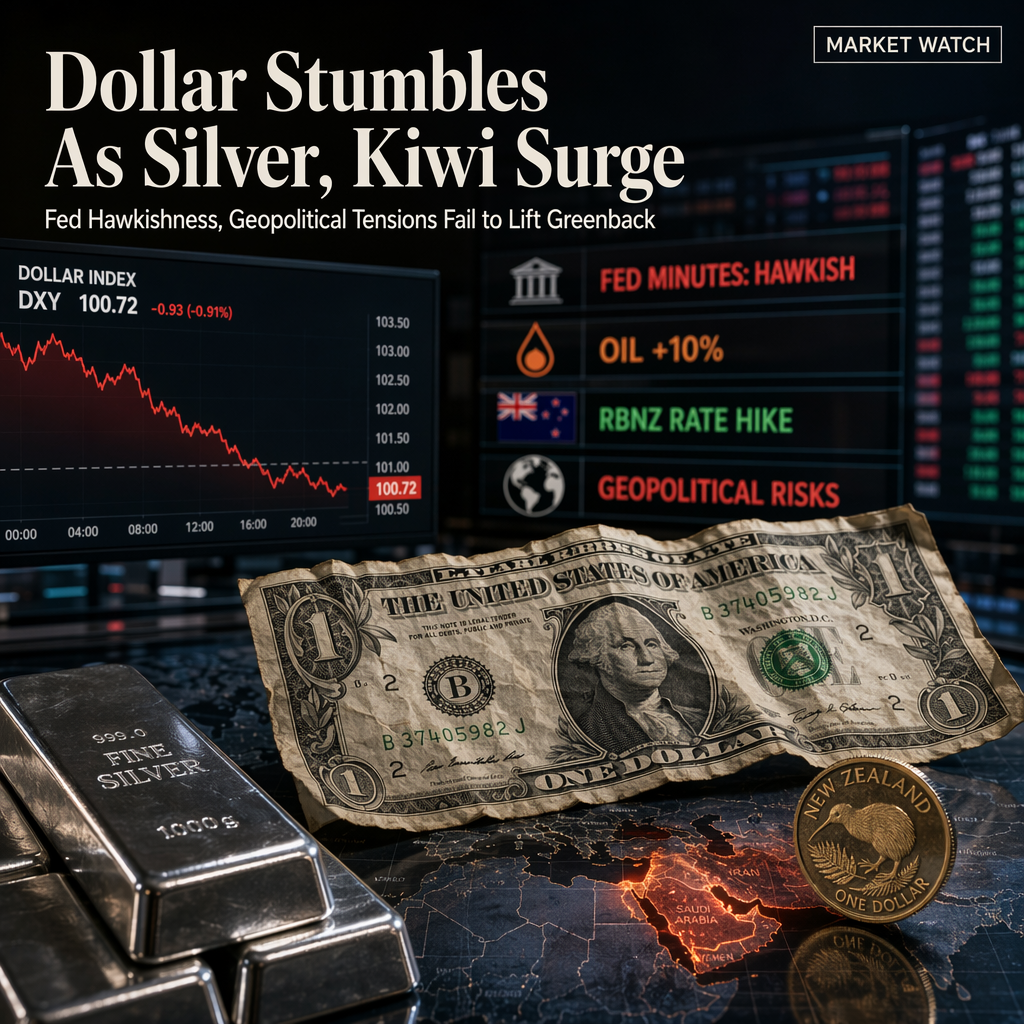
The US Dollar experienced broad weakness across major currencies on Thursday, despite multiple tailwinds including a hawkish Federal Reserve stance and escalating geopolitical tensions in the Middle East. The June Federal Open Market Committee (FOMC) minutes revealed that policymakers remain concerned about persistent inflation, with several members seeing a case for a rate hike and most indicating that a restrictive policy stance may need to be maintained if inflation proves stubborn [1][2][5]. However, the Dollar Index (DXY) dipped below 101.00 to test weekly lows, trading 0.25% lower to near 100.80, as investors were unimpressed with the Fed's commitment to bring inflation back to target [3][5].
Market reactions were notable: Silver (XAG/USD) jumped over 1% to near $59.00, benefiting from the weaker Dollar and renewed inflation concerns amid rising oil prices following US-Iran reciprocal attacks [5][6]. The US Dollar was the weakest against the New Zealand Dollar, which surged above 0.5700 after the Reserve Bank of New Zealand (RBNZ) raised its Official Cash Rate by 25 basis points to 2.50% and signaled further tightening may be needed to ensure inflation returns to target [6]. Meanwhile, USD/CHF retreated to near 0.8050 after being rejected at 0.8100, with technical indicators showing fading bullish momentum and the Dollar losing steam against the Swiss Franc [3].
Geopolitical tensions, including renewed US strikes on Iran and Iranian attacks on Kuwait and Bahrain, led to a nearly 10% rebound in oil prices. Despite these developments, the US Dollar failed to attract safe-haven flows, as investors remained hopeful for a return to negotiations between Washington and Tehran [1][3][5][6]. The correlation between EUR/USD and oil prices has weakened, and EUR/USD traded in a narrow range, largely unaffected by Iran-related headlines [1].
In the Japanese Yen market, USD/JPY retained an upside bias, with scope for a test of 162.80 intraday, though major resistance at 163.00 was unlikely to be reached. Over a 1–3 week horizon, trading is expected between 160.60 and 163.00, with the advance intact as long as the pair holds above the 21-day EMA at 161.00 [4].
Looking ahead, the next major trigger for the US Dollar will be the US Consumer Price Index (CPI) data for June, scheduled for release on Tuesday [5]. Some analysts note that softer Chinese inflation data may cap upside for China-proxy currencies like the Kiwi, but the RBNZ's hawkish stance remains a key driver [6].
CONCLUSION
Despite hawkish signals from the Fed and rising geopolitical risks, the US Dollar weakened across major currencies, boosting assets like Silver and the New Zealand Dollar. Market participants are now focused on upcoming US CPI data for further direction. The overall takeaway is that persistent inflation concerns and central bank policy remain dominant market drivers, but the Dollar's safe-haven appeal is muted amid hopes for diplomatic progress.