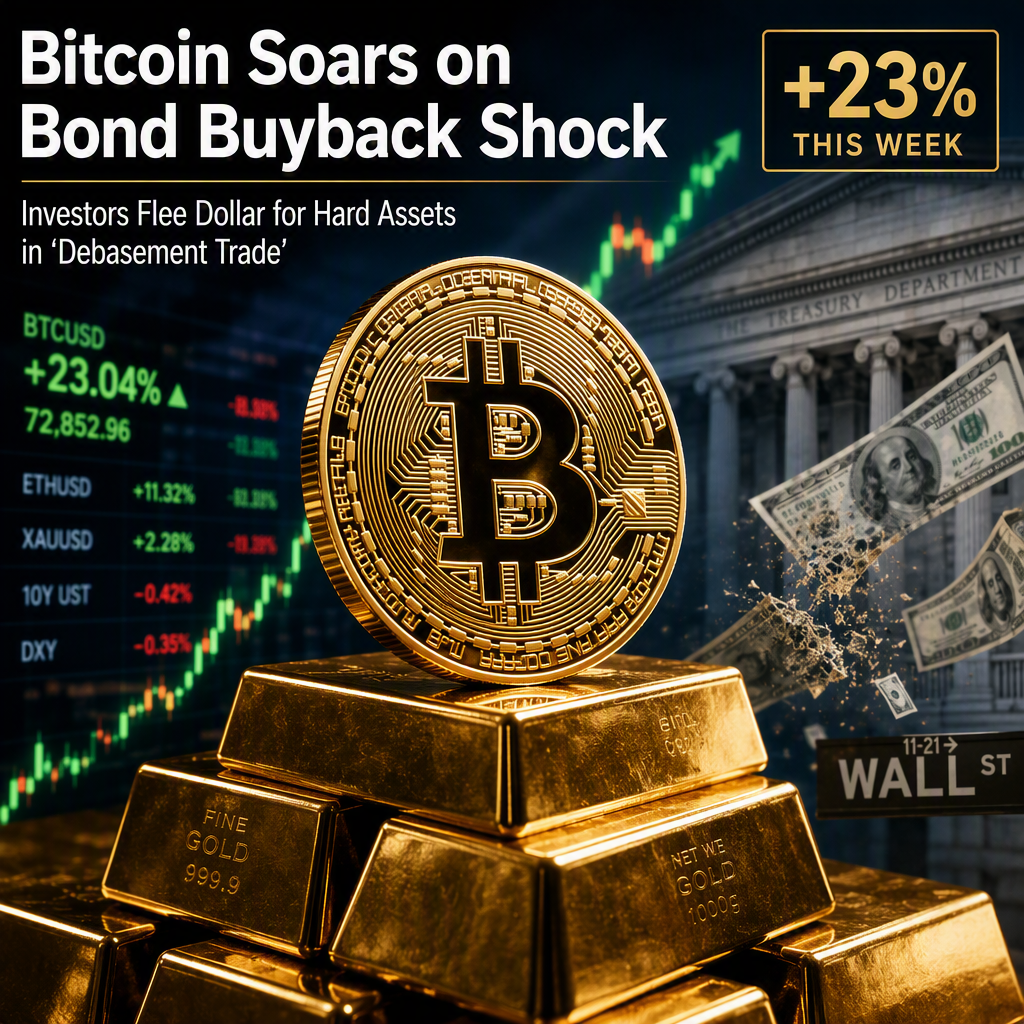
Bitcoin experienced a dramatic rally this week, climbing nearly 23% and trading close to $77,400 by Friday afternoon after starting the week around $62,600, marking its highest level since early June [1]. The surge began on August 19, 2026, when the U.S. Treasury announced it would at least double the size of its long-term bond buybacks from $2 billion to at least $4 billion per operation, starting September 9 [1]. This announcement came as the 30-year Treasury yield reached its highest point since 2007, prompting the government to act in an effort to lower long-term borrowing costs [1].
The market reaction was swift: long-term yields dropped, the U.S. dollar weakened, and investors flocked to hard assets such as gold and Bitcoin, a move described as the 'debasement trade' [1]. On the day of the announcement, Bitcoin jumped nearly 6%, then continued its ascent, clearing $72,000 by Thursday and approaching $77,400 by Friday, with a weekly gain of about 19% according to CNBC [1]. Gold also spiked to nearly $4,557, its highest since June [1]. In contrast, the S&P 500 fell approximately 0.87%, and Walmart's earnings miss heightened concerns about the strength of U.S. consumers [1].
The 'debasement trade' refers to investors selling assets tied to a government’s currency, such as bonds and the dollar, in favor of scarce assets like gold and Bitcoin, due to fears that the currency is losing value [1]. Traders interpreted the Treasury's move as a signal that authorities want cheaper money, which could weaken the dollar over time, making hard assets more attractive [1]. A strategist at 21Shares noted that the market viewed the Treasury's action as a subtle form of money-printing, boosting demand for debasement-hedge assets [1].
However, the article clarifies that the Treasury's buyback is not the same as quantitative easing (QE), since the Treasury must borrow funds to finance the buybacks rather than creating new money as the Federal Reserve does during QE [1].
CONCLUSION
Bitcoin's sharp rally was driven by investor concerns over U.S. currency debasement following the Treasury's expanded bond buyback program. The move triggered a flight to hard assets, with Bitcoin and gold outperforming traditional equities. The market's reaction underscores the sensitivity of risk assets to government interventions in the bond market.