
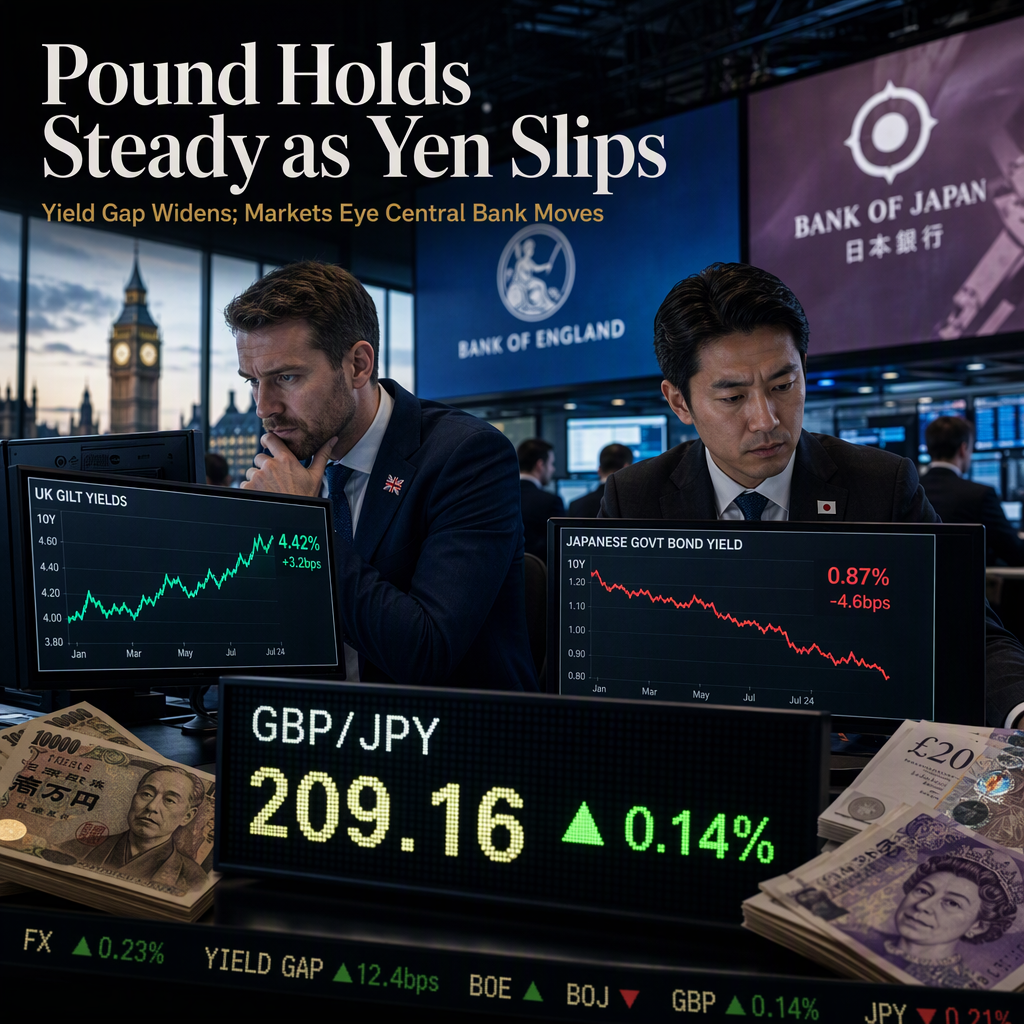
The British Pound (GBP) gained ground against the Japanese Yen (JPY) on Friday, with GBP/JPY trading around 209.16, up 0.14% on the day, as the Yen underperformed across the board [1]. This move was attributed to a pause in the global bond sell-off, which led to a sharper decline in Japanese government bond yields compared to their UK counterparts. Japan’s benchmark 10-year government bond yield fell toward 3.00% after reaching 3.153% earlier in the week, its highest level in approximately 30 years, while the UK 10-year gilt yield stood near 5.432%, below Thursday’s peak of 5.527%, the highest since 2007. The yield differential, with UK yields about 243 basis points above Japanese yields, supported the Pound against the Yen [1].
Expectations that the Bank of England (BoE) could raise interest rates before year-end also favored the GBP, while the Bank of Japan (BoJ) maintained a gradual tightening approach. BoE Governor Andrew Bailey emphasized the need for an unwavering commitment to returning inflation to target, noting subdued pass-through of energy costs but warning of risks if high energy prices persist [1]. BoJ Governor Kazuo Ueda stated that rates would be raised in response to economic and inflation developments, with the pace and timing dependent on baseline projections and risks [1].
Despite these developments, traders remained cautious about aggressive bullish positions in GBP/JPY, citing intervention risks as USD/JPY hovered around 158.00, close to the 160.00 level. Concerns over the UK’s fiscal outlook ahead of the October 28 budget also limited demand for the Pound, keeping GBP/JPY within the 207-210 range observed since early September [1]. Technical analysis indicated that GBP/JPY remained below key moving averages, with mixed momentum signals and initial support at 207 [1].
Meanwhile, United Overseas Bank (UOB) analysts observed choppy trading in USD/JPY, with the pair fluctuating between 157.51 and 158.36 and closing at 157.86 (-0.13%) [2]. For the coming sessions, UOB expects USD/JPY to trade within a 157.50–158.50 intraday range, and in the 1–3 week view, to consolidate within a narrower 157.00–158.70 band, reflecting ongoing volatility but no clear directional trend [2].
CONCLUSION
The British Pound's resilience against the Japanese Yen is underpinned by a widening yield differential and expectations of further BoE tightening, while the Yen remains pressured by lower yields and cautious BoJ policy. However, both GBP/JPY and USD/JPY are trading within defined ranges amid intervention risks and fiscal uncertainties, suggesting limited near-term directional momentum. Market participants remain watchful for policy signals and fiscal developments that could break the current consolidation.