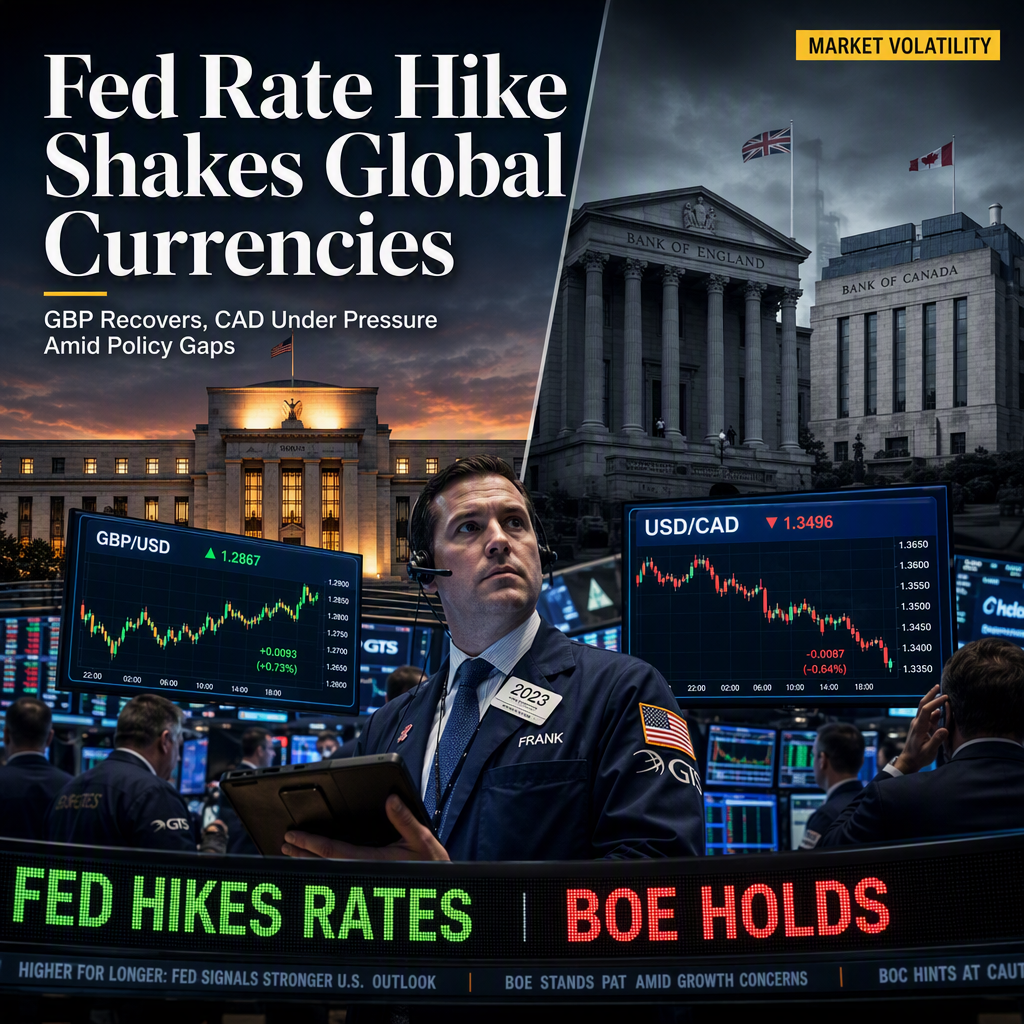
The US Federal Reserve (Fed) raised its benchmark rate by 25 basis points to a range of 3.75%–4.00% on Wednesday, marking its first hike since 2023 and the first in over three years, according to both articles [1][2]. Fed Chair Kevin Warsh emphasized persistent inflation concerns, stating, 'the plain fact is that inflation is too high and has been for too long,' and that recent inflation readings do not indicate meaningful improvement [1][2]. This hawkish stance has led traders to price in a 53.1% probability of another US rate hike at the Fed's October meeting, up from 44% a day earlier, per CME FedWatch tool data [1].
In the UK, the Bank of England's Monetary Policy Committee voted 6-3 to hold the Bank Rate at 3.75% despite inflation exceeding its 2% target. Three dissenters favored a 25 bps hike to 4.0%, and a hike of at least 25 bps is widely anticipated at the next meeting in November, according to LSEG data [1]. Strategists at Scotiabank note that the Pound is 'seeing marginal strength vs. the USD and extending its modest recovery in the aftermath of the BoE’s hawkish hold,' with yield spreads and UK fiscal signals offering renewed support [1]. However, technical analysis shows GBP/USD remains capped below key resistance levels, with a bearish near-term bias and the Relative Strength Index at 31.3, flirting with oversold territory [1].
For the Canadian Dollar, the widening US–Canada rate gap has led to CAD underperformance against the USD. The Bank of Canada maintained its key policy rate at 2.25% earlier this month, while the Fed's hike pushed the Fed/BoC policy rate differential back to 175 bps [2]. Scotiabank strategists highlight that wider front-end spreads are weighing heavily on the Loonie, and their fair value model suggests an equilibrium exchange rate of 1.3894, indicating USD overvaluation but little prospect for CAD recovery in the near term [2]. Additionally, US-Canada trade tensions have intensified, with the US imposing 50% tariffs on $20 billion of Canadian goods on August 22 and Canada retaliating with tariffs of 15% to 50% on $20 billion of US goods on September 8 [2]. This trade conflict offsets the positive impact of rising crude oil prices for the CAD [2].
Technical analysis for USD/CAD shows a constructive near-term bullish bias, with the pair breaking through the 1.3940 confluence (100-day SMA and 38.2% Fibonacci retracement). Bulls await acceptance above the 50.0% retracement at 1.3993, targeting further moves to 1.4054 (61.8%) and 1.414 (78.6%) [2]. Meanwhile, the Fed's hawkish outlook and persistent geopolitical uncertainties are expected to support the USD, favoring USD/CAD bulls [2].
CONCLUSION
The Fed's rate hike and hawkish outlook have created significant policy gaps with both the Bank of England and Bank of Canada, driving divergent moves in GBP/USD and USD/CAD. While GBP shows modest recovery amid UK fiscal optimism, CAD remains under pressure from rate differentials and trade tensions. Market sentiment is cautious, with technicals suggesting continued volatility and potential for further USD strength.