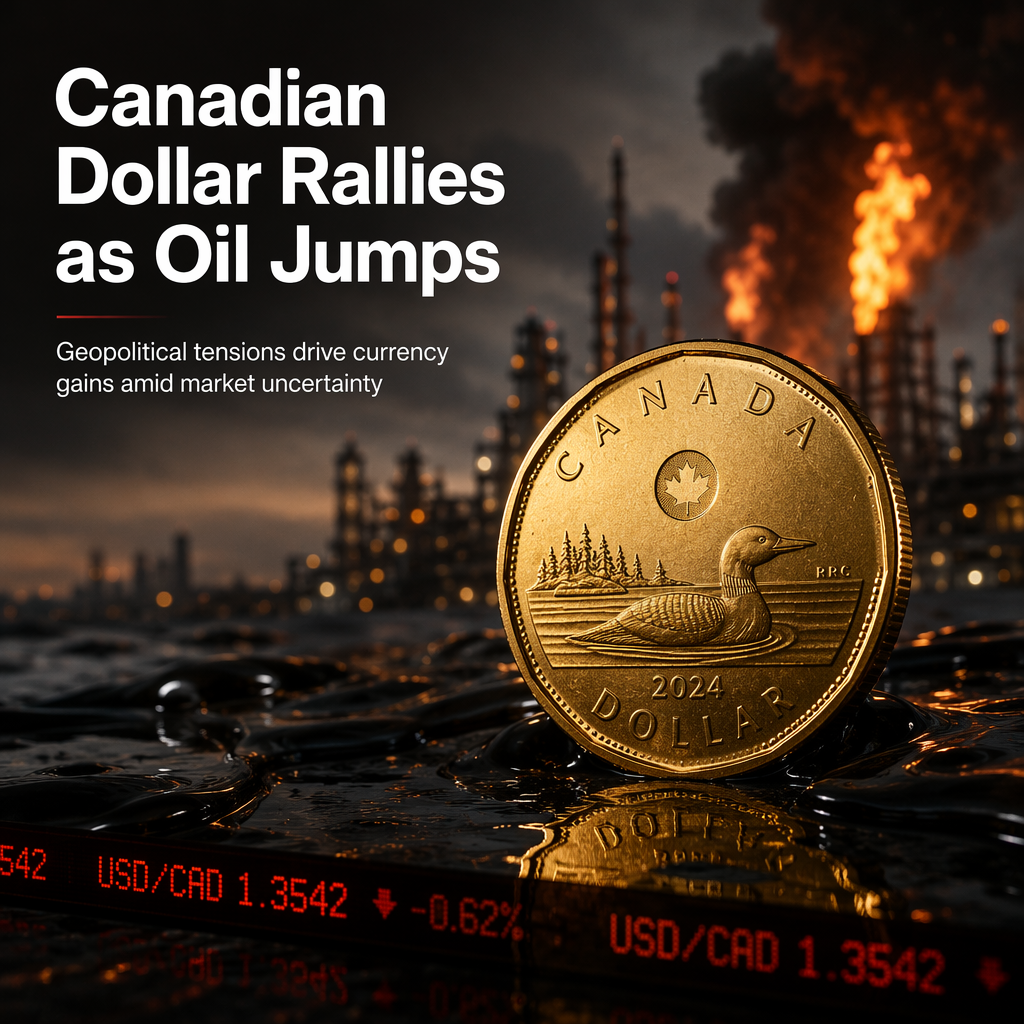
The Canadian Dollar (CAD) gained ground against the US Dollar (USD), with the USD/CAD pair extending its losses for the second consecutive day and trading around 1.4090 during European hours on Wednesday [1]. This movement was primarily driven by a rebound in oil prices, which surged following renewed hostilities in the Middle East. The escalation began when the US military reported intercepting a surprise Iranian attack targeting American troops stationed across the region. Additionally, Iran-backed militias in Iraq launched drone strikes against oil facilities in Saudi Arabia’s Eastern Region for a second consecutive day, though the extent of the damage remains unclear [1]. These attacks are believed to be retaliatory actions in response to recent US strikes on Iranian naval assets, which prompted immediate countermeasures. In response, CENTCOM executed precision airstrikes in Iraq aimed at neutralizing Iran-backed groups planning further operations against US forces and Saudi energy infrastructure [1].
The USD/CAD pair also faced downward pressure as the US Dollar struggled ahead of the Federal Reserve’s upcoming policy decision. While the Fed is widely expected to leave interest rates unchanged, traders are currently pricing in a 30.5% chance of an immediate rate hike, indicating notable uncertainty. Looking further ahead, markets are factoring in a 76.6% probability of a rate increase in September, reinforcing expectations that global borrowing costs will remain elevated for longer [1].
The article highlights that the Canadian Dollar is influenced by several factors, including oil prices, interest rates set by the Bank of Canada, and the health of both the Canadian and US economies. The recent surge in oil prices, Canada’s largest export, has provided support for the CAD amid heightened geopolitical risks and market uncertainty [1].
CONCLUSION
The Canadian Dollar has strengthened as oil prices rebounded due to renewed geopolitical tensions in the Middle East, particularly attacks on energy infrastructure. Market uncertainty ahead of the Federal Reserve’s policy decision and expectations for higher global borrowing costs have also influenced currency movements. The situation underscores the CAD’s sensitivity to both commodity prices and global risk sentiment.