
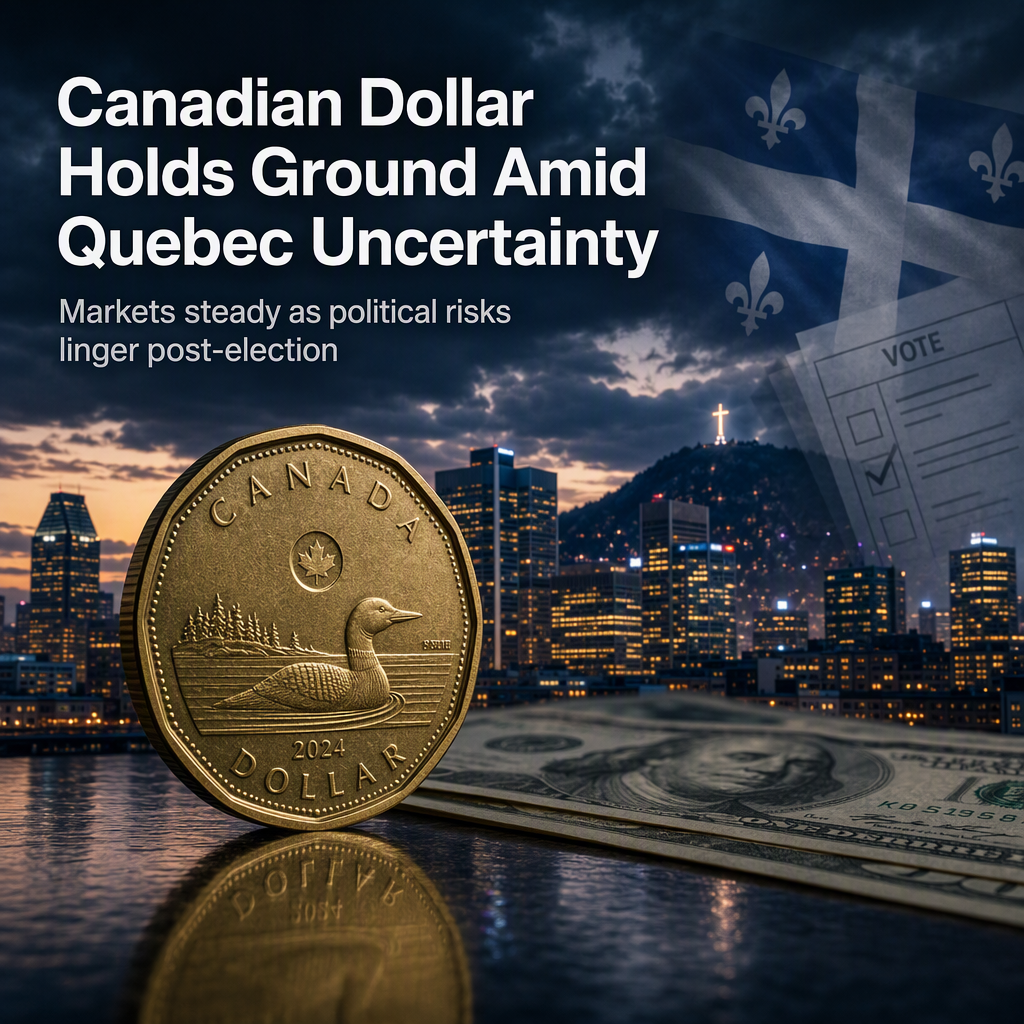
The Canadian Dollar (CAD) is trading flat against the US Dollar (USD), with markets showing little reaction to the recent provincial election in Quebec, according to Scotiabank strategists Shaun Osborne and Eric Theoret [1]. The election resulted in a minority win for the Parti Québécois (PQ), with the possibility of forming a governing majority alongside the Conservatives. Despite the lack of immediate market movement, medium-term political risks persist, particularly due to the PQ leader’s pledge to hold another secession referendum within his first four-year term, but only after the current US administration ends to avoid interference [1].
The outcome of the Quebec election has increased attention on the upcoming October 19 Alberta referendum, which is seen as a significant sentiment risk for the CAD. However, risk reversals remain relatively muted at present, indicating that the market is not yet pricing in substantial volatility related to these political developments [1].
From a technical perspective, the USD/CAD rally appears exhausted, with several bearish reversal signals observed in recent sessions. The pair has struggled to maintain levels above the mid-1.42s, and the Relative Strength Index (RSI) is noted to be extremely overbought around 80. There is limited support for USD/CAD between current levels and the psychologically important 1.40 level, suggesting potential for a pullback [1].
CONCLUSION
The Canadian Dollar remains range-bound against the US Dollar, with political risks from Quebec and Alberta serving as medium-term headwinds. While immediate market reaction is muted, technical indicators suggest the USD/CAD rally may be losing steam, and investors are closely monitoring upcoming political events for further direction.