
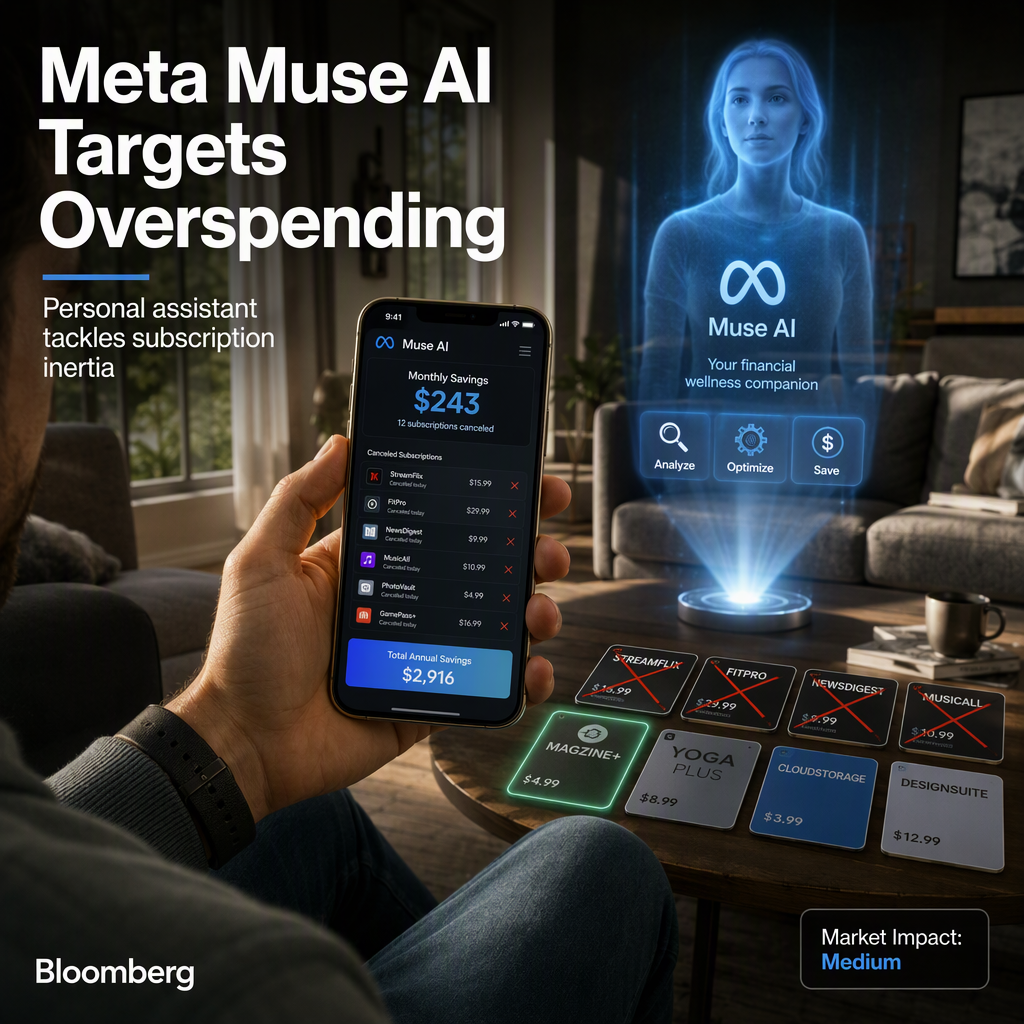
Meta Platforms Inc. launched its Muse AI agent this month, positioning it as a personal assistant with a focus on tackling the subscription economy, which has become a significant area of consumer spending growth in recent years [1]. Consumers who allowed Muse access to their banking and credit card statements found it effective as a budgeting coach, with the AI helping them identify and cancel unnecessary recurring subscriptions [1]. Americans have been increasing their subscription spending, with as many as 20 subscriptions per person and an average monthly spend of $157, according to a Mastercard and FT Strategies report published in April [1]. In 2025, 44% of U.S. consumers increased their subscription spending, raising average annual spend to $1,887 [1]. Bank of America payments data showed subscription spend rose 7.7% year-over-year in July, outpacing overall card spending, with entertainment and retail subscriptions accounting for about 43% of the total [1].
Meta's Muse AI agent addresses a longstanding issue in the subscription business model: consumer inertia and cancellation friction. Neale Mahoney, an economics professor at Stanford University, highlighted that consumers are about four times more likely to cancel subscriptions when prompted to make a decision, based on his 2025 American Economic Review paper [1]. The Stanford researchers estimated that sellers can roughly double revenue due to consumer inertia and friction in the cancellation process [1]. Mahoney noted that AI personal agents like Muse could significantly reduce these barriers, making it easier for consumers to identify and cancel forgotten or unused subscriptions [1].
While subscription-management services have existed for years, Muse integrates this capability into a broader personal assistant platform, potentially making recurring charges much easier to surface and cancel [1]. However, Mahoney pointed out that not all subscriptions are equally vulnerable; for example, physical subscriptions such as pet food are harder to forget due to the regular arrival of products [1].
The rollout of Muse could have notable implications for the subscription economy, potentially reducing revenue for businesses that rely on consumer inertia and friction to retain subscribers. The timing of Muse's launch is significant, given the continued growth in subscription spending and the increasing number of consumers who may benefit from easier management and cancellation of their subscriptions [1].
CONCLUSION
Meta's Muse AI agent is poised to disrupt the subscription economy by empowering consumers to identify and cancel unnecessary recurring charges, potentially reducing revenue for businesses reliant on consumer inertia. The integration of subscription management into a broader personal assistant platform marks a significant step in addressing overspending and friction in cancellation processes. Market impact is expected to be medium, as Muse could prompt changes in consumer behavior and subscription business models.