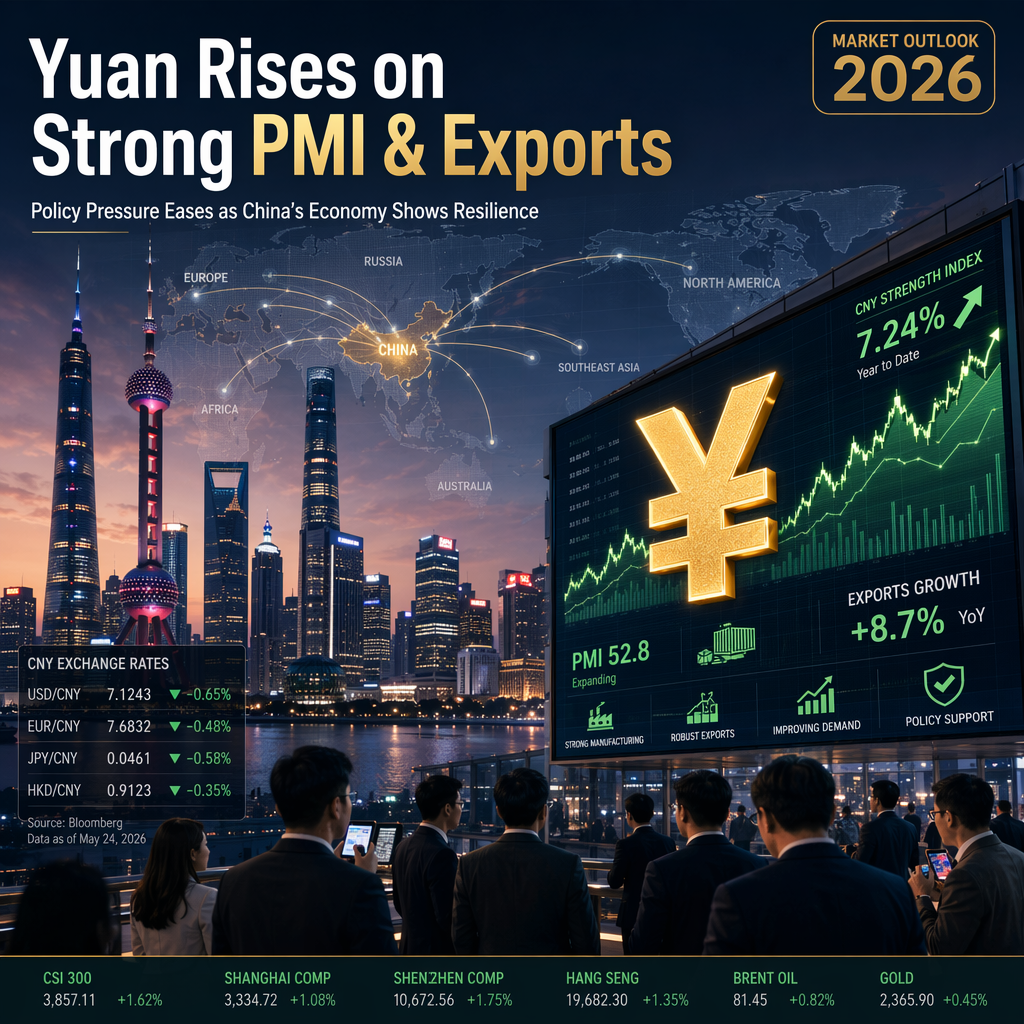
Societe Generale reports that the Chinese yuan has extended its gains following stronger-than-expected Purchasing Managers' Index (PMI) data, which signals slow but steady growth in China's economy and reduces the urgency for the People's Bank of China (PBoC) to implement further policy easing [1]. Specifically, the official manufacturing PMI rose to 50.3 in June from 50.0, while the non-manufacturing PMI increased to 50.2 from 50.1, both surpassing expectations [1]. The private RatingDog manufacturing PMI also expanded for the seventh consecutive month in June [1].
The yuan's appreciation is reflected in the USD/CNY exchange rate, which has fallen back below its 50-day moving average of 6.7938, a move attributed in part to a weaker-than-expected US Non-Farm Payrolls (NFP) report [1]. Societe Generale highlights that the yuan's strength in the first half of 2026 is underpinned by robust exports, particularly those benefiting from the global artificial intelligence (AI) boom [1]. The trade-weighted CEFTS RMB Index has climbed to its highest level since July 2022, further indicating the currency's resilience [1].
On the policy front, the National Development and Reform Commission (NDRC) has tightened oversight of fundraising activities, urging banks to avoid underwriting high-yield yuan and US dollar bonds in an effort to curb higher-cost borrowing and excessive debt financing, especially among local government financial vehicles [1]. The 10-year China Government Bond (CGB) yield rose by 3 basis points this week to 1.75% [1].
Internationally, discussions between EU trade chief Maros Sefcovic and China's commerce minister Wang Wentao in Brussels aimed to resolve ongoing trade issues, which may have implications for future trade relations [1]. Domestically, market attention is expected to shift to the upcoming Politburo meeting later this month, which could provide further policy direction [1].
CONCLUSION
Stronger-than-expected PMI data and robust export performance have bolstered the Chinese yuan, reducing immediate pressure on the PBoC to ease policy. Market participants are now focused on upcoming domestic policy meetings and ongoing international trade discussions for further direction.