
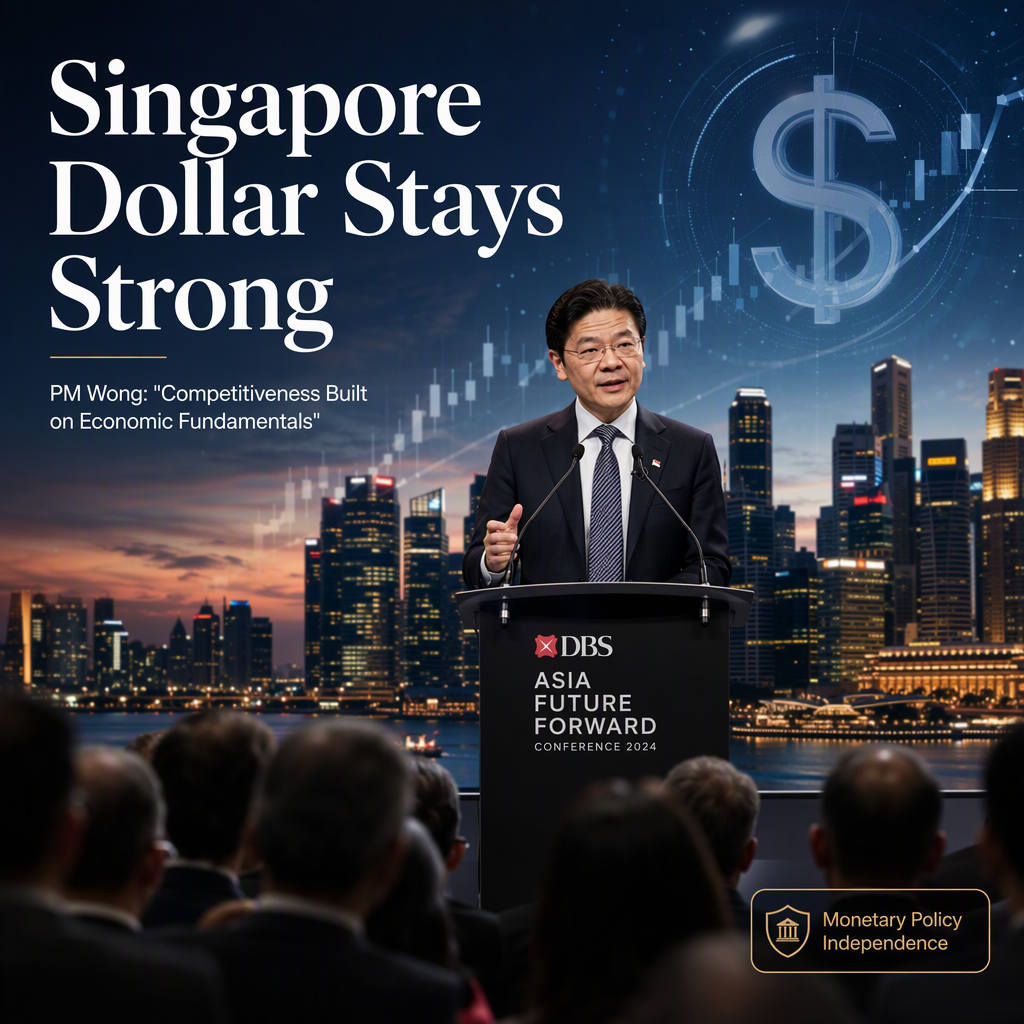
Singapore Prime Minister Lawrence Wong has firmly rejected the notion of weakening the Singapore dollar as a means to boost the country's competitiveness. Speaking at DBS's Asia Future Forward Conference in Singapore, Wong responded to comments from DBS CEO Tan Su Shan regarding Singapore's status as a safe haven and the resulting strength of its currency. Wong emphasized that Singapore must rely on its economic strengths rather than resorting to currency depreciation, stating, "You're surely not suggesting that we depress our exchange rate in order to be more competitive" [1].
Wong highlighted that the Monetary Authority of Singapore (MAS) will continue to exercise monetary policy independently, with the Singapore dollar reflecting the country's economic fundamentals. He noted that a strong and stable currency is expected if the economy performs well, and this approach helps contain imported inflation. Unlike most central banks that use interest rates, MAS manages monetary conditions through the exchange rate, pegging the Singapore dollar to a basket of currencies from major trading partners within an undisclosed policy band. This strategy is particularly important given Singapore's heavy reliance on international trade and imports [1].
The Singapore dollar has appreciated by almost 0.4% against the US dollar since the start of the year. Wong acknowledged the trade-offs of a strong currency, noting that while it helps cushion the cost of imported goods and services—especially during periods of elevated global inflation—it can also make Singaporean exports more expensive for overseas buyers, increasing pressure on exporters. He advised that companies seeking to export must factor currency strength into their cost structures, alongside other operating costs in Singapore, which remains a relatively expensive location in Southeast Asia [1].
Wong concluded that Singapore cannot compete on price alone and must differentiate itself through capabilities, stability, and predictability. He stated, "Companies are not looking for the cheapest locations. They are looking for capabilities. They are looking for stability. They are looking for predictability" [1].
CONCLUSION
Prime Minister Wong's remarks reinforce Singapore's commitment to maintaining a strong and stable currency anchored on economic fundamentals, rather than pursuing competitiveness through depreciation. This stance signals continued support for monetary independence and a focus on long-term economic strengths, with implications for exporters and businesses operating in Singapore.