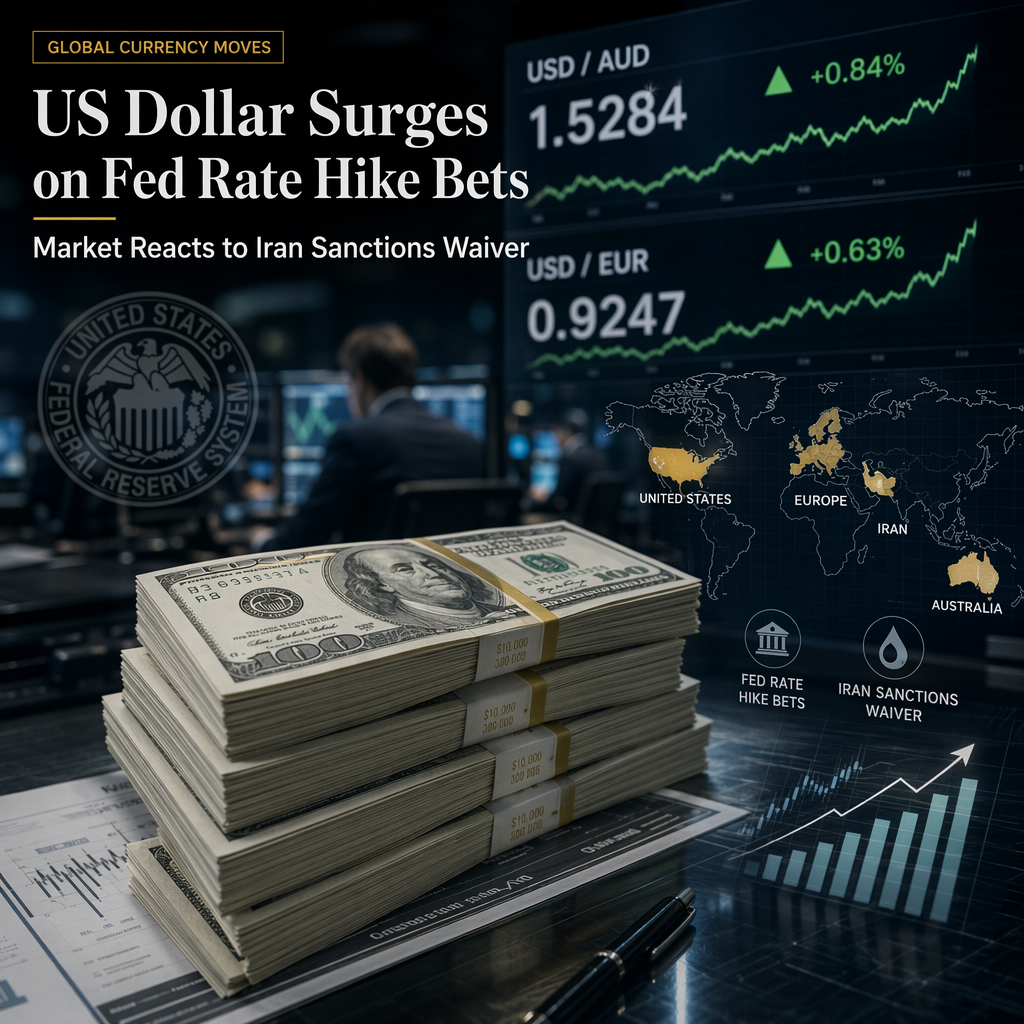
The US Dollar gained momentum on Monday, with the US Dollar Index (DXY) rising by 0.24% as investors responded to a more hawkish stance from the Federal Reserve and positive developments in US-Iran talks in Switzerland. The Australian Dollar (AUD/USD) slipped below 0.7000, retreating by 0.15%, while the Euro (EUR/USD) fell by 0.37% to 1.1428 late in the North American session, both reflecting the strengthening USD [1][2].
Money markets have priced in nearly 40 basis points of tightening for the Fed this year, and see a 45% chance of a rate hike at the July 29 meeting, according to Prime Terminal [1][2]. Commercial banks such as Bank of America and Deutsche Bank expect three and two rate hikes by the Federal Reserve in 2026, respectively, with BoFA forecasting hikes in September, October, and December, and Deutsche Bank expecting hikes in September and December [1][2]. Nearly half of Fed members are reportedly considering an interest rate increase [2].
Geopolitical developments contributed to USD strength, as the US waived sanctions on Iran for 60 days. US Vice President JD Vance described the negotiations as laying a "good foundation" for peace, though Iran denied nuclear talks. Fighting over Lebanon is reportedly ending after Iran threatened to close the Strait, prompting US President Trump to state he would resume attacks if Hormuz is shut [1][2].
In Europe, ECB President Lagarde commented that the inflation shock "is too large to ignore," but noted there is no evidence of "de-anchoring of inflation expectations or second-round effects." Her remarks were seen as modestly dovish, with the ECB's key rate not expected to exceed the neutral range of 1.75%-2.50% [2]. In Australia, upcoming inflation and jobs data are in focus, with higher inflation and unemployment potentially pressuring the RBA and increasing stagflation risks, while softer readings would ease pressure [1].
Technical analysis shows both AUD/USD and EUR/USD maintaining bearish near-term biases. AUD/USD trades at 0.6998, below key moving averages, with weak momentum signaled by the RSI slipping toward the mid-30s [1]. EUR/USD trades at 1.1428, within a downward channel and below clustered SMAs, with the RSI near oversold territory at 32 [2].
The upcoming US economic calendar includes S&P Global Flash PMIs, housing data, Q1 2026 GDP reports, the Core PCE Price Index, and Initial Jobless Claims [1][2].
CONCLUSION
The US Dollar's strength is driven by hawkish Fed expectations and easing geopolitical tensions following the US-Iran talks and sanctions waiver. Both the Australian Dollar and Euro have weakened against the USD, with technical indicators reinforcing bearish momentum. Market participants are closely watching upcoming US inflation and economic data for further direction.