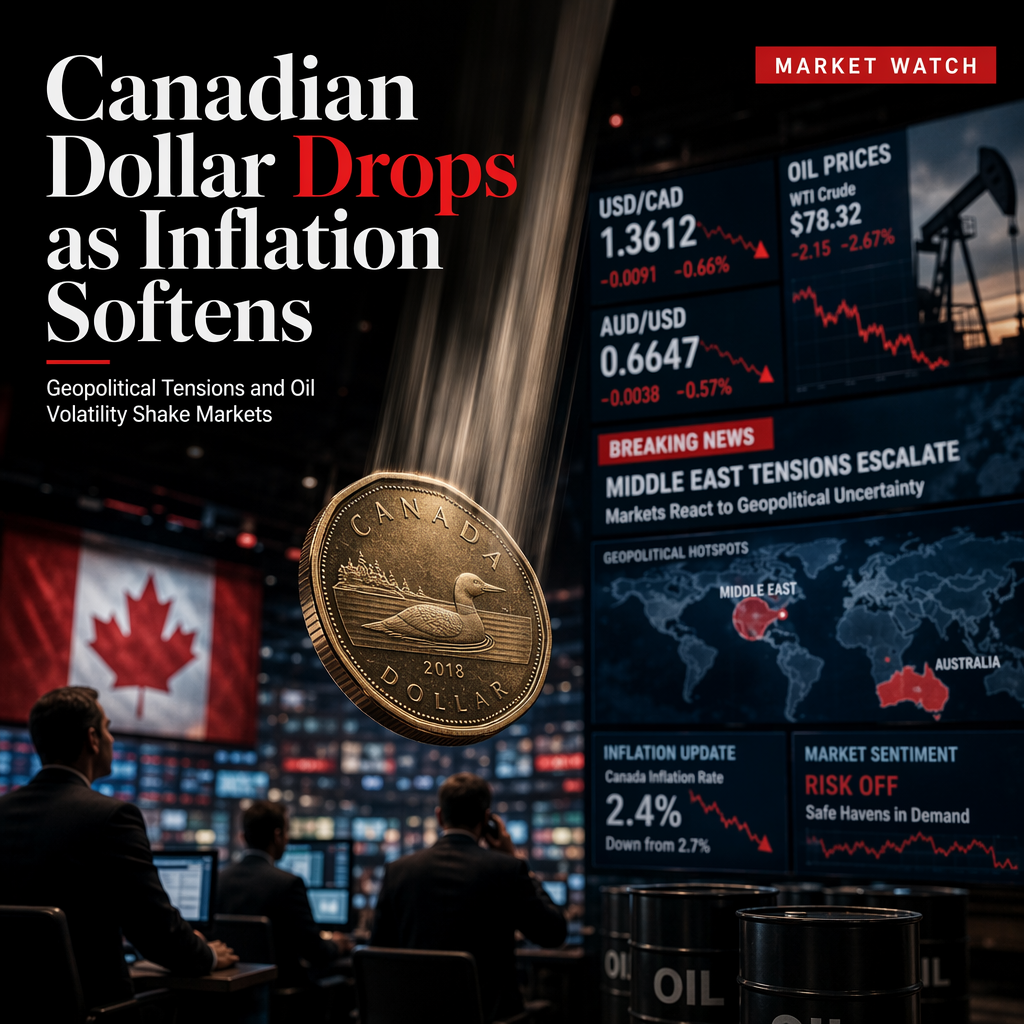
The Canadian Dollar (CAD) weakened against the US Dollar (USD) on Monday, with the USD/CAD pair trading around 1.4045, up 0.17% on the day, as softer-than-expected Canadian inflation data and a firmer US Dollar weighed on the Loonie [1]. Headline inflation in Canada fell 0.4% month-over-month in June, compared to market expectations for a 0.2% decline, reversing May’s 1.0% increase and marking the sharpest monthly fall since December 2024 [1]. On an annual basis, inflation eased to 2.8% from 3.2%, slightly below the 2.9% forecast [1]. The Bank of Canada’s preferred core CPI rose just 0.1% in June after a 0.6% increase in May, with the annual rate edging down to 2.1% from 2.2% [1].
According to Statistics Canada, slower year-over-year gasoline price increases contributed most to the slowdown in overall CPI growth [1]. Despite a sharp rebound in oil prices following renewed hostilities in the Middle East, core inflation remains near the Bank of Canada’s 2% target, supporting expectations that the central bank will maintain its current policy setting [1]. At its July meeting, the Bank of Canada raised its 2026 inflation forecast to 2.5% from 2.3% and expects inflation to return to the 2% target by early 2027 [1].
Geopolitical developments also influenced currency and commodity markets. Iranian Foreign Ministry spokesperson Esmaeil Baghaei stated that intermediaries had exchanged messages with Tehran in recent days and that any negotiations with the United States would be based on Iran's national interests [1]. These comments initially pressured oil prices and the US Dollar, as hopes for renewed diplomacy emerged [1][2]. However, the US Dollar later recovered after reports that Yemen’s Iran-aligned Houthis declared an immediate naval blockade against Saudi Arabia, though oil prices remained lower, adding pressure on the CAD [1]. West Texas Intermediate (WTI) crude oil traded around $81.00, retreating from $84.42, its highest level in over a month, while the US Dollar Index (DXY) traded near 100.90 after recovering from an intraday low of 100.65 [1].
In parallel, the Australian Dollar (AUD) appreciated against the US Dollar, with the AUD/USD pair rising above 0.7000, up more than 0.35% on the day, as risk aversion eased following the Iranian Foreign Minister’s comments [2]. The US Dollar opened the week on a weak footing, still weighed down by soft US inflation figures released last week, which dampened expectations of a Federal Reserve rate hike in July [2]. The Reserve Bank of Australia (RBA) paused rate hikes in June after three increases earlier in the year and signaled a 'wait-and-see' approach, though renewed hostilities in Iran and rebounding oil prices could add pressure for further tightening [2].
Both articles highlight the interplay between inflation data, central bank policy expectations, and geopolitical tensions in shaping currency and commodity markets. While the Canadian Dollar faces downward pressure from softer inflation and volatile oil prices, the Australian Dollar benefits from easing risk aversion and central bank policy dynamics [1][2].
CONCLUSION
Softer Canadian inflation and volatile oil prices have weakened the Canadian Dollar, while the Australian Dollar has strengthened amid easing risk aversion and central bank policy expectations. Geopolitical developments in the Middle East continue to drive market volatility, influencing both commodity and currency markets.