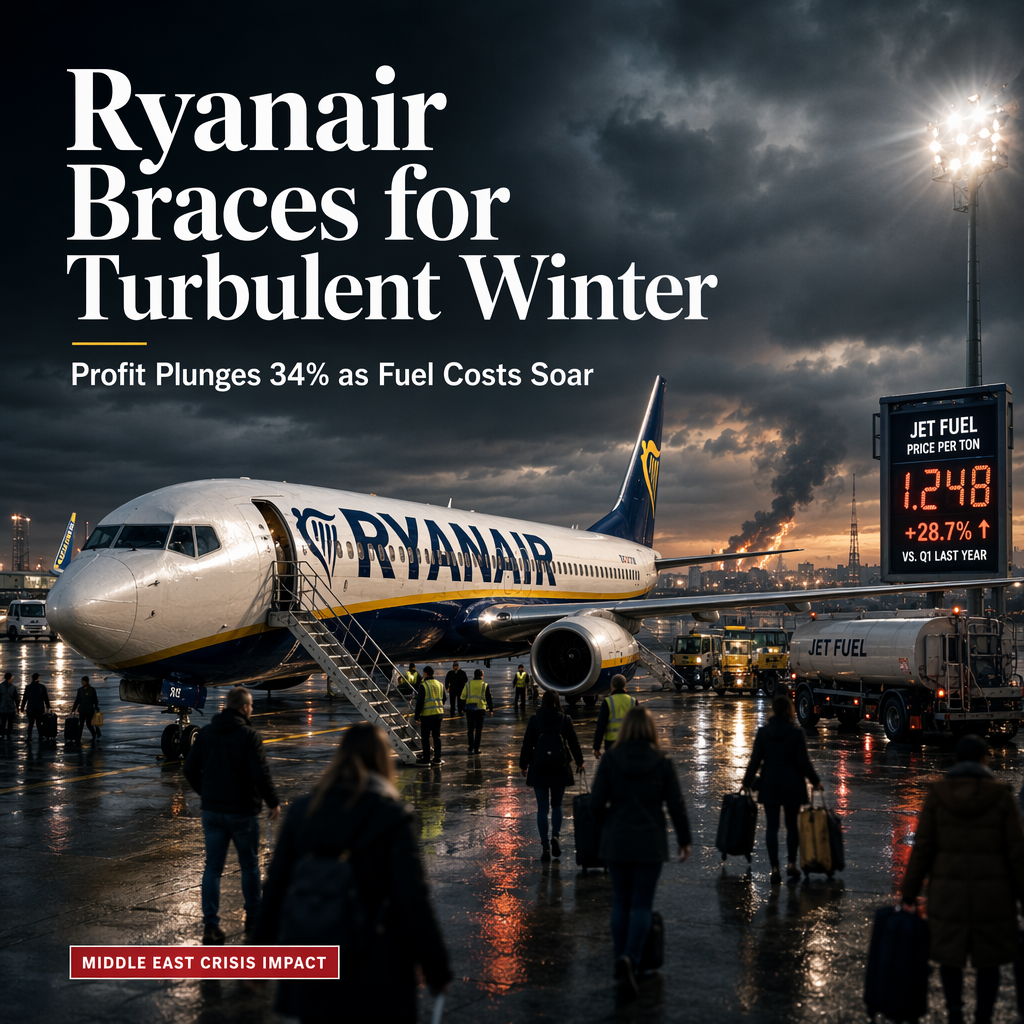
Ryanair reported a significant decline in its first-quarter profit, with profit after tax falling 34% to 538 million euros ($615.3 million) for the April to June period, compared to 820 million euros in the previous year [1]. The airline attributed this slump to rising prices for its unhedged fuel and a 6% decline in ticket fares, both of which were exacerbated by the ongoing Iran war and resulting Middle East crisis [1]. Operating costs increased by 11% to 3.81 billion euros, as the price of the company's 20% unhedged fuel more than doubled during the quarter [1].
Ryanair's CEO Michael O'Leary warned that European airlines are facing a 'difficult winter,' particularly those that are unprofitable, as consumers delay bookings due to the Middle East conflict, concerns about EU jet-fuel shortages, economic uncertainty, and later booking patterns [1]. O'Leary emphasized that Ryanair's 'conservative hedging policy' provides a cost advantage over other EU competitors, with 80% of its jet fuel for 2027 hedged at $67 per barrel and 15% for 2028 at $85 per barrel [1]. However, 20% of its fuel remains exposed to price spikes [1].
The company issued conservative guidance for the remainder of its financial year, noting that operating costs are highly dependent on the price of unhedged jet fuel and that profit after tax remains 'highly sensitive' to adverse geopolitical developments, including escalating conflicts in the Middle East and Ukraine [1]. O'Leary stated that Q2 pricing is trending modestly down year-on-year, and the final H1 fare outcome will depend on the strength of close-in bookings in August and September [1]. He also noted that there is 'zero H2 visibility,' making it too early to provide meaningful guidance for FY27 profit after tax [1].
The average price of jet fuel surged to $127 per barrel for the week ending July 10, up 41% from the prior year, according to the International Air Travel Association's Jet Fuel Price Monitor [1]. The International Energy Agency has warned that Europe could run out of jet fuel in a matter of weeks, as the majority of its imports come from the Middle East [1]. O'Leary previously told CNBC that if jet fuel prices remain elevated, competitors could face 'failures' [1].
CONCLUSION
Ryanair's Q1 results highlight the severe impact of rising fuel costs and geopolitical instability on the airline industry. With profits down sharply and ongoing uncertainty in the Middle East, Ryanair is bracing for a challenging winter and has issued cautious guidance. The company's hedging strategy offers some protection, but the broader market faces significant risks from fuel price volatility and consumer hesitancy.