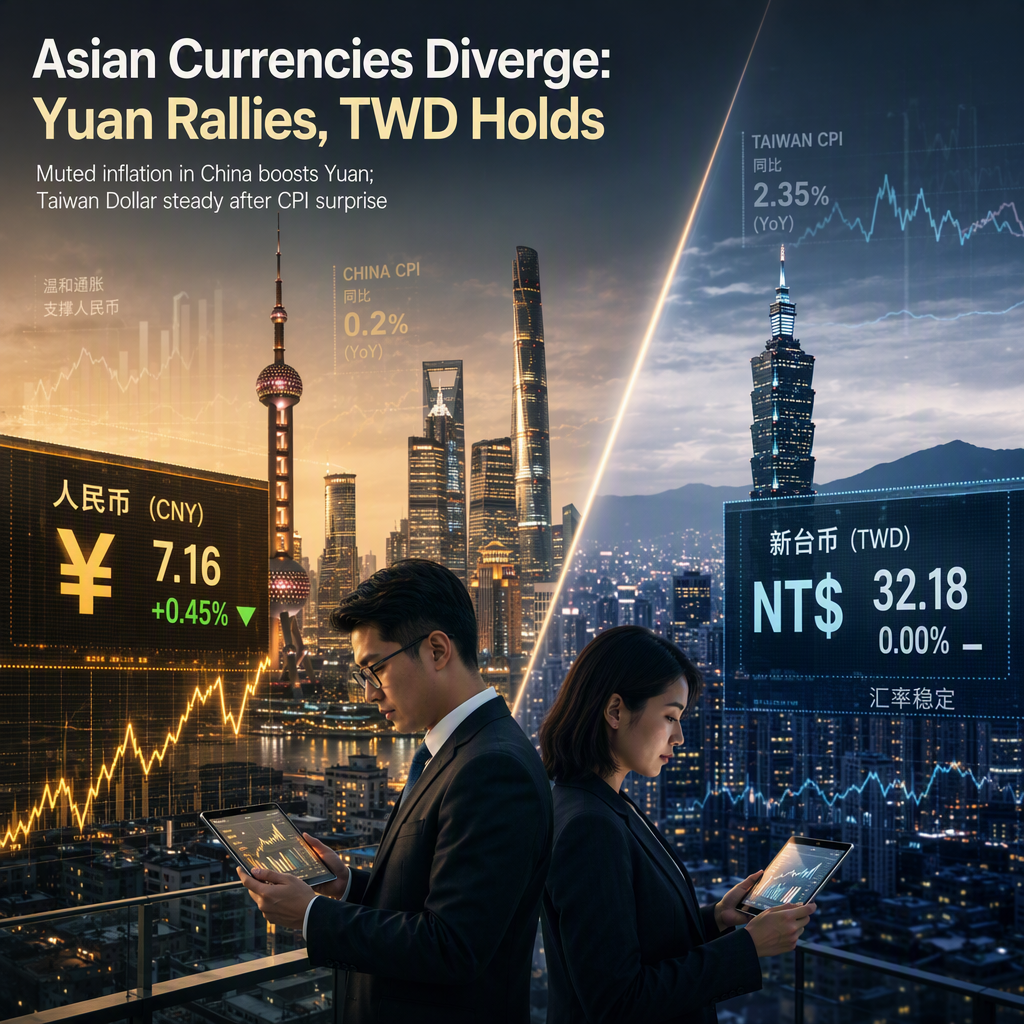
Recent inflation data from China and Taiwan have influenced the trajectories of their respective currencies against the US Dollar. In China, the USD/CNH pair continued its downward trend, reaching its lowest level since January 2023. This movement followed the release of August Consumer Price Index (CPI) data, which showed a modest rise of 0.8% year-on-year, in line with consensus and up from 0.5% in July. The increase was driven by communication equipment and energy prices. Notably, both core CPI and Producer Price Index (PPI) exceeded expectations, coming in at 1.0% y/y (consensus: 0.9%, prior: 0.9%) and 3.8% y/y (consensus: 3.6%, prior: 3.5%), respectively. Despite these increases, overall inflation remains subdued, with firms facing limited pricing power and squeezed profit margins due to the gap between CPI and PPI. Analysts at Brown Brothers Harriman (BBH) suggest that continued appreciation of the Chinese Yuan could support a shift toward consumption-led growth by boosting disposable income through cheaper imports, maintaining the USD/CNH downtrend [1].
In Taiwan, August CPI surprised to the downside, rising by 2.0% year-on-year (Bloomberg consensus: 2.4%) compared to 2.5% in July, marking the lowest reading since April. The moderation was attributed to softer food inflation, though headline inflation remained slightly above the Central Bank of the Republic of China's (CBC) 2% target for the first time in four months. Core CPI also eased to 2.3% (consensus: 2.5%) from 2.4% in July, but stayed above the CBC's 2026 forecast of 1.9% for the fourth consecutive month. Commerzbank notes that the CBC may consider a modest 12.5 basis point rate hike to 2.125% at its next quarterly meeting on 17 September, given robust economic growth and persistent inflation risks. The bank expects USD/TWD to consolidate within the 31.30–31.80 range in the near term, with JPY strength providing support but higher oil prices capping gains. As of yesterday, USD/TWD was little changed around 31.55, near a three-month low, amid broad USD weakness and sustained portfolio inflows. Foreign investors have net bought USD4.2 billion of Taiwanese equities over the past two sessions, and the Taiex index is up 62.6% year-to-date, making it Asia's second-best performing equity index after South Korea's Kospi (+65.0%) [2].
Looking ahead, analysts highlight that while Taiwan's headline inflation moderated, the decline was largely due to temporary food base effects, which may fade in the coming months. Weather-related supply risks and renewed geopolitical uncertainty could keep food and energy inflation elevated, suggesting the balance of risks remains tilted toward further modest tightening by the CBC [2]. In China, the subdued inflation environment and continued Yuan strength are seen as supportive of a transition toward more consumption-driven growth [1].
CONCLUSION
China's muted inflation and continued Yuan appreciation signal a shift toward consumption-led growth, while Taiwan's softer-than-expected CPI keeps the Taiwan Dollar in a consolidation range amid robust equity inflows. Both central banks face nuanced inflation dynamics, with China's subdued price pressures supporting currency strength and Taiwan's persistent core inflation keeping the door open for further policy tightening.