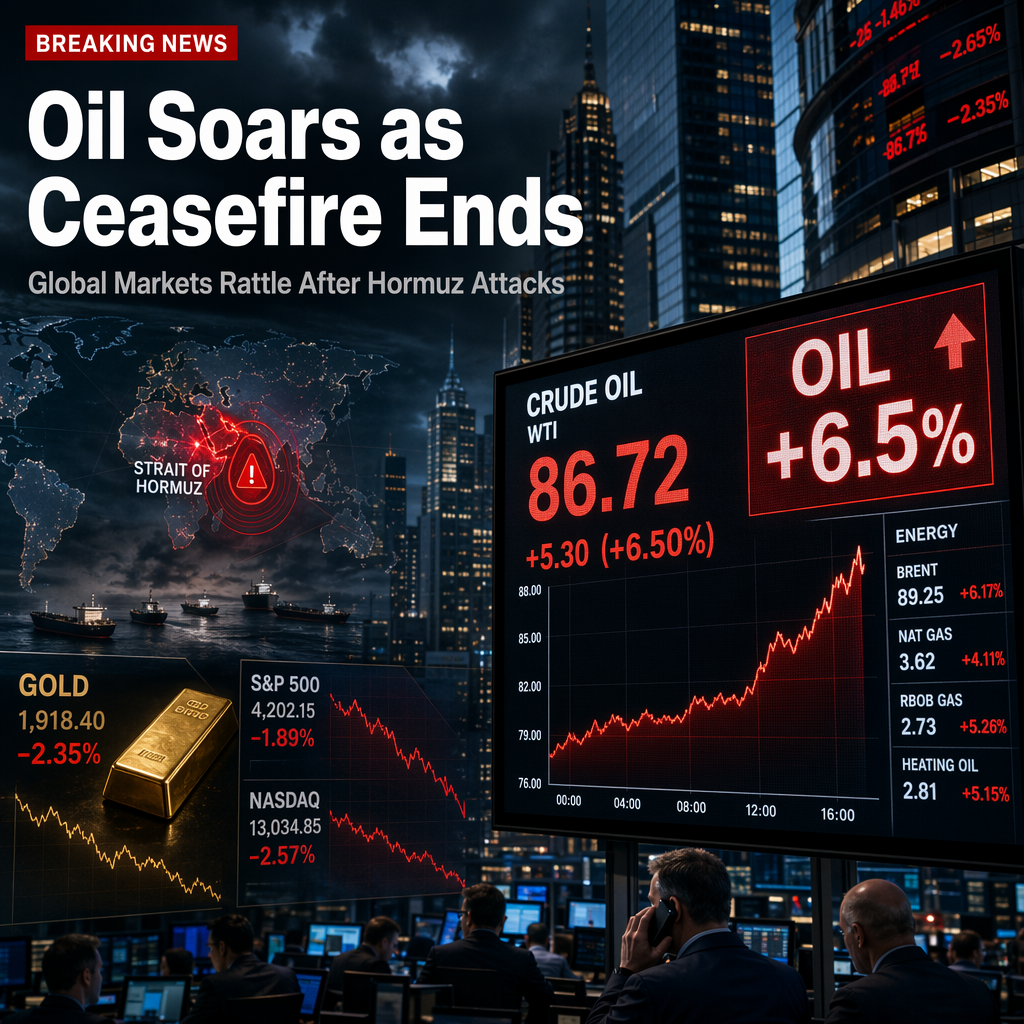
A sharp escalation in geopolitical tensions between the United States and Iran rattled global markets on Wednesday after U.S. President Donald Trump declared the ceasefire agreement with Iran 'over' following reciprocal attacks, including strikes on three oil tankers near the Strait of Hormuz [1][2][3][4]. Trump stated, 'To me, I think it’s over,' and added that while negotiations could continue, he considered them a 'waste of time' [1][2][4]. The U.S. responded by revoking Iran's authorization to export crude oil and launching military strikes against Iranian infrastructure [1][2][4].
The immediate market reaction was pronounced. Oil prices surged more than 6%, with U.S. crude jumping 6.5% to $75 per barrel and Brent rising 6.2% to nearly $79 per barrel, marking the largest one-day move since early June [4]. This spike halted the recent decline in U.S. gasoline prices, which had fallen from $4.56 per gallon in May to $3.79 but remained flat over the last two days [4]. Heating oil, a proxy for jet fuel, climbed 2% [4]. Airline stocks were among the hardest hit, with Delta and Southwest Airlines dropping 3%, United Airlines falling 3.5%, and cruise operators like Carnival and Royal Caribbean down nearly 4% [4].
Global equity markets reacted negatively, with U.S. stock futures pointing to a drop of more than 1% for the S&P 500, 1.5% for the Nasdaq 100, and over 710 points for the Dow [4]. European indexes also fell sharply, with Spain, Germany, and France down 2%, and Italy and the U.K. off by around 1.5% [4]. The New Zealand Dollar (NZD) and Euro (EUR) both lost ground against the U.S. Dollar (USD), as risk appetite diminished and investors sought safe-haven assets [1][3]. The NZD's earlier rally, spurred by a 25 basis point rate hike from the Reserve Bank of New Zealand to 2.5%, was quickly reversed as risk-off sentiment prevailed [1].
Gold prices declined 1.40% to around $4,050 per ounce, as elevated U.S. Treasury yields and a stronger USD outweighed gold's safe-haven appeal [2]. Market participants expressed concern that persistent geopolitical risks and higher energy prices could keep U.S. monetary policy restrictive, with attention turning to the release of the Federal Reserve's June meeting minutes for further guidance [2][3]. Technical analysis of EUR/USD suggested a potential bearish flag formation, with momentum indicators turning negative and the pair trading just above 1.1400 [3].
According to Capital.com analyst Daniela Ha, 'Renewed tensions in the Middle East have interrupted what had become an increasingly complacent market narrative, prompting investors to reassess geopolitical risks after several weeks of pricing in a smooth path toward de-escalation' [4]. Forward-looking statements from the Reserve Bank of New Zealand indicated openness to further monetary tightening, while investors awaited the Federal Reserve's minutes for clues on future U.S. policy moves [1][2][3].
CONCLUSION
The abrupt end to the U.S.-Iran ceasefire and subsequent military and economic actions triggered a surge in oil prices, a sell-off in global equities, and a flight to the U.S. Dollar. Market sentiment turned sharply risk-off, with investors bracing for continued volatility as they await further central bank guidance. The episode underscores the market's sensitivity to geopolitical developments and their potential to disrupt recent trends.