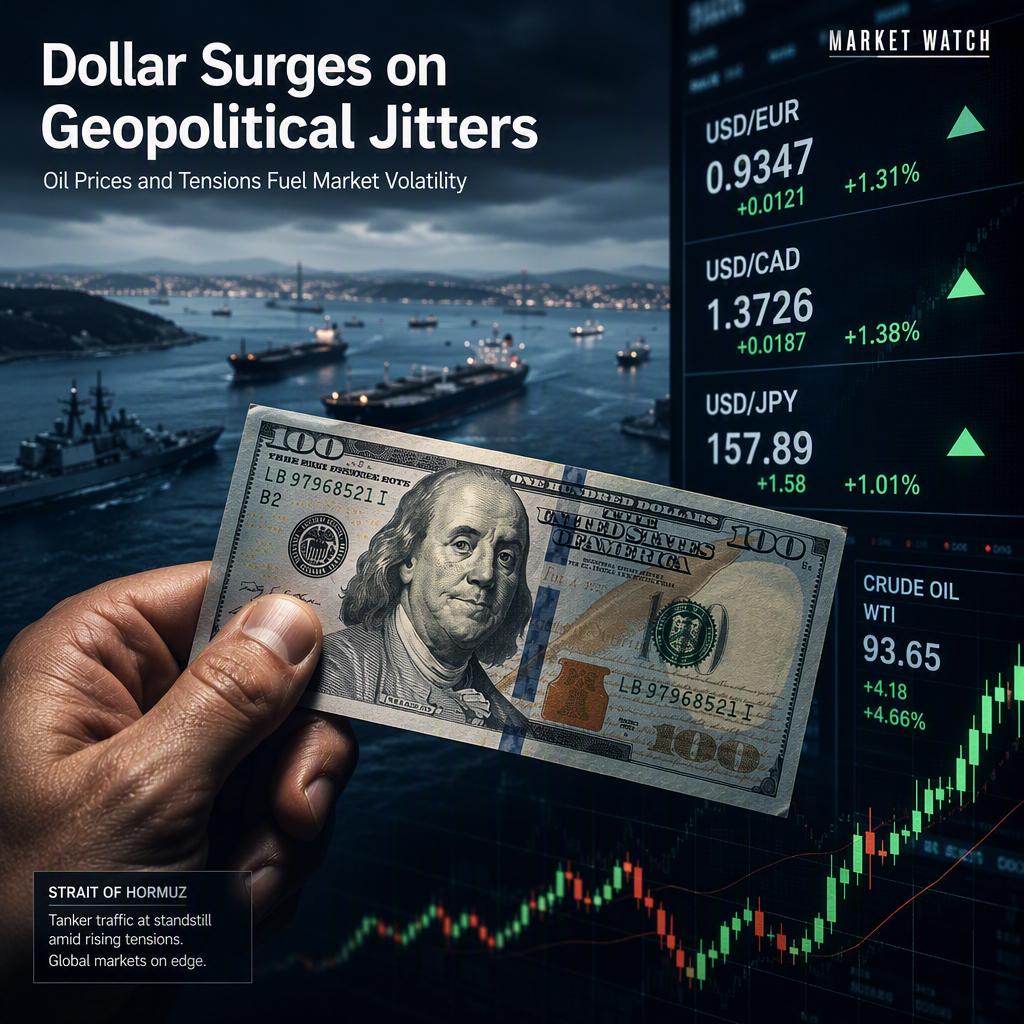
The US Dollar (USD) extended its gains against major currencies, including the Euro (EUR), Canadian Dollar (CAD), and Japanese Yen (JPY), as renewed safe-haven demand was fueled by escalating geopolitical tensions in the Middle East, particularly in the Strait of Hormuz [1][2][3]. The EUR/USD pair traded around 1.1520, marking its second consecutive day of losses, while USD/CAD hovered near 1.4020, and USD/JPY consolidated near the mid-158.00s after a week of recovery gains [1][2][3].
Market volatility surged as Iran's parliament reviewed a draft proposal to prohibit US and Israeli vessels from the Strait of Hormuz, impose a 20% cargo penalty on hostile nations, and maintain restrictions until the US blockade is lifted [1][2][3]. Additionally, Saudi Arabia cited intelligence reports of an imminent attack by Iraqi militias, coordinated with the Houthis in Yemen, further heightening geopolitical risks [3]. These developments have cast doubt on efforts to reopen the vital shipping corridor and have contributed to a rebound in crude oil prices, which in turn stoked inflation fears and speculation about further central bank tightening [1][2][3].
Rising US Treasury yields and hawkish rhetoric from Federal Reserve (Fed) officials, including Musalem and Chair Warsh, have reinforced expectations of potential rate hikes if inflation accelerates [2]. The CME FedWatch Tool indicated a 54.5% probability of a 25-basis-point Fed rate hike in September, down from 63.4% the previous week, as markets await the July Nonfarm Payrolls (NFP) report for further guidance on the Fed's policy path [1][2][3]. The FXS Fed Sentiment Index remained elevated at 138.69, and Musalem's FXS Speechtracker score was 7.4/10, both signaling a hawkish bias [2].
In the Eurozone, economic data showed retail sales contracted by 0.3% month-on-month in June, missing expectations for a 0.1% increase and nearly erasing May's 0.4% gain. Annual growth slowed to 0.7%, the weakest since July 2024, below the expected 1.0% and down from May's 1.9% [1]. The European Central Bank (ECB) recently held rates steady, with markets pricing in only one more hike by year-end and a roughly 40% chance of a second [1]. ECB's Kocher delivered a slightly less forceful speech (5.6/10 on FXS Speechtracker), but emphasized vigilance regarding energy-driven inflation risks and a data-dependent approach [1].
In Japan, the Yen remained under pressure due to weak domestic data and fiscal concerns. Household spending fell 3.3% year-on-year in June, marking the seventh consecutive month of contraction and defying expectations for a rise. This persistent weakness undermines the case for a Bank of Japan rate hike in September, favoring USD/JPY bulls [3].
Despite the USD's broad strength, the CAD found some support from rising oil prices, as Canada is a major crude exporter, though this was not enough to offset the Greenback's safe-haven appeal [2].
CONCLUSION
The US Dollar's safe-haven status was reinforced by escalating Middle East tensions and rising oil prices, driving losses in the Euro, Canadian Dollar, and Japanese Yen. Market focus now shifts to the upcoming US Nonfarm Payrolls report, which will be pivotal for the Fed's next policy move. Persistent inflation risks and geopolitical uncertainty are likely to keep volatility elevated in the near term.