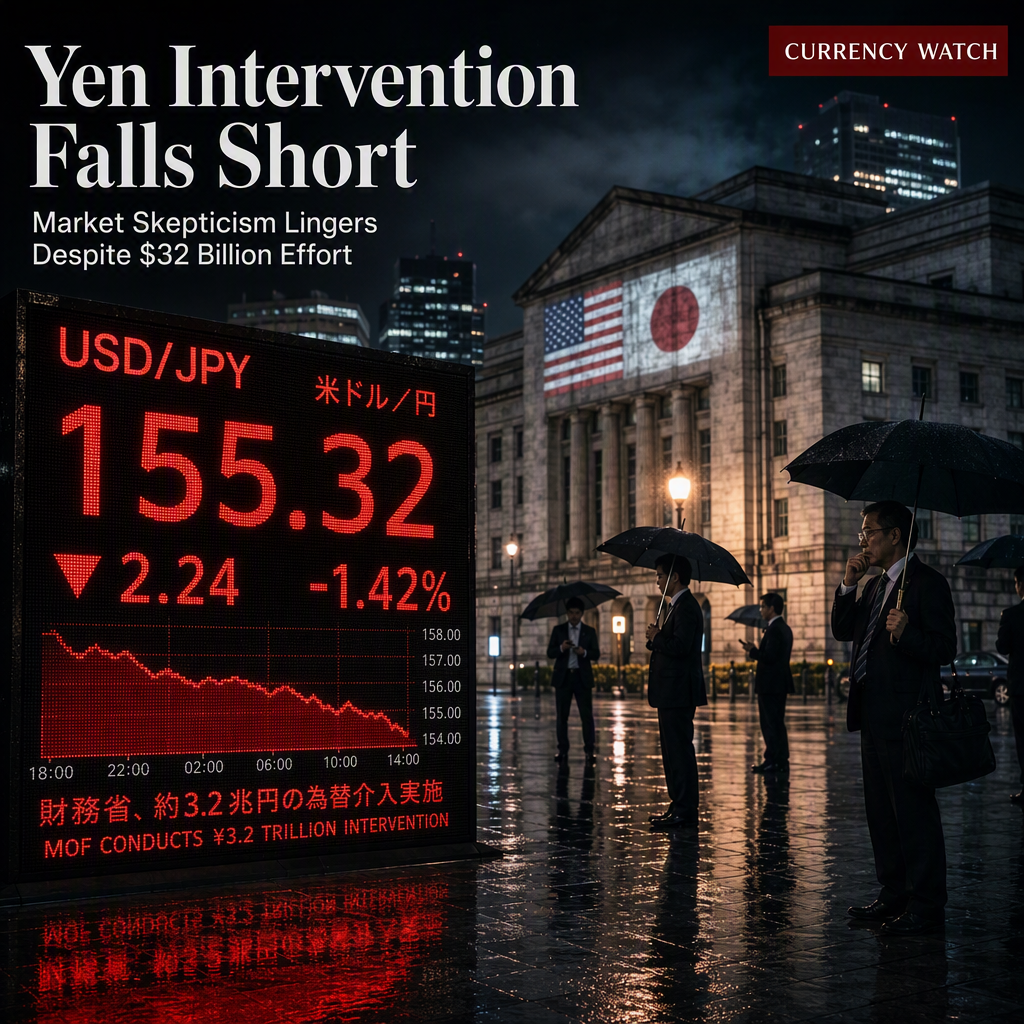
Last week, Japan and the U.S. conducted a coordinated market intervention aimed at propping up the yen, but the effort has had limited impact on reversing the currency's downward trajectory [1]. Despite reportedly spending up to $32 billion in the latest round of intervention, the yen remains under pressure and continues to trade near multi-decade lows against the U.S. dollar [1]. Market participants and analysts attribute the intervention's limited effectiveness to persistent doubts about the credibility and sustainability of Japan's fiscal and monetary policy [1].
Traders and analysts specifically cite skepticism regarding the Bank of Japan's (BOJ) commitment to tighter monetary policy and the government's willingness to address fiscal imbalances as key factors undermining confidence in the yen [1]. A Tokyo-based foreign exchange strategist commented, 'Without a clear change in fiscal or monetary policy, interventions will be seen as merely buying time. The market wants to see more concrete steps from the BOJ and the government' [1].
Technical analysts warn that key support levels for the yen remain vulnerable, and unless the BOJ signals a willingness to raise rates or tighten liquidity, the currency's downward trend could resume [1]. Market sentiment suggests that further interventions, in the absence of significant policy shifts, may only provide temporary relief [1].
Overall, the intervention has highlighted ongoing doubts about Japan's policy direction, and the market is expected to remain cautious, with traders closely monitoring for any signs of a fundamental shift in Tokyo's approach to fiscal and monetary management [1].
CONCLUSION
The coordinated intervention by Japan and the U.S. has failed to deliver a sustained recovery for the yen, reflecting deep market skepticism about Japan's fiscal and monetary policy direction. Unless Japanese authorities implement more concrete policy changes, market participants are likely to view future interventions as temporary measures with limited long-term impact.