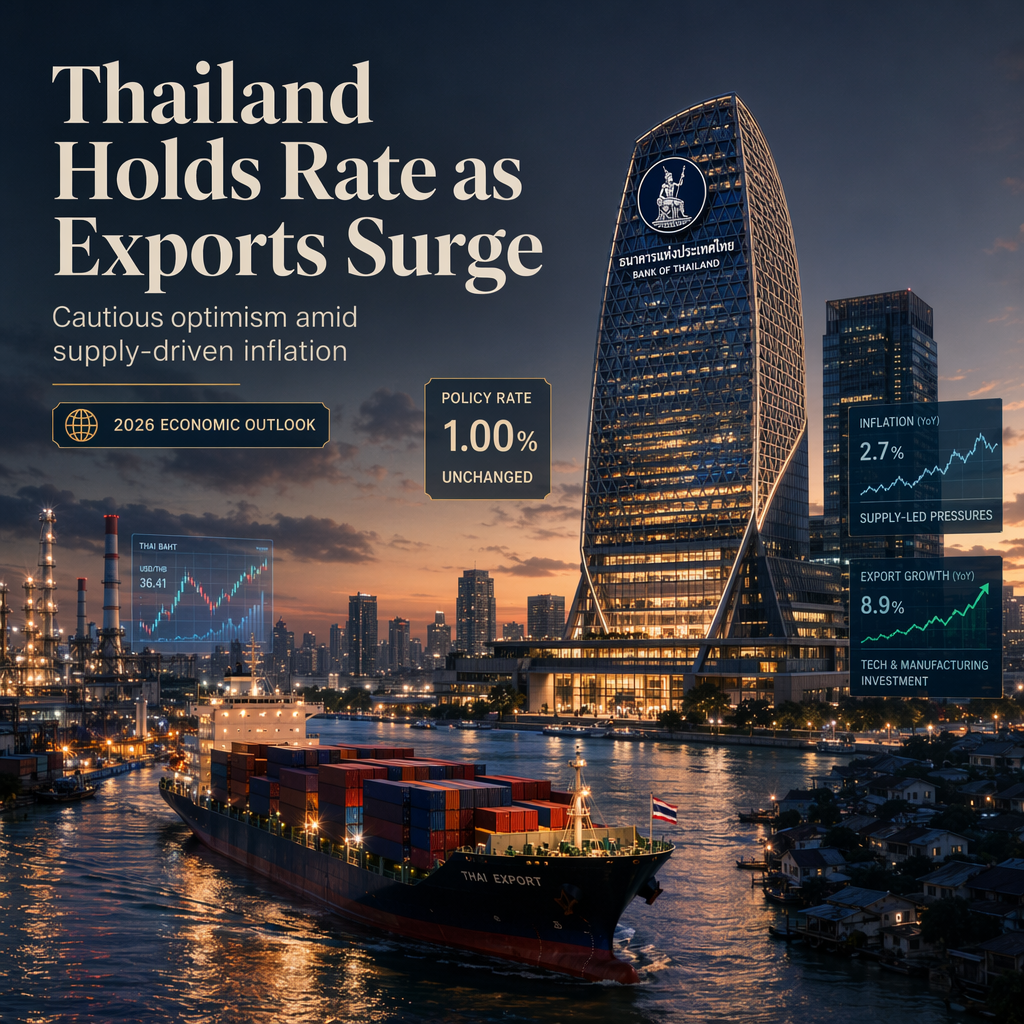
Thailand's economy began the second quarter of 2026 on a stronger note than previously anticipated, according to UOB economists Enrico Tanuwidjaja and Sathit Talaengsatya. The rebound is attributed primarily to robust exports and increased technology-linked investment, while domestic demand remains subdued [1]. The Bank of Thailand (BOT) maintained its policy rate at 1.00% following a unanimous decision in June, reflecting a cautious but stable monetary stance [1].
The BOT revised its GDP growth forecasts, projecting 2.3% for 2026 and 1.8% for 2027. This adjustment signals optimism for the near-term outlook but a more guarded view for the following year, as the current recovery is not yet broad-based or self-sustaining. The economists note that while April and May data have reduced recession risks and increased the likelihood of stronger 2026 growth, the domestic economy's health remains in question due to lagging household demand [1].
Inflation in Thailand is described as supply-led, driven by higher oil, freight, transport, and input costs, which have elevated headline inflation but left core inflation contained. As a result, UOB expects the BOT to keep its policy rate unchanged at 1.00% through 2026 and 2027, favoring a prolonged hold over a new easing cycle [1].
Looking ahead, UOB suggests that the next forecast should reassess the growth and inflation trajectory, with a bias toward stronger growth in 2026 due to positive surprises in exports, investment, and fiscal support, but a more cautious outlook for 2027 as the effects of front-loading and stimulus measures diminish [1].
CONCLUSION
Thailand's economic outlook has improved for 2026, driven by exports and investment, but domestic demand remains weak. The BOT is expected to maintain its policy rate at 1.00% through 2027, as inflation pressures are seen as supply-driven and growth prospects for 2027 are more uncertain.