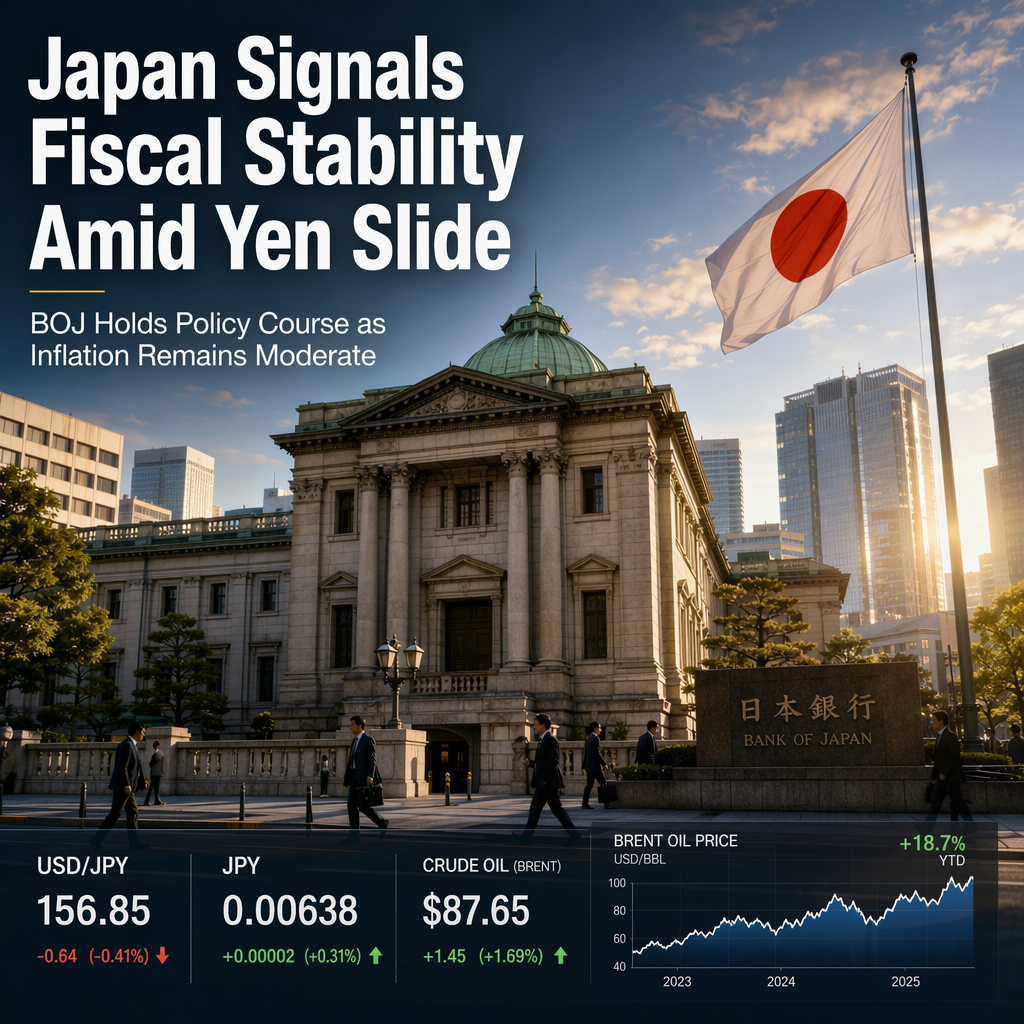
Japan's Economy Minister Minoru Kiuchi stated on Friday that the government is consistently signaling its commitment to fiscal sustainability, emphasizing that there has been no shift in the government's stance regarding fiscal policy. Kiuchi clarified that decisions on monetary policy tools remain the prerogative of the Bank of Japan (BOJ) [1]. He noted that the effect of the weak yen on local inflation is delayed and not necessarily significant, while wholesale prices have been climbing due to recent increases in oil prices. However, consumer inflation remains moderate [1].
At the time of reporting, the USD/JPY currency pair was up 0.01% on the day at 162.40, indicating a slight movement in the foreign exchange market following Kiuchi's comments [1]. The BOJ, which sets monetary policy in Japan, has a mandate to ensure price stability with an inflation target of around 2%. After years of ultra-loose monetary policy, including Quantitative and Qualitative Easing (QQE) and negative interest rates, the BOJ lifted interest rates in March 2024, signaling a retreat from its previous stance [1].
The BOJ's previous stimulus measures contributed to the depreciation of the yen against other major currencies, especially as other central banks raised interest rates to combat high inflation. This trend began to reverse in 2024 when the BOJ started unwinding its ultra-loose policy, prompted by a weaker yen and rising global energy prices that pushed Japanese inflation above the 2% target. The prospect of rising salaries also played a role in this policy shift [1].
Kiuchi's remarks reinforce the government's commitment to fiscal sustainability and clarify that monetary policy decisions remain with the BOJ, suggesting continued stability in policy direction. The moderate consumer inflation and delayed impact of the weak yen on local prices indicate that immediate market disruptions are unlikely, though the ongoing rise in wholesale prices due to oil may warrant attention [1].
CONCLUSION
Japan's government remains committed to fiscal sustainability, with monetary policy decisions firmly in the hands of the Bank of Japan. While the yen remains weak and wholesale prices are rising, consumer inflation is still moderate, suggesting limited immediate market impact. The slight uptick in USD/JPY reflects cautious market sentiment following the reaffirmation of policy stability.