
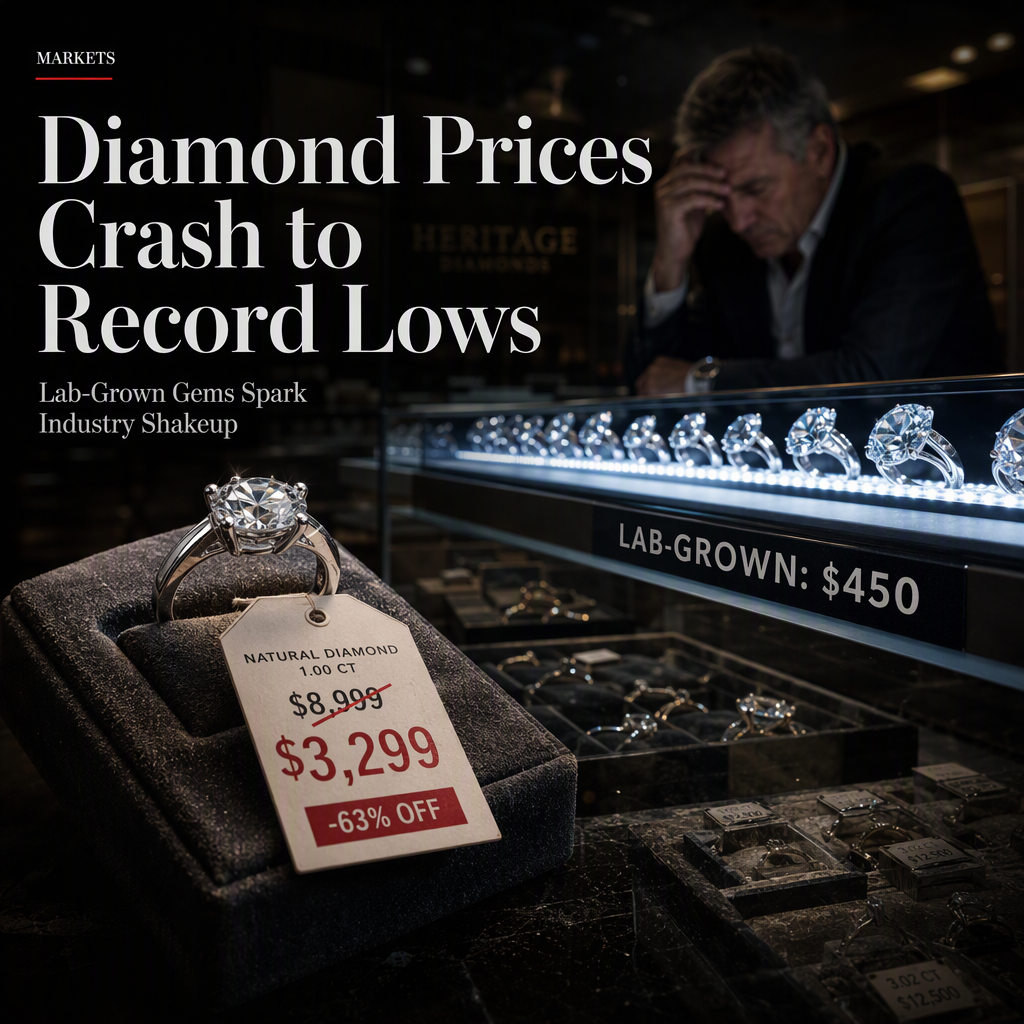
Natural diamond prices have fallen to record lows, with the average price of a 1-carat stone now at $3,898—representing a 51% decline from $8,007 in 2021, according to Rapaport Group data [1]. The Diamond Standard Index, which tracks investment-grade diamond prices, reached its lowest level ever at 2,490 in early August 2026 and was just above 2,500 this week [1]. This dramatic price drop is attributed to a combination of factors, including a persistent oversupply of mined diamonds and the rapid rise of lab-grown alternatives [1].
Industry experts, such as Diamond Standard CEO Cormac Kinney, point to a significant inventory overhang from 2023 and 2024, following excess production during the Covid period, as well as declining sales due to the popularity of lab-grown diamonds [1]. Lab-grown diamonds, which are chemically and physically identical to natural stones, are significantly cheaper; for example, a nearly colorless lab diamond with excellent cut can be purchased for $450, compared to $2,800 to $3,200 for a natural stone with similar specifications [1]. In some cases, lab-grown stones are priced up to 90% lower than their mined counterparts, depending on size, cut, and color [1].
This price advantage has led to a surge in consumer demand for lab-grown diamonds, especially among those seeking affordable options for engagement and fashion jewelry. In 2025, engagement rings with lab-grown center stones accounted for 61% of all engagement ring sales, a 239% increase since 2020, according to The Knot 2026 Real Weddings Study [1]. The lab-grown diamond market is projected to reach nearly $92 billion by 2034, up from $29.46 billion in 2025, reflecting more than 200% growth, according to Fortune Business Insights [1].
Industry voices caution against viewing diamonds as a financial investment. Cory Schifter, owner of Casale Jewelers, stated, "You shouldn't be buying a diamond thinking that there's a financial investment [aspect] to it" [1].
CONCLUSION
Natural diamond prices have collapsed due to oversupply and the rapid adoption of lab-grown alternatives, which offer similar quality at a fraction of the price. With lab-grown diamonds capturing a majority share of the engagement ring market and projected to see continued growth, the outlook for natural diamond prices remains pressured. Industry experts warn consumers not to view diamonds as a reliable investment.