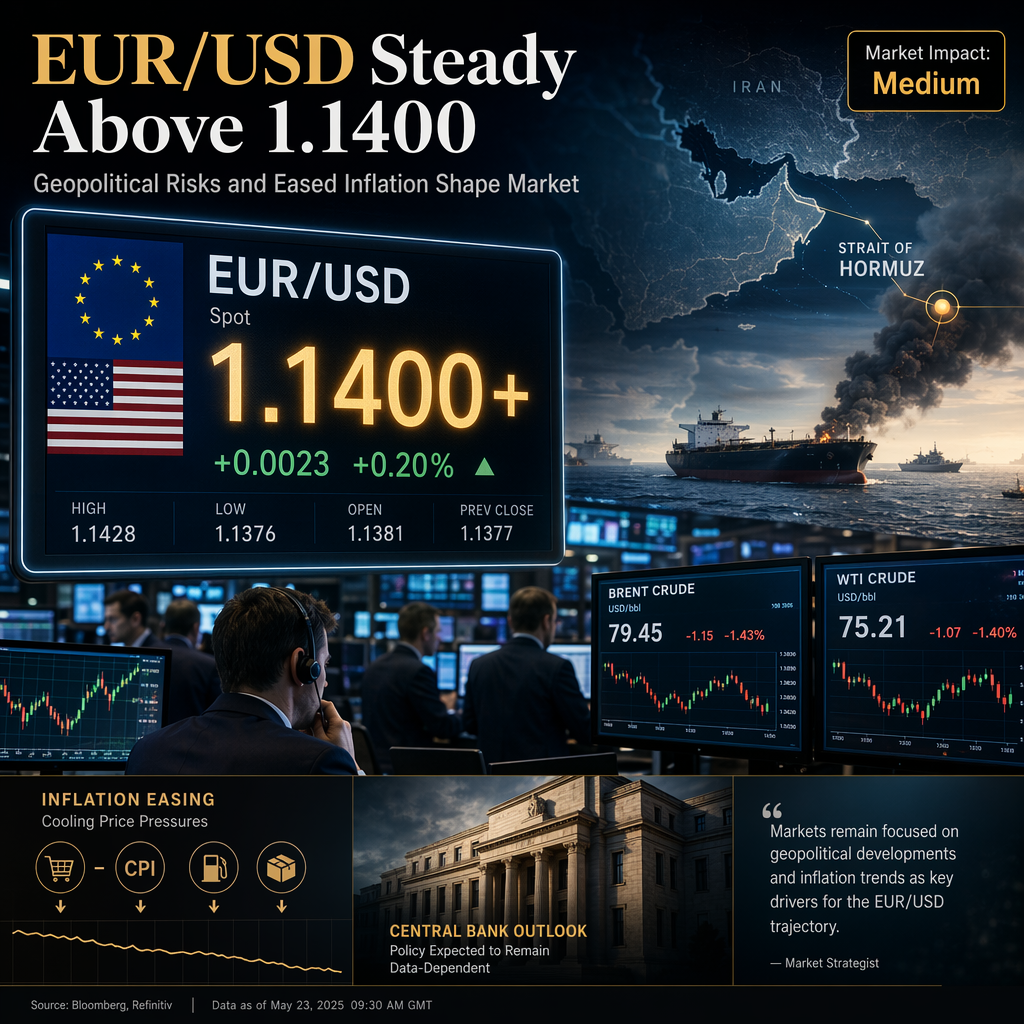
The EUR/USD currency pair continued its sideways consolidation during the Asian session on Tuesday, maintaining levels comfortably above the 1.1400 mark and remaining close to a nearly two-week high reached last Thursday [1]. This stability comes as geopolitical tensions rise in the Strait of Hormuz, where a maritime agency reported that an oil tanker was struck by an unidentified projectile. These developments have put strain on the 60-day US-Iran ceasefire and provided support for the US Dollar (USD) as a safe-haven asset, thereby acting as a headwind for the EUR/USD pair [1].
Recent declines in crude oil prices have helped ease inflation concerns, reducing pressure on central banks to pursue aggressive monetary tightening. Additionally, soft US jobs data released last Thursday tempered market expectations for further interest rate hikes by the US Federal Reserve (Fed), limiting aggressive USD bullishness and supporting the case for potential upside in the EUR/USD pair [1].
On the European side, expectations for European Central Bank (ECB) rate hikes have cooled following an unexpected drop in Eurozone inflation. This has led to increased caution among traders regarding any significant appreciation of the Euro, with analysts suggesting that strong follow-through buying is needed before confirming a bottom for the EUR/USD pair near the 1.1325 region, which was the lowest level since May 2025, touched in June [1].
Overall, the interplay of geopolitical risks, inflation trends, and central bank policy expectations is keeping the EUR/USD pair in a consolidative range, with market participants awaiting clearer signals before taking decisive positions [1].
CONCLUSION
The EUR/USD pair remains range-bound above 1.1400, supported by geopolitical tensions and softer US economic data, but capped by cooling ECB rate hike expectations. Market participants are exercising caution, awaiting stronger signals before confirming a trend reversal. The overall market impact is medium, with sentiment slightly positive for the Euro in the near term.