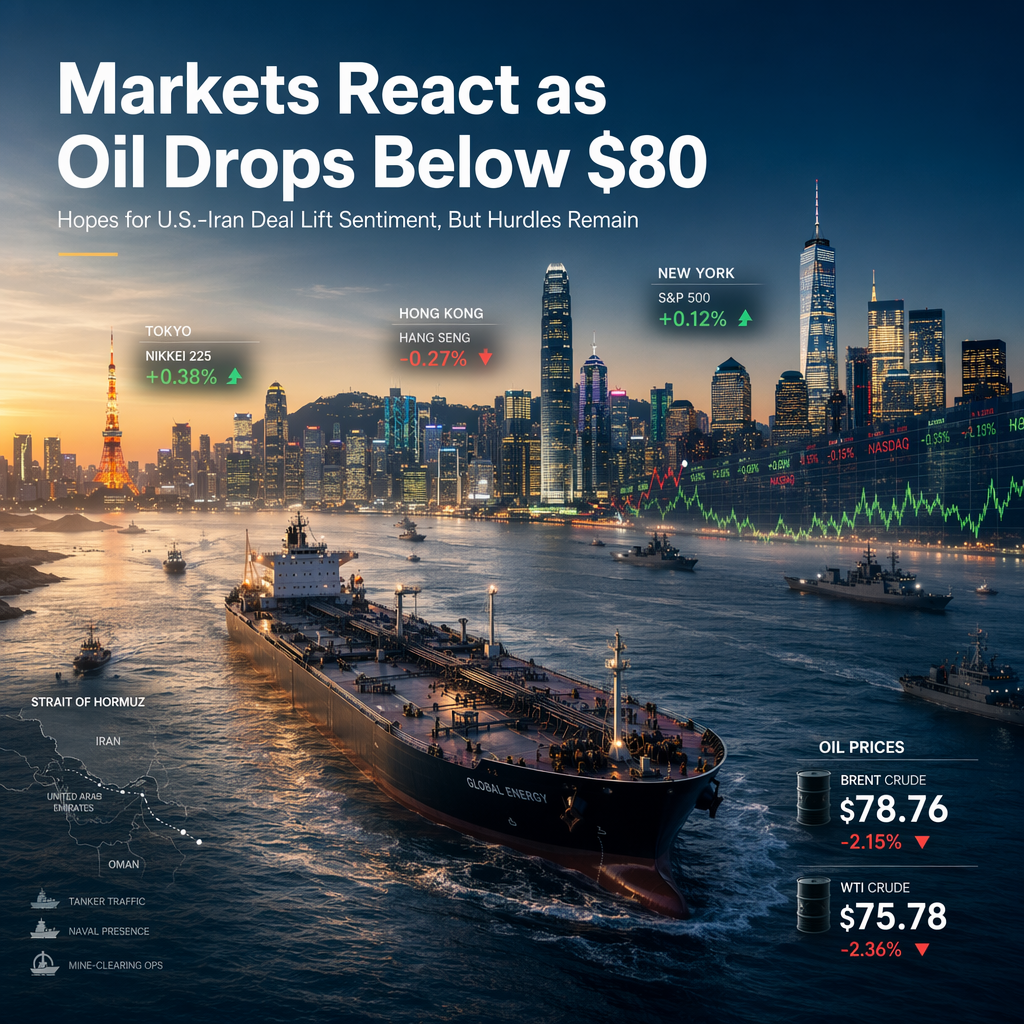
Asian shares showed a mixed performance on Wednesday as investors awaited further details on an interim agreement between the U.S. and Iran aimed at ending the ongoing war. This optimism contributed to oil prices trading below $80 a barrel, with Brent crude down 0.3% at $78.76 per barrel after a more than 5% drop on Tuesday. Benchmark U.S. crude also declined 0.4% to $75.78 a barrel. The potential reopening of the Strait of Hormuz, a critical route for global oil and gas transit, was cited as a key factor behind the recent stabilization in oil prices, though challenges such as mine clearance and restarting idled production fields remain, according to HSBC economists [1].
In equity markets, Tokyo’s Nikkei 225 rose by 497.75 points to 69,902.25, buoyed by official data showing a 17% year-on-year jump in Japan’s exports for May, driven by strong demand for high-tech products. Conversely, South Korea’s Kospi edged 0.2% lower to 8,706.10, with Samsung Electronics falling 1.9% amid a broader sell-off in AI-related shares. Hong Kong’s Hang Seng lost 0.8% to 24,273.95, and the Shanghai Composite slipped 0.1% to 4,089.26. Australia’s S&P/ASX 200 climbed 0.5% to 8,965.30, while Taiwan’s Taiex fell 0.5% and India’s Sensex rose 0.3% [1].
U.S. futures edged higher ahead of the Federal Reserve’s policy decision, following a mixed Wall Street session where the S&P 500 fell 0.6% to 7,511.35 and the Dow Jones Industrial Average gained 0.6% to 51,999.67. The Fed began its two-day meeting under new chair Kevin Warsh, with a decision on interest rates expected Wednesday. While President Donald Trump has advocated for lower rates to stimulate the economy, concerns persist about inflation stemming from the energy shock caused by the Iran war. Most analysts expect the Fed to keep rates unchanged, and the yield on the U.S. 10-year Treasury fell to below 4.44% from 4.47%. Preston Caldwell, chief U.S. economist at Morningstar, noted that weak wage and rent growth could lead to sharply lower inflation once the energy price shock subsides, and he does not anticipate a rate hike in 2026 [1].
CONCLUSION
Markets responded cautiously to optimism over a potential U.S.-Iran interim war deal, with oil prices falling and equities showing mixed results across Asia. While the prospect of normalized oil flows is seen as positive, significant logistical hurdles remain. The Federal Reserve is widely expected to hold rates steady amid ongoing inflation concerns, with analysts projecting a potential easing of inflation pressures once energy markets stabilize.