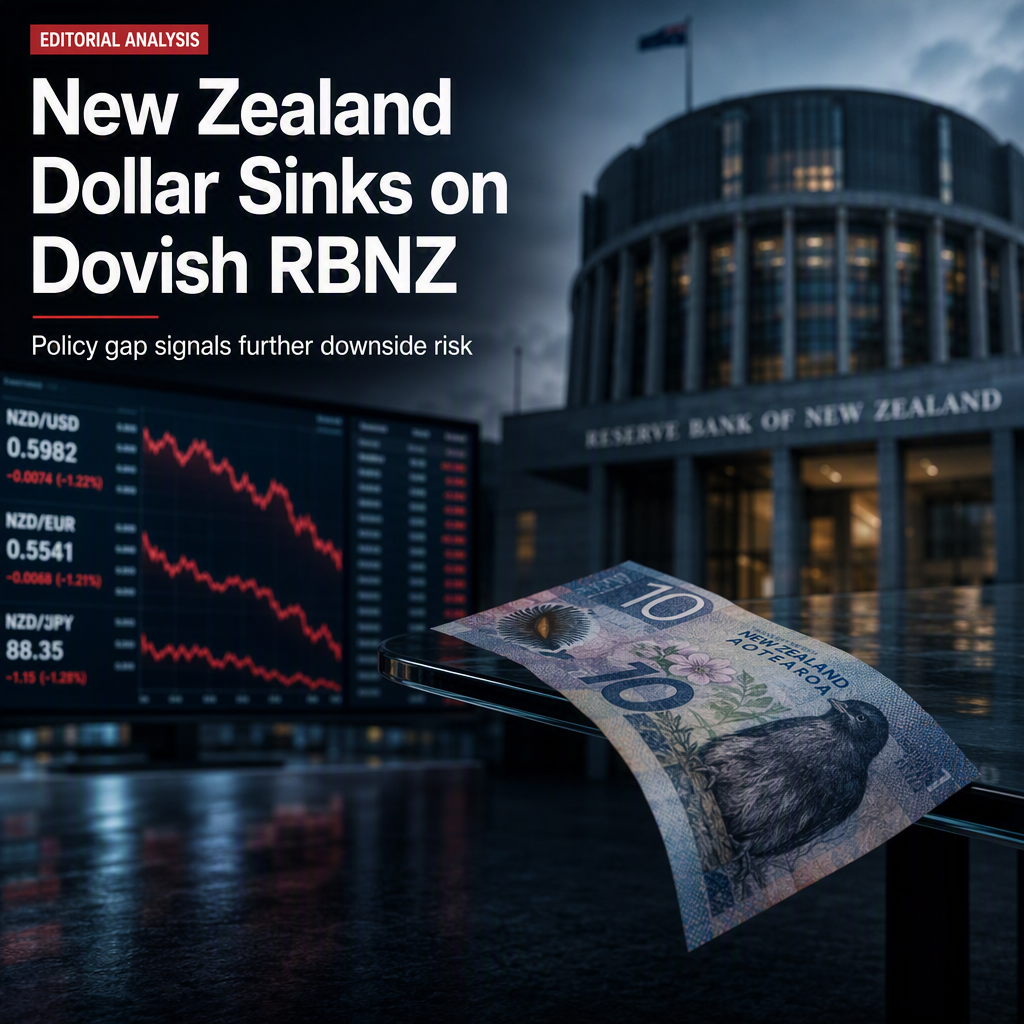
The Reserve Bank of New Zealand (RBNZ) raised its Official Cash Rate (OCR) by 25 basis points to 2.75%, marking the second consecutive rate hike, as widely anticipated by the market [1]. Despite the increase, the New Zealand Dollar (NZD) underperformed following the announcement, reflecting investor disappointment with the central bank's dovish tone [1].
The RBNZ indicated that the latest rate hike 'reduces the risk that the OCR needs to increase by more later,' signaling a reduced need for further tightening in the near term [1]. The central bank emphasized that 'spare capacity remains in the economy, particularly in the labour market,' suggesting that inflationary pressures may be less acute than previously feared [1].
Importantly, the RBNZ left its projected OCR path virtually unchanged from May, still forecasting a peak of around 3.25% in 2028 [1]. This projection stands in contrast to market pricing, with the swaps curve implying the OCR could reach 4.00% within the next two years [1]. The discrepancy between the RBNZ's guidance and market expectations has created room for a dovish repricing, which continues to weigh on the NZD [1].
Analysts at Brown Brothers Harriman (BBH) noted that the policy path gap is likely to keep pressure on the New Zealand Dollar, as investors adjust their expectations in line with the central bank's more cautious outlook [1].
CONCLUSION
The RBNZ's dovish rate hike and unchanged policy path have led to underperformance in the New Zealand Dollar, as market participants recalibrate expectations for future tightening. The gap between the RBNZ's guidance and market pricing suggests further downward pressure on the NZD may persist. Investors are likely to remain cautious until there is greater clarity on the central bank's future policy direction.