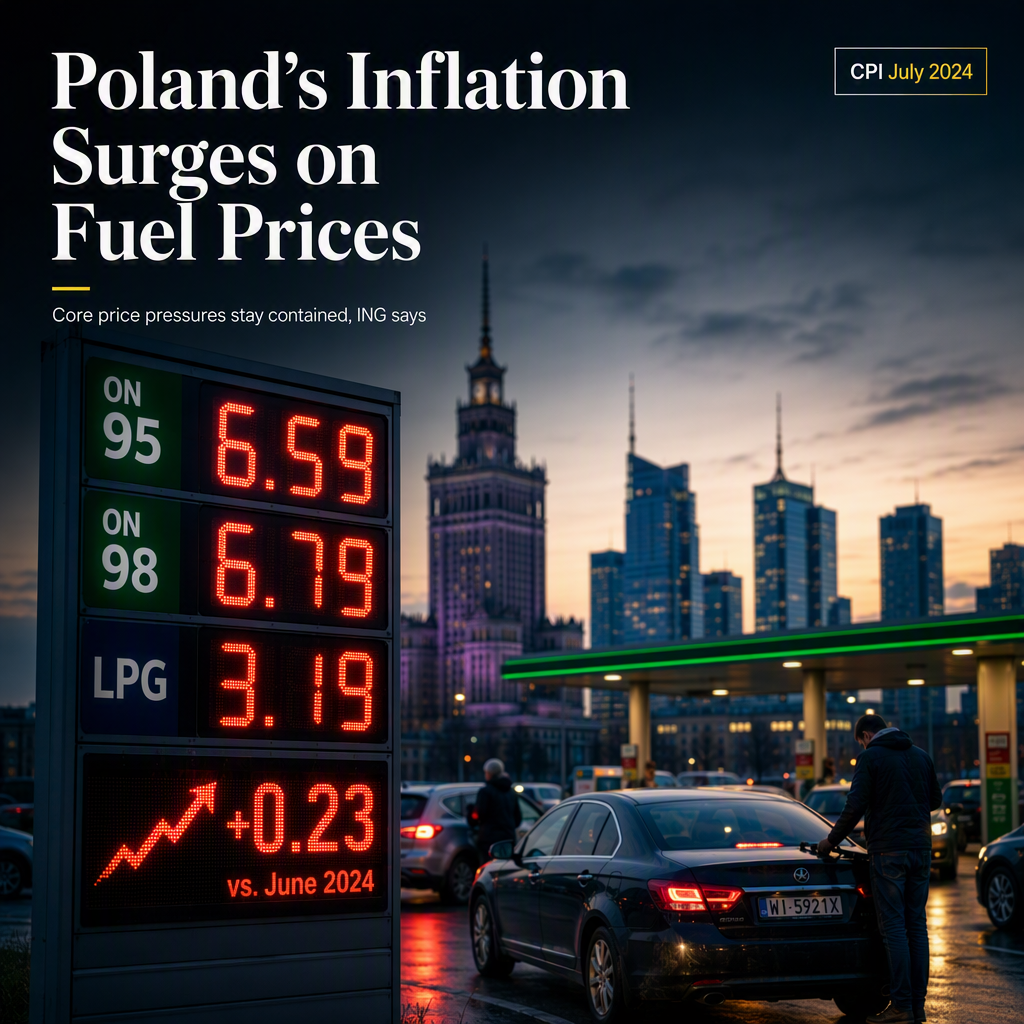
Poland's final July Consumer Price Index (CPI) reading confirmed an acceleration in consumer price growth to 3.0% year-over-year (YoY), up from 2.5% YoY in June, according to ING's Adam Antoniak [1]. The primary driver of this increase was a sharp rise in fuel prices, which followed the restoration of the standard 23% VAT rate from the previously reduced 8% rate and the removal of the fuel price cap at the beginning of July [1]. Additionally, higher oil prices after the collapse of the Memorandum of Understanding (MoU) between the US and Iran contributed to this surge, resulting in retail petrol and diesel prices in Poland rising by 15.8% month-over-month (MoM) [1]. Consequently, annual fuel price inflation accelerated to 7.0% YoY in July from 1.3% YoY in June, contributing approximately 0.5-0.6 percentage points to the headline CPI inflation [1].
Despite the fuel-driven shock, other price pressures in the inflation basket remained subdued. Housing energy inflation eased slightly due to lower liquid fuel prices compared with June, and food price inflation continued its downward trend, supported by broad-based food disinflation and competitive retail chains [1]. Core inflation, excluding food and energy, edged up by 0.1 percentage points to 3.1% YoY in July from 3.0% YoY in June, but there were no signs of broad-based upward pressure on prices [1]. The information and communication category saw a slight increase in annual inflation, driven by higher prices for computers, data storage devices, and mobile phone services [1].
Headline inflation remains within the central bank's target range of 2.5% ±1 percentage point, despite the increase in fuel prices [1]. ING does not believe the current inflation picture or outlook warrants a monetary policy response, citing contained underlying price pressures, moderating wage growth, and a cooler labor market as supporting factors [1].
CONCLUSION
Poland's July inflation uptick was primarily fueled by a one-off surge in fuel prices, while underlying price pressures remain contained. With headline inflation still within the central bank's target range and no broad-based inflationary trends, ING sees no need for a monetary policy response at this time.