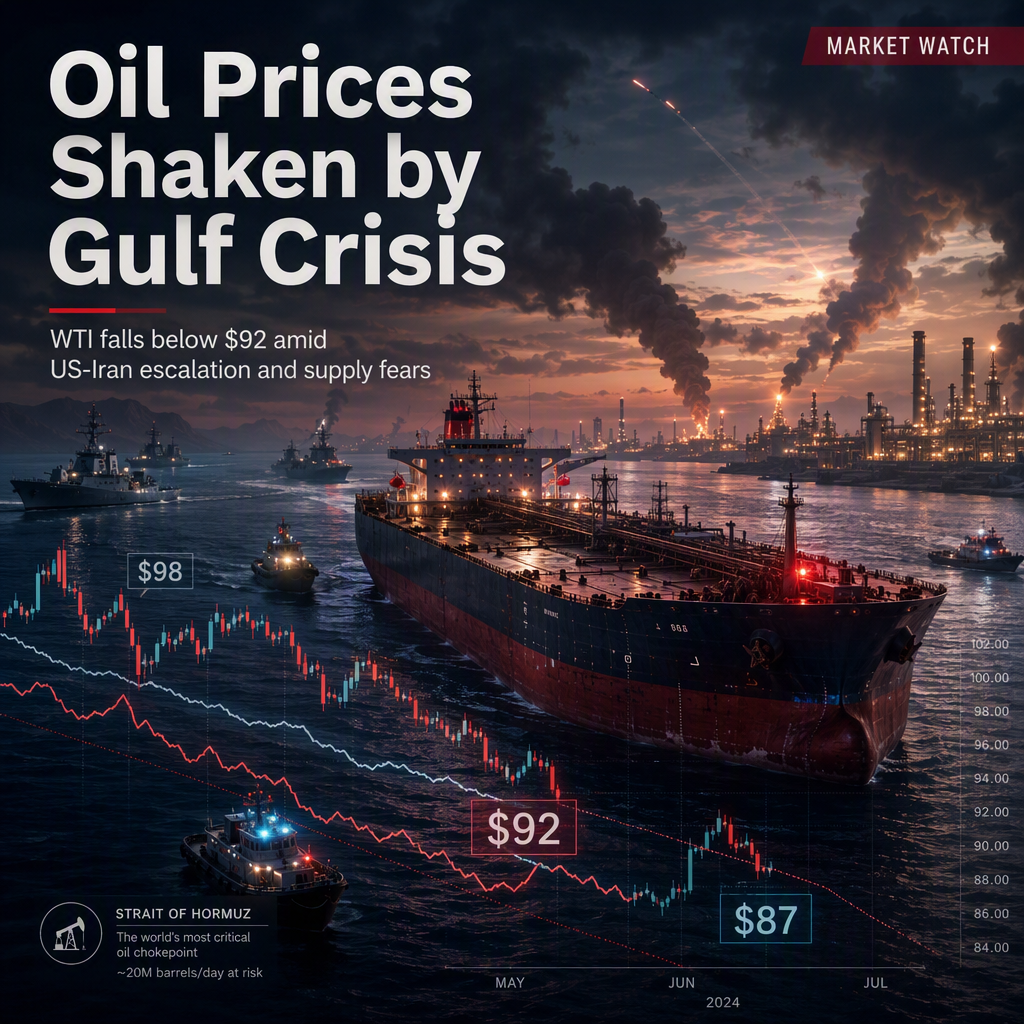
West Texas Intermediate (WTI), the benchmark US crude oil price, reached a fresh three-month high around $92.50 during the Asian session on Wednesday but subsequently slipped below the $92.00 mark, lacking follow-through momentum [1]. The recent surge in WTI prices is attributed to escalating tensions between the US and Iran, with the US reportedly attacking Iranian oil tankers in the Gulf of Oman and near Kharg Island. In retaliation, Iran fired over 30 missiles at US forces stationed at the Al Azraq base in Jordan and issued warnings that ships in Kuwaiti and Bahraini ports hosting US forces could also be targeted [1].
These developments have heightened the geopolitical risk premium, supporting crude oil prices. The ongoing military confrontations have disrupted shipping traffic through the Strait of Hormuz, a critical chokepoint for global oil flows. Iran's security chief, Mohsen Rezaei, stated that Tehran is preparing to enforce a full blockade around the strategic waterway in response to economic sanctions. Additionally, Iran has threatened to retaliate against any new US attacks on its assets, warning that energy infrastructure across the Gulf remains vulnerable, which has exacerbated fears of a prolonged disruption to oil supplies [1].
From a technical perspective, WTI remains well above the 200-day Simple Moving Average (SMA) at $78.52 and is attempting to build momentum beyond the 61.8% Fibonacci retracement at $91.88. Momentum indicators, including a Relative Strength Index (RSI) near 66 and a positive MACD, suggest sustained buying pressure, though not yet at extreme levels. Immediate resistance is noted at the 78.6% Fibonacci retracement at $98.69, with further resistance at the cycle high of $107.36. On the downside, support levels are identified at $87.10 (50% retracement), $82.32 (38.2% retracement), $78.52 (200-day SMA), and $76.40 (23.6% retracement) [1].
Despite the supportive fundamental backdrop, market participants appear cautious, awaiting the release of US inflation figures for further cues regarding the US Federal Reserve's policy path. The outcome of these data releases is expected to influence the US Dollar and, by extension, USD-denominated commodities such as crude oil [1].
CONCLUSION
WTI prices remain buoyed by heightened geopolitical risks and potential supply disruptions in the Middle East, though traders are exercising caution ahead of key US inflation data. The market outlook for crude oil stays positive in the near term, with technical indicators supporting further upside, but uncertainty around macroeconomic policy continues to temper bullish sentiment.