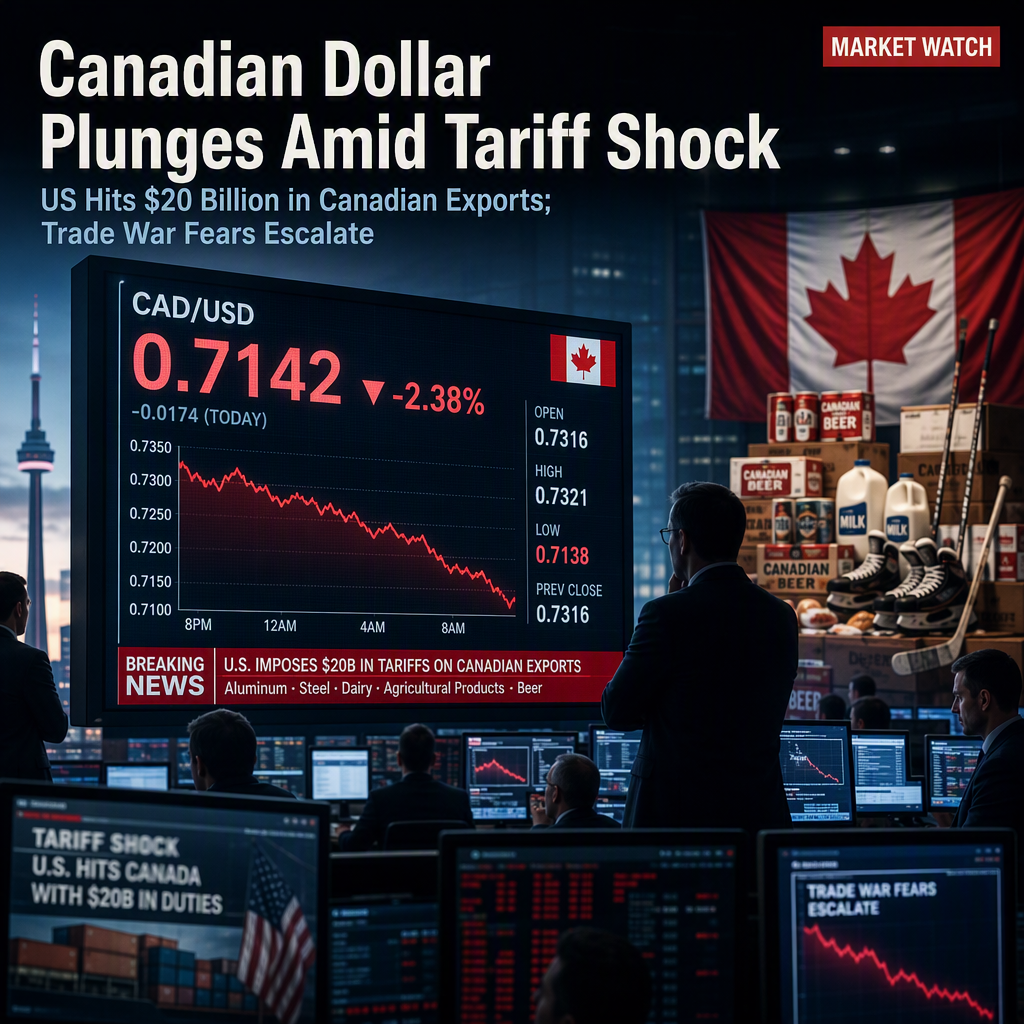
The Canadian Dollar (CAD) has come under significant pressure following the breakdown of trade negotiations between the US and Canada, resulting in the US imposing tariffs on USD 20 billion worth of Canadian exports. According to MUFG's Derek Halpenny, these tariffs, which took effect at 12:01am on Saturday, target a range of goods including beer, wine, spirits, milk products, and hockey equipment, and represent 5% of Canada’s exports to the US [1]. The CAD has been the clear underperformer in the G10 currency group since the announcement, with the risk of a tit-for-tat tariff spiral weighing heavily on investor sentiment [1][5].
Halpenny notes that the market's medium-term response will depend on whether the situation escalates further, as a rapid US retaliation could prompt Canadian Prime Minister Carney to match tariffs 'dollar for dollar,' potentially eroding investor confidence and intensifying downside risks for the CAD [1]. He also highlights that the current 2-year US-Canada swap spread suggests USD/CAD should be trading about 2% higher than Friday’s spot close, indicating the CAD may be overvalued at current levels [1].
The broader market context is also unfavorable for the CAD. The US Dollar has strengthened against the Canadian Dollar, with data showing the USD as the strongest performer against the CAD among major currencies today [5]. This underperformance is compounded by fading support from higher oil prices and the risk of further escalation in the trade dispute [1][5].
Analysts emphasize that the longer the trade war remains unresolved, the greater the risk of economic harm to Canada, with potential for further CAD depreciation if investor confidence deteriorates [1]. ING analysts also point out that renewed US-Canada trade tensions are contributing to a softer start for the US Dollar this week, but the risk of a major re-escalation in tariffs is seen as a negative for the dollar as well, given the broader implications for global trade and risk sentiment [2].
No specific forward-looking statements or official policy responses from Canadian authorities beyond the 'dollar for dollar' retaliation pledge were cited in the sources. However, the consensus among analysts is that the situation remains fluid and market participants are closely watching for signs of further escalation or resolution [1][2][5].
CONCLUSION
The imposition of USD 20 billion in US tariffs on Canadian exports has triggered a sharp underperformance in the Canadian Dollar, with markets wary of a deepening trade war. Analysts warn that unresolved tensions and the risk of tit-for-tat measures could further erode investor confidence and weigh on the CAD. The situation remains highly uncertain, with market participants awaiting further developments.