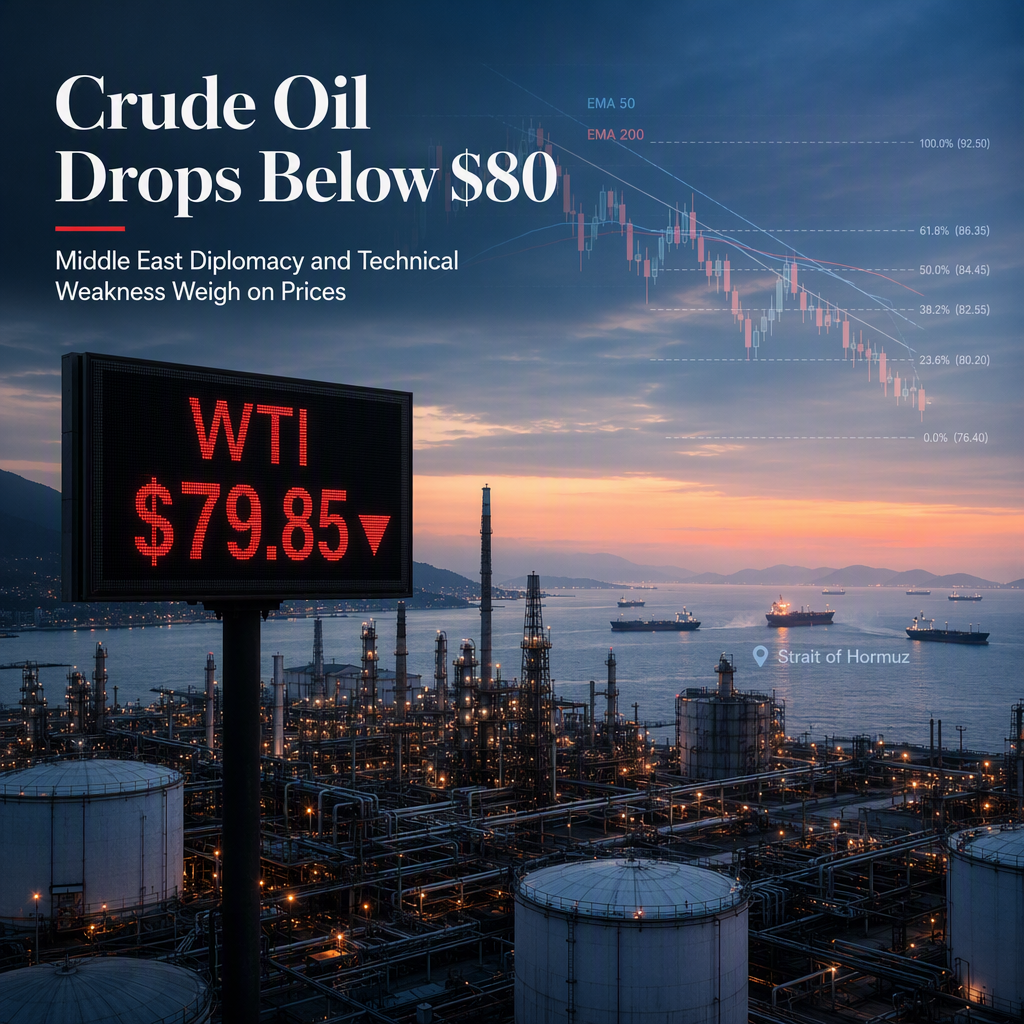
West Texas Intermediate (WTI), the benchmark for US crude oil, experienced selling pressure for the third consecutive day, dropping to a nearly two-week low during the Asian session on Wednesday. WTI is currently trading just below the $80.00 psychological mark, extending its retracement from the monthly peak reached last Friday [1]. This decline is attributed to positive developments in the Middle East, specifically Iran's announcement of renewed talks with Oman to manage commercial shipping through the Strait of Hormuz. Additionally, the US has offered Iran sanctions relief and an end to the naval blockade in exchange for reopening the strategic waterway and halting attacks by regional proxies. These diplomatic moves have revived hopes for a resolution to the US-Iran conflict, leading traders to reduce the geopolitical risk premium, which has weighed on crude oil prices [1].
From a technical standpoint, WTI's overnight breakdown below the 100-period Exponential Moving Average (EMA) on the 4-hour chart acted as a key trigger for bearish sentiment. The price now sits below the 50% Fibonacci retracement level of the recent recovery from the monthly swing low, reinforcing a negative outlook and supporting the case for further losses. Momentum indicators remain bearish, with the Moving Average Convergence Divergence (MACD) at -0.65 and the Relative Strength Index (RSI) at 23.15, indicating oversold conditions. Initial support is identified at the 61.8% retracement level of $78.61, with further backing at $76.27 and a structural floor near the prior swing low at $73.30. A sustained break below this level could extend the bearish phase despite oversold technicals [1].
On the upside, immediate resistance is seen at the 50.0% retracement level of $80.26, followed by the 38.2% level at $81.90 and the 100-period EMA at $82.44. This creates a dense supply zone ahead of higher resistance at the 23.6% retracement of $83.93 and the recent cycle high near $87.22 [1].
No analyst opinions or forward-looking statements beyond the technical outlook were provided in the source article.
CONCLUSION
WTI crude oil's decline below $80 is driven by easing geopolitical tensions in the Middle East and bearish technical signals. The market is currently pricing out risk premiums, and technical indicators suggest the potential for further downside despite oversold conditions. Traders are closely watching support and resistance levels for signs of a reversal or continued weakness.