
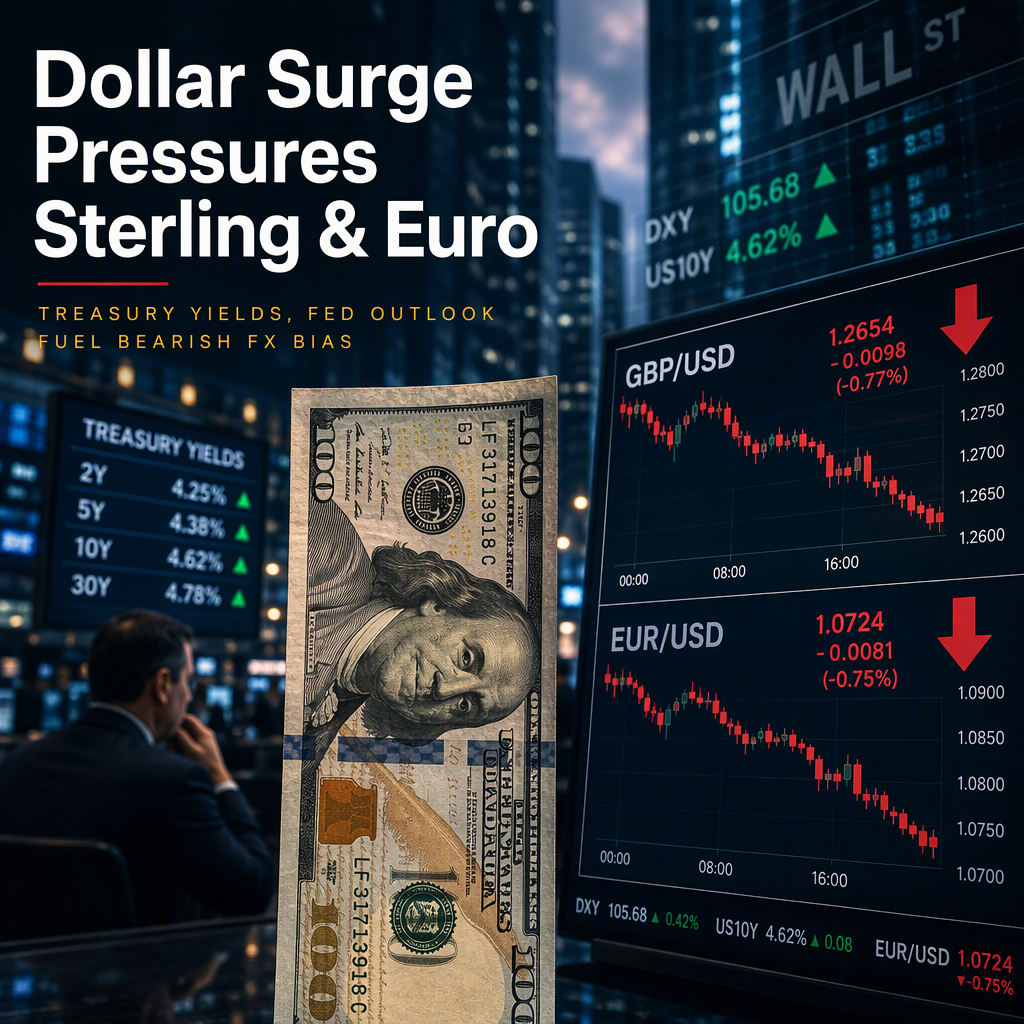
Both GBP/USD and EUR/USD currency pairs are exhibiting bearish near-term biases as the US Dollar (USD) remains supported by elevated US Treasury yields and hawkish expectations for Federal Reserve policy. The GBP/USD pair is up 0.15% at around 1.3245 in the early European session, with the British Pound outperforming its peers despite skepticism from market experts regarding the Bank of England's (BoE) hawkish repricing. Strategists at Brown Brothers Harriman note that the swaps curve implies about 100bps of BoE rate hikes in the next twelve months to 4.75%, but argue that the BoE may not need to tighten as much as markets expect, given that rates are already in the 2%-4% neutral range [1]. Last week, BoE Governor Andrew Bailey warned that persistently higher energy prices could challenge the central bank’s stance of not raising interest rates [1].
Technical analysis for GBP/USD shows the pair trading around 1.3240, maintaining a bearish bias as it holds below the 20-period EMA at 1.3387. The pair has been sliding away from late-July highs, with the EMA acting as overhead supply and likely capping rallies [1]. The British Pound was the strongest against the Japanese Yen today, according to the currency heat map [1].
EUR/USD, meanwhile, consolidates above the 1.1350 pivotal support but lacks bullish conviction, trading below the 1.1400 mark and close to the lowest level since July 28. The pair remains vulnerable amid the underlying bullish sentiment surrounding the USD, which is underpinned by the Fed's hawkish outlook, oil-driven inflation fears, and persistent geopolitical uncertainties such as the US-Iran standoff [2]. Spot prices maintain a clear bearish bias below the 200-day EMA, with the MACD indicator reinforcing downside pressure and the RSI around 28 signaling oversold conditions [2]. Analysts suggest waiting for follow-through selling below 1.1350 before positioning for further weakness toward the year-to-date low near 1.1325, with any recovery likely capped near the 1.1460 supply zone and the 200-day SMA at 1.1557 [2].
The US Dollar has been the strongest against the New Zealand Dollar this month, with a 4.33% gain, and has also posted gains against the EUR (2.03%), GBP (2.31%), JPY (2.14%), CAD (2.00%), and CHF (2.67%) [2]. Elevated US Treasury yields remain near a 19-year high of 5.23% [1]. Market participants are closely watching upcoming US macro data, including the Personal Consumption Expenditures (PCE) Price Index on Wednesday, the final Q2 GDP print, and the US Nonfarm Payrolls (NFP) report on Friday, which are expected to provide fresh impetus to the USD and impact both GBP/USD and EUR/USD pairs [1][2].
CONCLUSION
The US Dollar's strength, driven by elevated Treasury yields and hawkish Fed expectations, is exerting bearish pressure on both GBP/USD and EUR/USD. Technical indicators and analyst commentary from both sources reinforce the negative outlook, with upcoming US macro data likely to further influence market direction. Investors should remain cautious as both pairs face key resistance levels and potential for further downside.