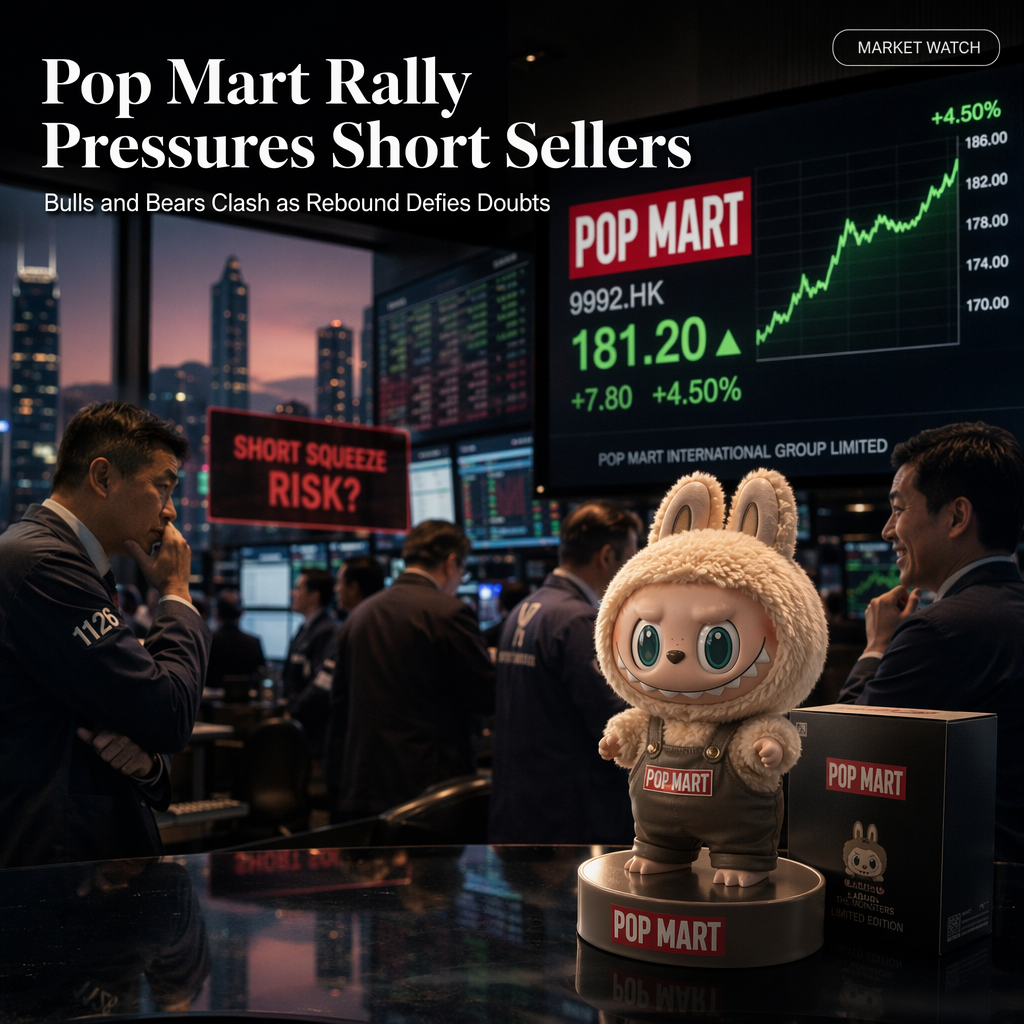
Pop Mart International has become a focal point for short sellers in Hong Kong, standing out as the only one among the city's most shorted stocks where bearish traders are currently losing money, according to S&P Global Market Intelligence [1]. Despite persistent skepticism, short interest in Pop Mart climbed to 12.67% of shares outstanding as of Tuesday, up from 11.3% in April [1]. This comes as the company's shares have more than halved from their August peak last year to 153 Hong Kong dollars ($19.5) as of Tuesday, but have recently rebounded by 8% since their year-to-date low in April [1].
The ongoing tension between bearish and bullish investors is fueled by diverging views on Pop Mart's prospects. Bears cite signs of cooling demand in key overseas markets and question the sustainability of the company's rapid growth, particularly pointing to waning appetite for the Labubu toy line [1]. In contrast, bulls highlight new product launches and what they perceive as attractive valuations, with S&P Global Market Intelligence's Matt Chessum noting "resilient" consumer demand and the growing risk of a technical short squeeze as the stock recovers [1].
Analyst opinions remain divided. Lydia Ling, Citigroup's director of equity research, maintained a buy rating in June but lowered her target price to 263 Hong Kong dollars, citing Pop Mart's long-term growth potential in intellectual property development and overseas expansion, while acknowledging near-term volatility in overseas markets as a headwind [1]. Meanwhile, Bernstein's Melinda Hu reiterated an underperform rating with a target price of 181 Hong Kong dollars, pointing to management's acknowledgment of "less accumulation" in overseas teams, fan bases, and retail infrastructure compared to China as evidence of underlying weakness [1].
Management's own statements reinforce the narrative of a transitional period for the company. In Pop Mart's 2025 annual report, chairman and CEO Wang Ning described the current phase as a "pit stop year," emphasizing a focus on quality over quantity and organizational restructuring, which Bernstein's Hu interprets as signaling decelerating growth [1].
CONCLUSION
Pop Mart's recent share price recovery has put short sellers under pressure, even as skepticism persists regarding its overseas growth prospects. Analyst opinions are mixed, with some seeing long-term potential and others warning of near-term challenges. The company's management has signaled a period of consolidation, suggesting that growth may slow as Pop Mart focuses on strengthening its foundations.