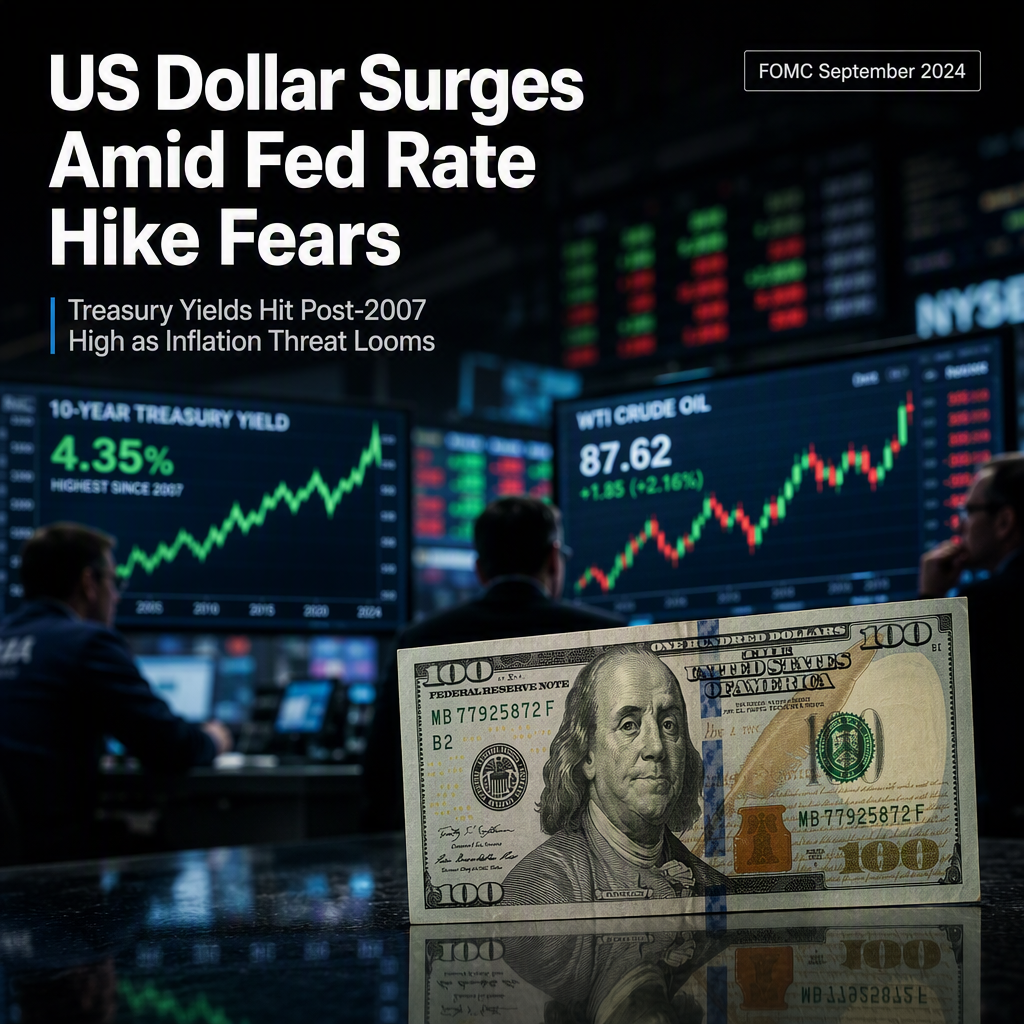
The US Dollar has remained firm, exerting downward pressure on EUR/USD and other currency pairs, as investors await the Federal Reserve's highly anticipated monetary policy decision at the September FOMC meeting [1][2][3][4]. Market participants are assigning over a 90% probability to a 25 basis point rate hike, with CME FedWatch tool showing a 92.5% chance, up significantly from 33% a month ago [2][4]. Danske Bank and MUFG both note that the dollar's strength is underpinned by rising US Treasury yields, with the 10-year yield reaching 5.00% and the 2-year at 4.66% [1][2][4]. This marks a post-2007 high for the 10-year yield, driven by persistent inflation pressures and elevated oil prices, with Brent crude holding above $100 per barrel and US retail gasoline prices above $4 per gallon [2][4].
In Europe, Germany's September ZEW survey showed a sharp improvement in current conditions, with the index rising to -47.1 (consensus: -52.1, prior: -61.1), the highest level in three and a half years, attributed to fiscal easing and increased manufacturing orders. However, expectations for future growth disappointed, remaining at 34.7 (consensus: 40.0, prior: 34.2), reflecting tightening financial conditions and higher energy costs [1]. The impact of these factors is expected to take months to materialize, as indicated by the survey [1].
On the technical front, the NZD/USD pair bounced off a two-month low at 0.5735 but remains vulnerable, trading just above mid-0.5700s. The pair maintains a bearish tone below the 200-day SMA at 0.5855, with momentum indicators suggesting downside momentum persists. Immediate resistance is at 0.5765, while support is seen at 0.5704 and 0.5627 [3]. The US Dollar's pullback after retesting a two-week high has provided some relief, but oil-driven inflation risks and elevated US bond yields continue to support the greenback [3].
Analysts highlight the Fed's challenging trade-off between combating persistent inflation—driven by high energy and commodity prices—and the negative effects of tighter monetary policy on US debt servicing and housing [2][4]. Brent Wilsey of Wilsey Asset Management warns that a surprise hold from the Fed could unsettle stocks and damage the central bank's credibility, while Jonathan Pryor of Marex notes the Fed is entering a new phase of monetary policy, shifting away from earlier expectations of a prolonged rate-cutting cycle [4]. Escalating tensions in the Middle East are also cited as adding upside risks to oil prices and inflation [2].
CONCLUSION
Markets are overwhelmingly expecting a 25bp Fed rate hike, with surging Treasury yields and persistent inflation reinforcing the dollar's strength. Analysts caution that any deviation from expectations could trigger volatility and impact the Fed's credibility. The central bank faces a delicate balancing act as it navigates inflation risks and the broader implications of tighter policy.