
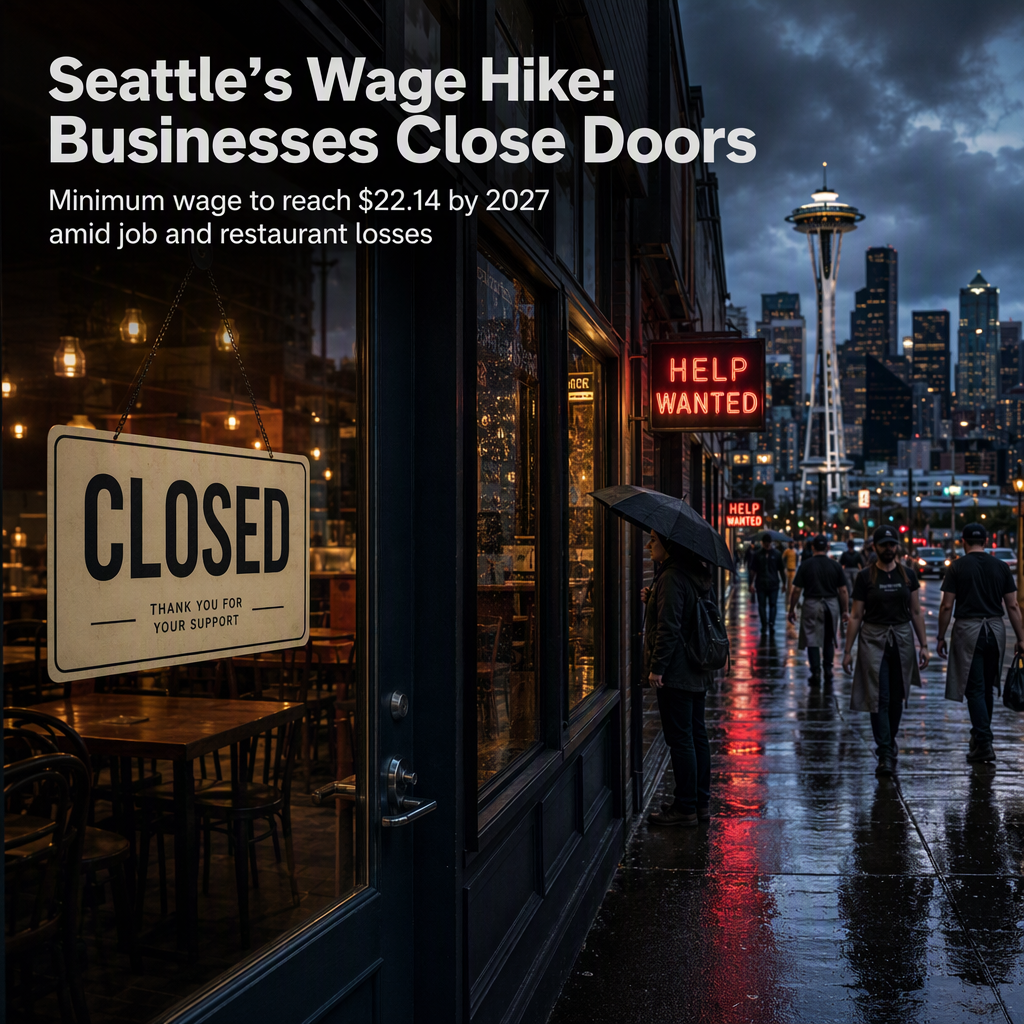
Seattle is set to raise its minimum wage to $22.14 an hour in 2027, making it the highest in the United States if no other jurisdiction surpasses it by then [1]. The policy requires all Seattle employers, including small businesses, to pay the same minimum wage, with annual adjustments for inflation beginning in 2025 [1]. Following the implementation of these wage hikes, 450 Seattle restaurants—about 16% of the city's total—closed during the first half of 2025 [1]. Additionally, restaurant and retail transactions in some business and shopping districts, including areas around Amazon and Microsoft campuses, fell by as much as 7% over the prior year, according to Square data cited by The Wall Street Journal [1].
Several Seattle restaurant owners attributed their closures to rising labor costs, with one owner stating, 'If the servers are making $20 an hour, then I gotta pay the cooks $35' [1]. Anthony Anton, CEO of the Washington Hospitality Association, noted that 'operators are making less money than ever and are charging more than ever' [1]. A peer-reviewed study from the University of Wisconsin, Madison, found that the announcement of Seattle’s minimum wage increase decreased the formation of new businesses within city limits while increasing new business formation in adjacent suburbs with lower wage floors [1].
Proponents of the wage hike argue that Seattle’s high cost of living necessitates higher pay to prevent more residents from falling into poverty and suggest that higher wages can improve staff retention [1]. However, the city’s business environment has been deteriorating since before the minimum wage hikes, with about 500 local businesses closing from early 2020 to 2023, and 543 vacant storefronts counted a year later, according to the Downtown Seattle Association [1]. Business owners have cited property crime and local economic factors as additional reasons for their exits [1].
Job postings in the Seattle metropolitan area fell by 35% between February 2020 and October 2025, a decline second only to San Francisco, according to an Axios analysis [1].
CONCLUSION
Seattle’s move to raise its minimum wage to $22.14 by 2027 is accompanied by significant business closures and a sharp decline in job postings. While supporters argue the increase is necessary for cost-of-living reasons, data points to mounting pressures on local businesses and a challenging economic environment.