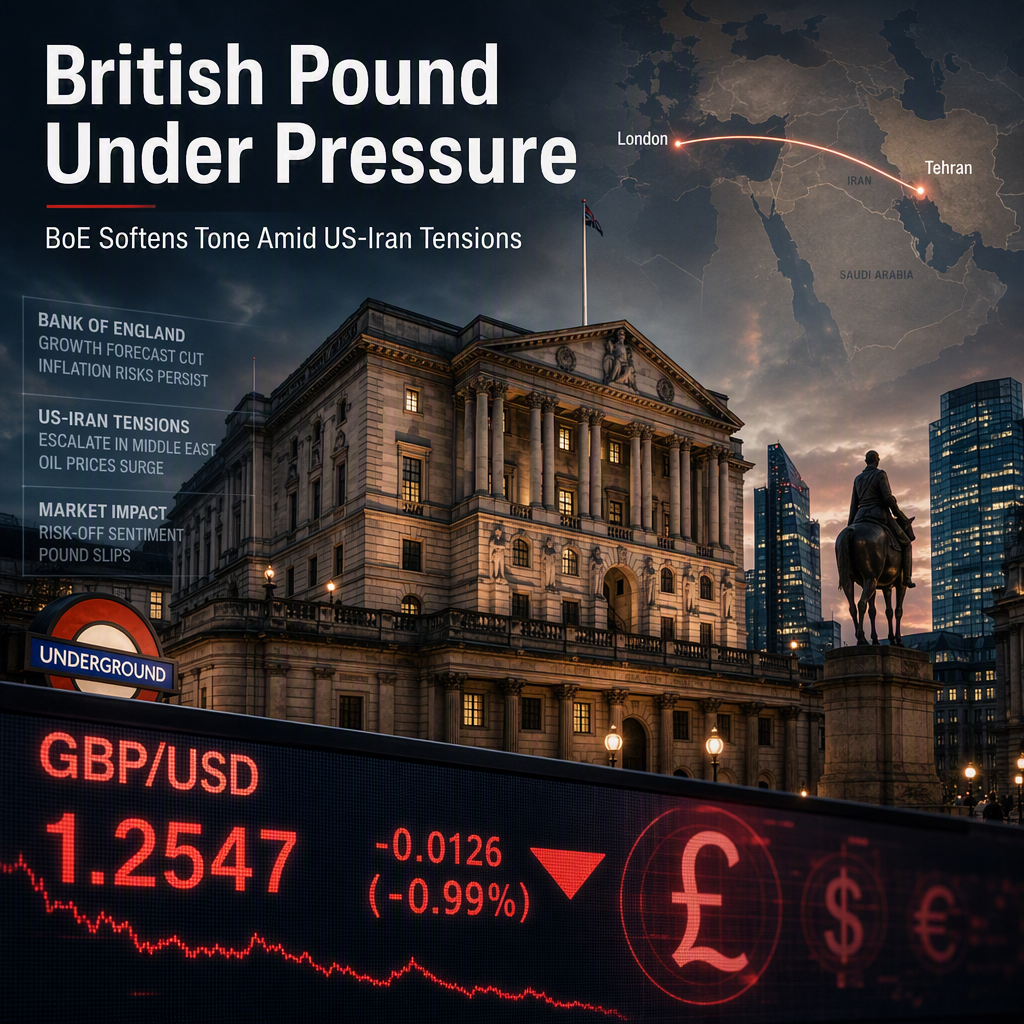
The British Pound (GBP) struggled to maintain its recent gains, with GBP/USD trading around 1.3470 during Asian hours on Monday after three consecutive days of advances [1]. The currency's weakness persisted despite a general easing of risk aversion, which was fueled by hopes for a diplomatic breakthrough between the United States and Iran. These hopes followed reports that US President Donald Trump had postponed planned military strikes, stating on Truth Social that Iran and other Middle Eastern nations requested more time to finalize an agreement that would reopen the Strait of Hormuz and eliminate Iran's nuclear threat [1].
However, market uncertainty remained elevated as Iranian officials, via Mehr news agency, swiftly dismissed Trump's claims, labeling them as "nothing but a new lie" and asserting that Iran's armed forces are on high alert and fully prepared for any scenario [1]. This conflicting narrative contributed to ongoing volatility in the currency markets.
On the monetary policy front, the Bank of England (BoE) decided to keep interest rates unchanged last week but indicated that further hikes remain possible due to the uncertainty surrounding the US-Iran situation [1]. Money markets are still pricing in a 25-basis-point rate increase by the end of the year, according to Prime Terminal data [1]. Analysts at Scotiabank described the BoE's latest decision as a sign of "softened hawkishness," highlighting that Governor Andrew Bailey downplayed the urgency of the next rate hike. The Monetary Policy Committee (MPC) voted 6–3 to hold rates, with three members advocating for a 25 basis point increase, reflecting a cautious approach to inflation risks [1].
CONCLUSION
The British Pound remains under pressure as geopolitical tensions and a cautious Bank of England stance weigh on sentiment. While hopes for a US-Iran diplomatic breakthrough have eased risk aversion, persistent uncertainty and a split BoE vote suggest the market will remain volatile in the near term.