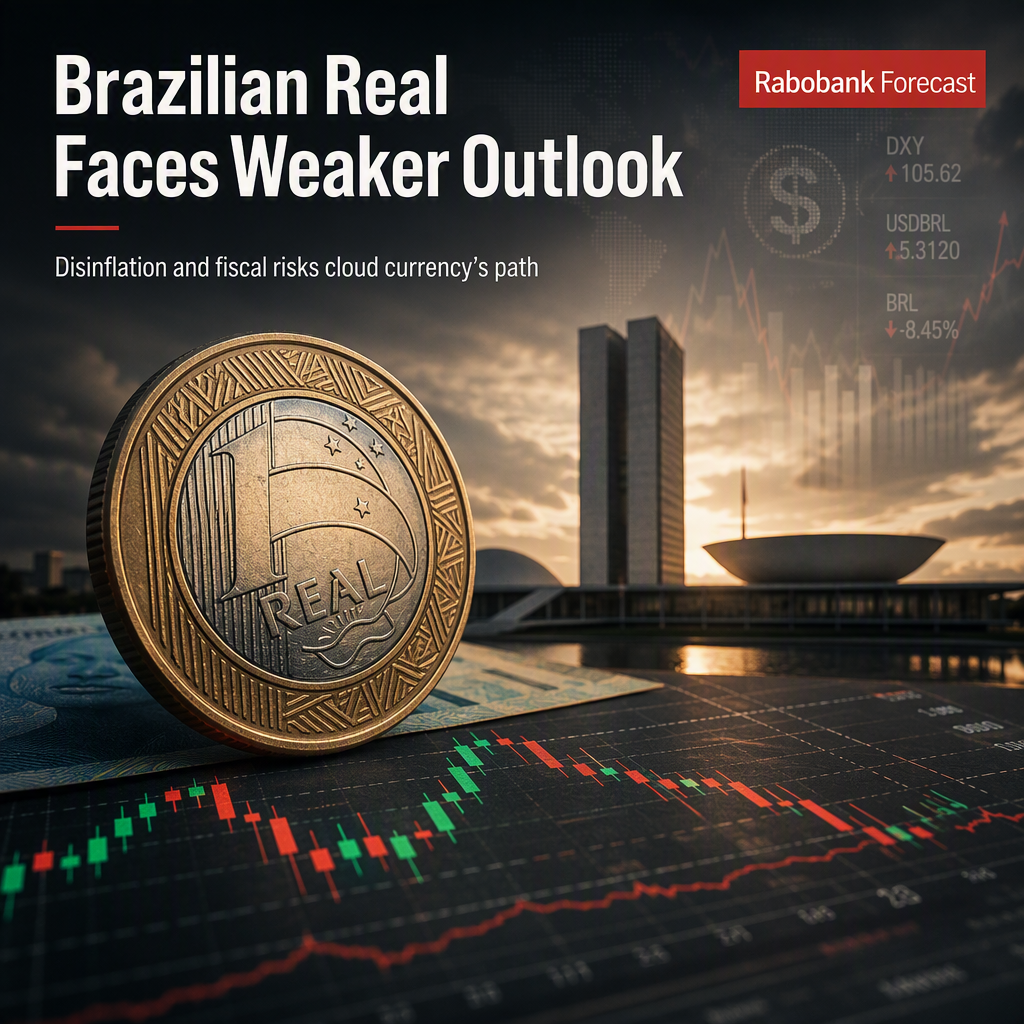
Rabobank's Brazil weekly notes that the Brazilian Real (BRL) recently appreciated to BRL 5.0587 per U.S. dollar, marking a 0.48% gain against the dollar for the week and ranking as the eighth-best performer among 24 emerging-market currencies [1]. Despite this recent strength, Rabobank projects a weaker outlook for the BRL, citing expectations of a narrower interest rate differential between Brazil and developed markets in 2026, as well as a stronger global dollar and Brazil's fragile fiscal situation during an election year [1]. The bank forecasts the USD/BRL exchange rate to return to 5.35 by year-end [1].
On the domestic front, Brazil's July IPCA-15 inflation reading came in below all expectations, indicating ongoing disinflation, while labor market data continues to show a tight job market, though initial signs of a slowdown are emerging [1]. Fiscal data for June revealed a larger deficit, with the National Treasury reporting a Central Government primary deficit of BRL 48.2 billion, compared to market and Rabobank expectations of BRL -48.0 billion, and a previous deficit of BRL -53.1 billion in May [1].
Market attention is now focused on the upcoming Copom interest rate decision scheduled for Wednesday, which could further influence the BRL's trajectory [1]. Rabobank emphasizes that the combination of narrowing interest rate differentials, a potentially recovering U.S. dollar, and Brazil's fiscal vulnerabilities are likely to guide the currency toward a weaker position by the end of the year [1].
CONCLUSION
Rabobank expects the Brazilian Real to weaken toward BRL 5.35 per dollar by year-end, driven by disinflation, fiscal risks, and narrowing interest rate differentials. The upcoming Copom interest rate decision and Brazil's fiscal performance remain key factors for market participants. Overall, the outlook for the BRL is cautious amid domestic and global headwinds.